


Choosing the Right Fit: A Deep Dive into the Goodwe 10kW On-Grid Inverter and Your Solar Future
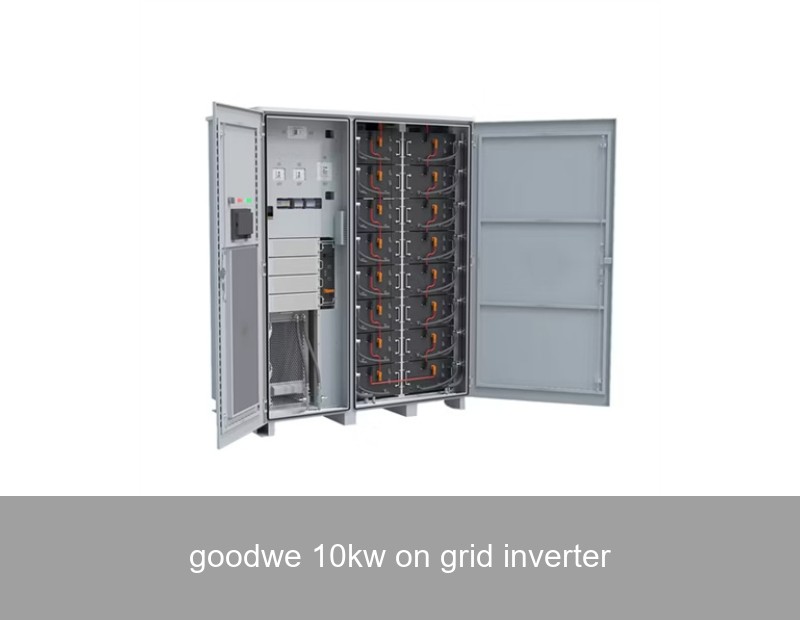
So, you're planning a significant solar installation for your home or business, and the Goodwe 10kW on-grid inverter has caught your eye. It's a popular choice in the 8-12kW range, a sweet spot for larger residential or light commercial properties. But with so much riding on the heart of your photovoltaic (PV) system, how do you know if it's the optimal component for your specific energy goals? More importantly, how does this single component fit into the broader picture of a reliable, efficient, and intelligent energy system? Let's unpack the capabilities, considerations, and context you need to make an empowered decision for your renewable energy journey.
Table of Contents
- The Inverter's Critical Role: More Than Just Conversion
- Goodwe 10kW On-Grid Inverter: Specifications and Strengths
- Beyond the Inverter: The Imperative of System-Level Thinking
- Real-World Application: A Case Study from Southern Europe
- Future-Proofing Your Investment: The Storage Readiness Question
- Making Your Choice: Key Questions to Ask
The Inverter's Critical Role: More Than Just Conversion
We all know the basics: a solar inverter converts the direct current (DC) electricity generated by your panels into usable alternating current (AC) for your home and the grid. However, modern inverters like the Goodwe 10kW on-grid inverter are sophisticated energy managers. Their efficiency (often 98%+ for top models) directly impacts your system's yield, meaning how much of your precious solar generation actually powers your appliances. They handle voltage fluctuations, ensure grid compliance with strict regulations in regions like the EU and North America, and provide crucial monitoring data. Choosing an inverter isn't just about picking a power rating; it's about selecting the brain of your solar operation.
Goodwe 10kW On-Grid Inverter: Specifications and Strengths
The Goodwe 10kW single-phase or three-phase model is designed for robust, medium-scale installations. Let's look at its typical profile:
- High Peak Efficiency: Reaching over 98%, it minimizes energy losses during conversion.
- Multiple MPPT Trackers: Most models feature two or more Maximum Power Point Trackers. This is crucial if your roof has different orientations or shading issues, as it allows different sections of your array to operate at their individual optimal points.
- Grid Service Functions: It supports features like reactive power control, which can help stabilize the local grid—a value increasingly appreciated by utilities.
- Monitoring Platform: Goodwe provides a user-friendly app for tracking production and consumption in near real-time.
However, a key consideration for forward-thinking homeowners is that a standard on-grid inverter has a fundamental limitation: when the grid goes down, it shuts off for safety. Even with the sun shining, you'll be without power. This leads us to a vital, broader conversation.

Image Source: Unsplash (Representative image of a solar inverter)
Beyond the Inverter: The Imperative of System-Level Thinking
Focusing solely on the inverter is like buying a powerful engine without considering the chassis, transmission, and safety systems of the car. Your solar panels, inverter, wiring, and—increasingly—your battery storage system must work in flawless harmony. This is where the expertise of a system integrator like Highjoule becomes paramount.
Since 2005, Highjoule has specialized in designing and delivering integrated, intelligent energy solutions. We don't just sell components; we engineer resilient power ecosystems. For a client considering a 10kW solar array, we would assess:
- Energy Consumption Patterns: When do you use electricity? Daytime, nighttime, or both?
- Grid Reliability & Tariffs: Is your grid prone to outages? Do you have time-of-use rates where storing solar for evening use saves money?
- Future Expansion: Do you plan to add an electric vehicle charger, a heat pump, or battery storage later?
This holistic analysis often reveals that a hybrid inverter system or a dedicated storage solution paired with the solar array delivers far greater long-term value and energy independence than a standalone on-grid inverter.
Real-World Application: A Case Study from Southern Europe
Let's ground this in reality. A family-owned winery in Tuscany, Italy, approached Highjoule with a 12kWp solar array and a standard grid-tie inverter. Their pain points were high evening energy use for cooling and occasional grid instability during peak harvest season.
The Data & Solution: Our analysis showed they were exporting 65% of their daytime solar production to the grid at a low feed-in tariff, only to import expensive power at night. We designed a retrofit solution centered not on replacing their entire system, but on integrating a Highjoule H-Joule 10 modular battery storage system (10kWh capacity) with a compatible hybrid inverter. The existing solar panels were retained, and the new system was configured for self-consumption optimization.
The Outcome: The system now stores excess daytime solar energy. Result? Their grid electricity imports dropped by over 80%, and they have backup power for critical cooling systems. The project achieved a return on investment in under 7 years, enhanced by local energy incentives. This case underscores that the optimal solution is rarely just a bigger or better solar inverter, but intelligent energy management.

Image Source: Unsplash (Representative image of a winery with solar panels)
Future-Proofing Your Investment: The Storage Readiness Question
The energy landscape is shifting rapidly. Governments on both sides of the Atlantic are gradually reducing feed-in tariffs, making self-consumption more economically attractive. The question evolves from "How much can I sell?" to "How much can I use?"
While the Goodwe 10kW on-grid inverter is a capable component, you must ask: Is it storage-ready? Can it seamlessly integrate with a battery system later without requiring a full replacement? Many standalone on-grid inverters cannot. Highjoule's approach often involves deploying hybrid inverters or AC-coupled storage solutions from the outset, even if batteries are a Phase 2 project. This "storage-ready" design protects your initial investment and ensures a painless upgrade path. Our Highjoule H-Joule series, for instance, is designed for modular scalability, allowing you to add battery capacity as your needs and budget evolve.
Making Your Choice: Key Questions to Ask
As you evaluate the Goodwe 10kW on-grid inverter or any other, bring these questions to your installer or system designer:
| Consideration | Questions to Ask |
|---|---|
| System Compatibility | Is this inverter optimally matched to my panel strings (voltage & current)? Does it support future panel expansion? |
| Grid Services & Compliance | Is it fully certified for my country (e.g., VDE-AR-N 4105 in Germany, UL 1741 SA in the US)? Does it offer advanced grid-support functions? |
| Storage Pathway | If I want batteries in 2-3 years, what will that process look like with this setup? Will it require a costly inverter swap? |
| Warranty & Support | What is the product warranty, and does the installer offer a long-term service guarantee? Who handles troubleshooting? |
For further reading on grid compliance and inverter standards, you can refer to this resource from the National Renewable Energy Laboratory (NREL).
Your Energy Independence Journey
Selecting a Goodwe 10kW on-grid inverter might be a technically sound piece of your puzzle, but is it the cornerstone of the resilient, cost-effective, and sustainable energy system you envision? The true value in today's market lies not in isolated components, but in integrated, intelligent design that prioritizes self-consumption and security.
At Highjoule, we bridge the gap between high-quality components like inverters and the complete, living energy system your property deserves. With deep expertise across Europe and the US, we help commercial, industrial, and residential clients navigate these exact decisions. What specific energy challenge—be it rising costs, reliability concerns, or sustainability goals—is prompting you to explore a 10kW solar solution today?
 Inquiry
 Online Chat