


Why Green Power Is Better Because It's Smarter, More Reliable, and Future-Proof
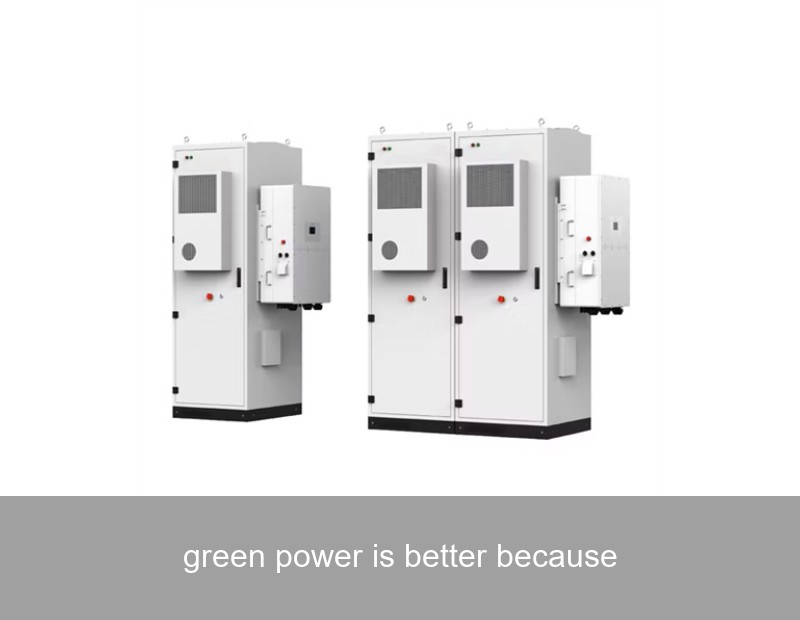
You've likely heard the environmental arguments for green power a hundred times. But what if the most compelling case isn't just about saving the planet—it's about saving your budget, securing your energy, and building a more resilient future? The conversation is shifting. Today, green power is better because it represents a fundamental upgrade in how we generate, manage, and consume electricity. It's smarter economics, enhanced reliability, and true energy independence, all rolled into one. Let's explore why this shift is happening now and how businesses and homeowners are capitalizing on it with intelligent storage solutions.
Table of Contents
- The Phenomenon: From Cost Burden to Strategic Asset
- The Data: Economics and Resilience Speak Volumes
- Case Study: A U.S. Manufacturing Plant's Transformation
- How It Works: The Intelligence Behind Modern Green Power
- Highjoule's Role: Making Advanced Green Power a Reality
- Your Energy Future: A Question of Control
The Phenomenon: From Cost Burden to Strategic Asset
For decades, electricity was a predictable, one-way street: you paid your utility bill and hoped the lights stayed on. Volatility was low, and control was minimal. The rise of renewables like solar and wind changed the generation landscape, but introduced a new challenge: intermittency. The sun doesn't always shine, and the wind doesn't always blow. This created a paradox—clean energy was available, but not always reliable on demand. This is where the old narrative breaks down and the new one begins. Green power is better because modern technology, particularly advanced energy storage systems (ESS), has solved this puzzle. Energy is no longer just consumed; it's harvested, stored, optimized, and deployed intelligently. This transforms it from a passive cost into an active, manageable asset on your balance sheet.
The Data: Economics and Resilience Speak Volumes
Let's talk numbers. The economic argument for green power coupled with storage is now undeniable. According to the International Renewable Energy Agency (IRENA), the levelized cost of electricity from utility-scale solar photovoltaics fell by a staggering 89% between 2010 and 2022. But the cost of generation is only half the story.
The real value is unlocked by avoiding costs. For commercial and industrial users, this comes in two main forms:
- Demand Charge Reduction: Utilities often charge based on your peak power draw (kW), not just total consumption (kWh). An intelligent battery system can discharge during these short peak periods, shaving the peak and slashing this portion of the bill by 30-50%.
- Time-of-Use (TOU) Arbitrage: In regions with TOU rates, you can store cheap energy from the grid or your solar panels during off-peak hours and use it during expensive peak hours.
Beyond economics, resilience has a quantifiable value. Power outages cost the U.S. economy an average of $150 billion annually (U.S. Department of Energy). For a hospital, data center, or factory, even a few minutes of downtime can mean millions in losses. A green power system with backup capability provides an insurance policy that pays for itself.

Image source: Unsplash - A modern commercial solar and storage installation.
Case Study: A U.S. Manufacturing Plant's Transformation
Let's make this concrete. A mid-sized automotive parts manufacturer in Ohio faced two critical issues: erratic and high demand charges from their utility, and vulnerability to grid instability that threatened their just-in-time production line.
The Solution: They deployed a hybrid system: a 1.2 MW rooftop solar array paired with a 2.4 MWh containerized battery energy storage system (BESS). The system was designed not just for backup, but for daily financial optimization.
The Data-Driven Outcome (First Year):
| Metric | Result |
|---|---|
| Annual Electricity Cost Savings | $218,000 |
| Peak Demand Reduction | 40% |
| On-Site Renewable Consumption | Increased from 55% to 85% |
| CO2 Emissions Avoided | Equivalent to 180 gasoline-powered cars |
| ROI Period | Under 5 years |
The plant manager noted, "The system pays for itself through demand charge management alone. The backup power during a winter grid alert was an unexpected bonus that saved us from a potentially catastrophic shutdown. For us, green power is better because it gave us predictability in both our costs and our operations."
How It Works: The Intelligence Behind Modern Green Power
So, what makes this possible? It's the convergence of three key components:
- Hardware (The Muscle): High-performance lithium-ion battery racks, efficient inverters, and robust thermal management systems.
- Software (The Brain): This is the true differentiator. Advanced energy management software (EMS) uses AI and real-time data to make decisions. It analyzes weather forecasts, electricity rates, and consumption patterns to determine the optimal second to charge or discharge the batteries.
- Grid Services (The Value-Add): In some markets, aggregated storage systems can provide services to the grid, like frequency regulation, creating an additional revenue stream for the system owner.
This intelligent layer is crucial. It ensures the system isn't just storing energy, but is actively working to maximize your financial and operational goals every single day.
Highjoule's Role: Making Advanced Green Power a Reality
This is where Highjoule's expertise comes into play. Since 2005, we've moved beyond simply providing batteries. We deliver integrated, intelligent power solutions. For our commercial and industrial clients across Europe and North America, we design systems where the whole is greater than the sum of its parts.
Our flagship product, the Highjoule H-Series Modular Storage Platform, is engineered for scalability and longevity. Its liquid-cooling architecture ensures peak performance and safety, while its modular design allows capacity to grow with your needs. Paired with our Neuron Energy Management Platform, the system autonomously optimizes for your specific priorities—be it cost savings, carbon reduction, or resilience.
For residential and small commercial applications, our E-Series All-in-One Unit brings this intelligent energy management to a compact, plug-and-play format. Whether it's integrating with existing solar, providing whole-home backup, or participating in a virtual power plant, Highjoule systems are built on the principle that green power is better because it should be effortless and intelligent for the user.

Image source: Unsplash - Representative of a utility-scale BESS installation.
Your Energy Future: A Question of Control
The evidence is clear. The transition to green power is no longer a moral choice alone; it's a strategic business and personal decision. It's about taking control from the utility and putting it in your own hands. It's about price certainty in an uncertain world. It's about keeping your operations running when others go dark.
The question is no longer "Can I afford to switch?" but rather "Can I afford not to?" What would a 30-40% reduction in your peak power costs do for your bottom line? What is the value of never having to worry about a grid outage again?
We invite you to explore what an intelligent green power system, designed for your specific goals, could look like. What's the first energy challenge you'd want to solve: reducing your demand charges, achieving 24/7 clean power, or simply gaining peace of mind?
 Inquiry
 Online Chat