


Demystifying the Hi Power Battery 150Ah Price: A Guide to True Value
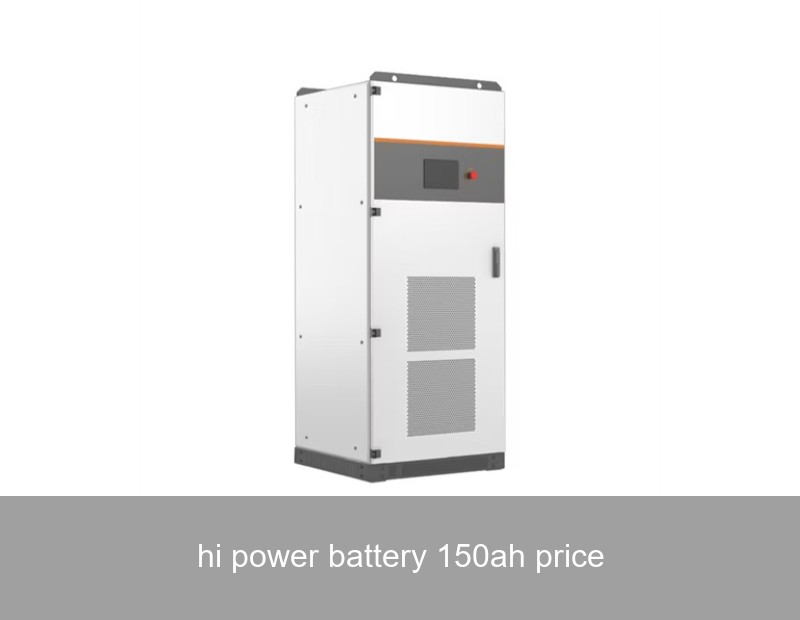
So, you're searching for a "hi power battery 150ah price." You've likely been met with a dizzying array of numbers, specifications, and promises. It's a common starting point, but here's the truth seasoned energy professionals know: focusing solely on the upfront cost per amp-hour is like buying a car based only on the size of its gas tank. The real value—and the real cost—of a high-power battery lies in its performance over a decade or more. In this article, we'll peel back the layers on what determines the price of a 150Ah battery, how to translate cost into long-term value, and what you should really be investing in for your solar-plus-storage or backup power project.
Understanding the "Hi-Power" 150Ah Battery
The term "hi-power" in the battery world typically refers to lithium iron phosphate (LiFePO4 or LFP) batteries designed to deliver high discharge and charge currents. Unlike standard batteries that may trickle out energy, a true hi-power 150Ah battery can release a large portion of its stored energy rapidly without damaging itself. This is crucial for applications like starting heavy equipment, covering household peak loads (think air conditioner and oven running simultaneously), or providing seamless backup during a grid outage.
When you see a price quote, it's the culmination of several core components:
- Cell Chemistry & Quality: Not all LiFePO4 cells are created equal. Grade A cells from reputable manufacturers offer superior cycle life, consistency, and safety but come at a higher initial cost.
- Battery Management System (BMS): This is the brain of the battery. A sophisticated BMS protects against overcharge, deep discharge, overheating, and ensures cell balancing. A cheap BMS is a primary point of failure.
- Thermal Management: Can the battery dissipate heat effectively during high-power cycles? Passive cooling might be cheaper; active thermal management adds cost but ensures performance in extreme temperatures.
- Warranty & Lifespan: A battery rated for 6,000 cycles at 90% depth of discharge (DoD) will inherently cost more than one rated for 3,000 cycles at 80% DoD. The warranty length and terms are a direct reflection of the manufacturer's confidence.

Image: A professional battery energy storage system relies on high-quality cells and intelligent management. (Source: Unsplash)
The Price Breakdown: More Than Just a Number
Let's talk numbers. In the European and US markets, you might find standalone 150Ah LiFePO4 batteries ranging from $500 to $1,500 or more. Why such a wide range? That cheaper unit likely uses lower-grade cells, a basic BMS, and offers a shorter warranty. The premium option isn't just "more expensive"; it's engineered for resilience.
Consider this: the Levelized Cost of Storage (LCOS) is the metric that matters. LCOS accounts for the total cost of owning and operating the storage system over its lifetime, divided by the total energy it will deliver. A cheaper battery with a shorter lifespan and lower efficiency will often have a higher LCOS than a more robust, initially pricier unit.
| Cost Factor | Low-Price Battery Implication | High-Value Battery Implication |
|---|---|---|
| Upfront Price (e.g., $600) | Lower initial investment. | Higher initial investment. |
| Cycle Life (e.g., 3,000 vs. 6,000 cycles) | May need replacement twice as fast, doubling long-term cost. | Lasts potentially for decades, reducing replacement costs. |
| Round-Trip Efficiency (e.g., 92% vs. 98%) | Loses more energy as heat; you pay for energy you never use. | More of your solar generation or grid charge is usable. |
| Warranty & Support | Limited or unclear warranty; difficult support channels. | Comprehensive 10+ year warranty with local technical support. |
From Cost to Value: A Real-World Case Study
Let's look at a concrete example from the commercial sector in Bavaria, Germany. A medium-sized dairy farm with a 100kW rooftop solar array was experiencing high grid demand charges and wanted to increase self-consumption. Their initial quote included a low-cost 150Ah battery bank system.
However, after a detailed analysis, they opted for a Highjoule HPS Series modular industrial battery system. While the per-kWh upfront cost was about 15% higher, the Highjoule system's data showed decisive advantages:
- Projected Cycle Life: The Highjoule system was guaranteed for 7,500 cycles at 90% DoD, compared to the generic system's estimated 4,000 cycles at 80% DoD.
- Peak Power Capability: The farm's milking equipment caused sharp power spikes. The HPS series' high C-rate discharge handled these seamlessly, while the cheaper system would have required oversizing.
- Integrated Energy Management: The system's AI-driven software optimized charging from solar and discharging to avoid peak tariffs automatically.
The Result? After two years of operation, the farm's energy bill reduced by 68%, and the system's performance degradation was less than 2%, tracking perfectly for a 20+ year lifespan. The higher initial price translated into a significantly lower lifetime cost and greater energy independence. You can explore more on the importance of cycle life and efficiency in the U.S. Department of Energy's resources on energy storage.
The Highjoule Solution: Engineering Value Beyond the Price Tag
At Highjoule, we approach the "hi power battery 150ah price" question from an engineering-first perspective. Since 2005, we've designed our systems not to be the cheapest on the shelf, but to deliver the lowest lifetime cost of ownership for our clients in Europe, North America, and globally.
Our HES (Home Energy Stack) and CIS (Commercial & Industrial Storage) product lines, which feature modular 150Ah-class battery modules, are built with this philosophy:
- Military-Grade LiFePO4 Cells: We source only Grade A cells, ensuring energy density and longevity.
- Proprietary Adaptive BMS: Our BMS doesn't just protect; it learns usage patterns to optimize cell health and performance in real-time.
- Scalable Architecture: Start with what you need and add modules seamlessly as your energy needs grow, protecting your initial investment.
- Grid-Forming Inverter Compatibility: Our systems are designed to work with advanced inverters that can create a stable "microgrid" during outages, keeping your lights on and business running.
This integrated approach means you're not just buying a battery; you're investing in a resilient, intelligent energy asset. For a deeper dive into battery safety and standards, which directly influence quality and cost, the NFPA 855 standard for energy storage installation is a key resource.

Image: A modern home energy system integrating solar and wall-mounted storage. (Source: Unsplash)
Making Your Decision: Key Questions to Ask
Before you fixate on a price per Ah, ask your provider these questions:
- What is the cycle life rating at a specific Depth of Discharge (DoD) (e.g., 6,000 cycles at 90% DoD)?
- What is the round-trip efficiency under real-world, not just ideal, conditions?
- Does the warranty guarantee a minimum capacity retention (e.g., 70% after 10 years) throughout its term?
- Is the system equipped with active thermal management for my climate?
- Can you provide case studies or performance data from installations in a similar application?
The energy storage market is evolving rapidly. With policies like the U.S. Inflation Reduction Act (IRA) offering tax credits, the effective net price of a quality system is more attractive than ever. But the incentive shouldn't drive you to a subpar product; it should enable you to invest in a solution that truly lasts.
Ready to Calculate Your Actual Cost of Ownership?
What would a detailed analysis reveal about the true 10-year cost of the storage solution you're considering for your home or business? We invite you to connect with a Highjoule energy specialist for a free, no-obligation evaluation based on your specific load profile and energy goals.
 Inquiry
 Online Chat