


Decoding the Battery ESS Price: Why Lithium-Ion Still Dominates
If you're exploring energy storage for your home or business, you've undoubtedly encountered a key question: what drives the battery ESS price? While terms like flow batteries or sodium-ion make headlines, the market reality is that lithium-ion-based energy storage systems (ESS) continue to be the go-to solution. But why, in an era of rapid innovation, does this technology hold its ground on both performance and cost? The answer lies in a powerful combination of mature supply chains, relentless energy density improvements, and smart system design that maximizes value over the system's entire life. Let's unpack the economics behind the lithium battery ESS price and what it means for your investment in a resilient, sustainable energy future.
Table of Contents
- The Price Puzzle: More Than Just a Battery Sticker Price
- The Lithium-Ion Advantage: Scale, Energy Density, and Intelligence
- Real-World Case: A California Winery's Strategic Storage Solution
- Looking Beyond the Battery Cell: System Integration is Key
- The Highjoule Approach: Engineering Value into Every ESS
The Price Puzzle: More Than Just a Battery Sticker Price
When you receive a quote for a battery energy storage system, the initial figure can be surprising. It's crucial to understand that the battery ESS price encompasses far more than just the lithium-ion cells. Think of it as the difference between buying a car engine versus a fully engineered, safety-tested, and warrantied vehicle. The total cost includes:
- Battery Cells & Modules: The core electrochemical units, where chemistry (like LFP - Lithium Iron Phosphate) plays a major role in cost, safety, and lifespan.
- Battery Management System (BMS): The essential "brain" that monitors cell health, ensures safety, and optimizes performance.
- Power Conversion System (PCS): The inverter that converts DC battery power to AC power for your home or grid.
- Thermal Management: A critical system (air or liquid cooling) to keep batteries at optimal temperature, directly impacting longevity.
- Enclosure, Safety Systems, and Software: The physical housing, fire suppression, and the intelligent energy management platform that controls when to store or dispatch energy.
- Installation, Permitting, and Grid Interconnection: Often a significant portion of the upfront cost.
Therefore, the most meaningful metric isn't just upfront cost, but Levelized Cost of Storage (LCOS). LCOS accounts for the total cost of ownership over the system's life, divided by the total energy it will dispatch. A system with a slightly higher upfront battery ESS price but superior efficiency, longer lifespan, and better warranty can have a far lower LCOS, making it the smarter economic choice.

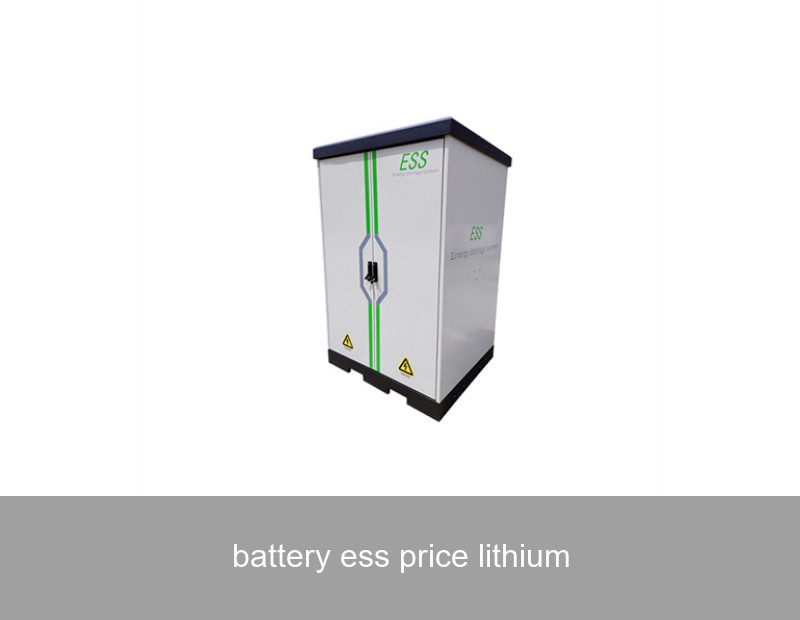
A holistic battery ESS price includes advanced enclosures, safety systems, and thermal management, not just cells.
The Lithium-Ion Advantage: Scale, Energy Density, and Intelligence
So, why does lithium-ion, specifically LFP chemistry, currently set the benchmark? The reasons are multifaceted:
- Unmatched Manufacturing Scale: Driven by the electric vehicle revolution, global investment in lithium-ion gigafactories has plummeted cell costs. According to BloombergNEF, the volume-weighted average price for a lithium-ion battery pack fell by 89% between 2010 and 2023 (BloombergNEF, 2023). This scale directly benefits stationary storage.
- Superior Energy Density: Lithium-ion packs more energy into a smaller, lighter footprint than most alternatives. This is critical for space-constrained residential and commercial sites, reducing balance-of-system costs for mounting and enclosures.
- Proven Track Record & Falling LCOE: With over a decade of grid-scale deployment, lithium-ion's performance and degradation profiles are well-understood. The Levelized Cost of Electricity (LCOE) from lithium-ion storage has fallen dramatically, making it competitive with peaking gas plants for many applications.
However, it's not just about the chemistry. The intelligence built around the battery is what unlocks its true value. An advanced ESS doesn't just store energy; it makes real-time decisions based on electricity rates, weather forecasts, consumption patterns, and grid needs to maximize financial returns and reliability.
Real-World Case: A California Winery's Strategic Storage Solution
Let's look at a concrete example from California's Napa Valley, a region with high electricity costs, a need for premium power quality for sensitive equipment, and increasing grid instability. A medium-sized winery faced a monthly demand charge of nearly $15,000 and frequent brief outages that risked disrupting fermentation cycles.
They installed a 500 kWh / 750 kW lithium-ion (LFP) ESS. The system was programmed for:
- Demand Charge Management: The ESS discharges during short periods of peak facility load, "shaving" the peak power draw from the grid, which is the primary determinant of demand charges.
- Backup Power: Providing seamless transition to backup power for critical loads during grid outages.
- Arbitrage: Storing energy when utility rates are low (overnight) and using it when rates are high (late afternoon).
| Metric | Result |
|---|---|
| Upfront Battery ESS Price (Installed) | ~$280,000 |
| Annual Demand Charge Savings | $85,000 |
| Annual Arbitrage Revenue | $12,000 |
| Simple Payback Period | < 3 years |
| Added Value: Protected Production | Prevented spoilage during 4 short outages in Year 1 |
This case demonstrates how the battery ESS price is an investment, not just an expense. The system paid for itself in under three years and now generates ongoing operational savings while mitigating business risk—a compelling value proposition enabled by intelligent lithium-ion technology.
Looking Beyond the Battery Cell: System Integration is Key
The winery's success story hinges on seamless integration. The best cells, if poorly managed, will underperform and degrade quickly. This is where companies like Highjoule differentiate. As a global provider since 2005, we don't just supply batteries; we deliver integrated, intelligent power solutions. Our systems are built with:
- Highjoule Sentrium™ BMS: Our proprietary BMS goes beyond voltage balancing, offering cell-level monitoring and predictive analytics to extend lifespan and preempt issues.
- Adaptive Thermal Management: Our liquid cooling systems maintain optimal temperature uniformity (±2°C) across all cells, a critical factor in achieving the promised 6,000+ cycle life of our LFP solutions.
- Highjoule Apex™ Energy OS: This cloud-based platform is the command center. It integrates weather data, utility tariffs, and load forecasts to autonomously optimize the system's operation for your specific financial and resilience goals.
This holistic engineering approach ensures that the promised performance on the spec sheet is what you experience in the field for decades, making the total battery ESS price a sound long-term investment.

For residential applications, a sleek, integrated system like Highjoule's HOMESERIES provides both energy independence and aesthetic appeal.
The Highjoule Approach: Engineering Value into Every ESS
At Highjoule, we apply our deep expertise across commercial, industrial, residential, and microgrid applications to engineer out hidden costs and engineer in long-term value. For a commercial client concerned with the battery ESS price, we demonstrate value through:
- Customized Design: We analyze your specific load profile, tariff structure, and site constraints to right-size the system, avoiding over- or under-spending.
- Performance Guarantees: Our contracts include clear performance and throughput warranties, ensuring your system delivers the expected financial return.
- Future-Proofing: Our modular architecture allows for capacity expansion as your needs grow, protecting your initial investment.
- Comprehensive Services: From initial consultation and grid interconnection support to long-term monitoring and maintenance, we provide a single point of responsibility.
Our INDUSTRYSERIES for C&I clients and GRIDSERIES for utility-scale projects are built on this philosophy, turning the complexity of storage into a simple, reliable, and profitable asset for our customers.
Is Your ESS Quote Telling the Full Story?
When you evaluate a battery ESS price, are you comparing just the cost of the containers, or are you evaluating the total cost of ownership and the intelligence that will maximize your savings? What specific energy challenge—be it soaring demand charges, unreliable grid power, or integrating renewable sources—are you aiming to solve, and how does the proposed system's software and guarantees directly address that?
We invite you to share your site's latest utility bill or energy goals with Highjoule's experts. Let us provide a detailed value analysis that shows not just a price, but a pathway to energy resilience and control.
 Inquiry
 Online Chat