


Unlocking Potential: How High Energy Lithium Battery Technology is Reshaping Our Power Grids
Imagine a world where a sunny afternoon in Spain can power an evening in Germany, or where a gusty night in Texas can keep the lights on in California the next day. This isn't science fiction; it's the promise being unlocked by today's most advanced high energy lithium battery systems. For over a decade, the conversation around renewable energy has shifted from "how do we generate it?" to a more pressing question: "how do we store it reliably?" The answer is increasingly found in the remarkable evolution of lithium-based energy storage, which is moving beyond our phones and cars to become the cornerstone of a resilient, decarbonized electrical grid.
Table of Contents
- The Challenge: Intermittency is the Achilles' Heel of Renewables
- The Solution: What Makes a Battery "High Energy"?
- Real-World Impact: A Case Study from California
- Beyond the Megawatt: High Energy Storage for Business and Home
- The Future Grid: Intelligent, Distributed, and Secure
- Making the Choice: What to Look for in a System
The Challenge: Intermittency is the Achilles' Heel of Renewables
Let's face it: the sun doesn't always shine, and the wind doesn't always blow. This fundamental truth has been the single biggest hurdle to a full-scale transition to renewable energy. Grid operators are tasked with a delicate balancing act—matching supply with demand in real-time. A sudden drop in wind generation or a passing cloud over a large solar farm can create instability, leading to voltage fluctuations or, in worst-case scenarios, blackouts.
The data paints a clear picture. According to the International Renewable Energy Agency (IRENA), for the world to meet its climate goals, the global energy storage capacity needs to expand by a factor of 15 by 2030. We're not just talking about storing energy for a few hours; we need solutions that can shift massive amounts of power across longer durations, from peak solar production at noon to peak household demand in the evening and through the night. This is where the unique capabilities of modern high energy lithium battery systems come into play.
The Solution: What Makes a Battery "High Energy"?
Not all lithium batteries are created equal. When we say "high energy lithium battery," we're specifically referring to cells and systems engineered for maximum energy density. Think of it as the "fuel tank" capacity of the battery. A high energy density battery can store more kilowatt-hours (kWh) of electricity in a given volume or weight compared to a standard lithium battery, which might be optimized for high power (rapid charging/discharging).
The magic happens through advanced chemistry and engineering. Many of today's leading systems utilize variations like Lithium Nickel Manganese Cobalt Oxide (NMC) or Lithium Iron Phosphate (LFP) in sophisticated configurations. LFP chemistry, in particular, has gained tremendous traction for grid-scale and commercial storage due to its excellent safety profile, long cycle life (often over 6,000 cycles), and stability. It's the workhorse chemistry that prioritizes longevity and total energy throughput over its lifetime.
At Highjoule, our approach integrates this cutting-edge cell technology with systems-level intelligence. Our HiveStack™ Commercial & Industrial (C&I) Energy Storage System is a prime example. It's built around a modular, high-energy LFP battery design, but its true power lies in the HiveMind™ AI-driven energy management platform. This software doesn't just store and release energy; it learns a facility's load patterns, forecasts weather and utility rates, and autonomously decides the most economical and efficient moment to charge or discharge. This transforms a passive battery into an active financial and operational asset.
Key Advantages of Modern High Energy Lithium Systems:
- Longer Duration Storage: Delivering 4, 6, 8 hours or more of continuous power, bridging wider gaps in renewable generation.
- Enhanced Grid Stability: Providing critical services like frequency regulation and voltage support to keep the grid smooth and reliable.
- Superior Economics: Higher energy density often translates to a lower levelized cost of storage (LCOS) over the system's lifetime.
- Inherent Safety: Chemistries like LFP are thermally stable, significantly reducing fire risk compared to older technologies.

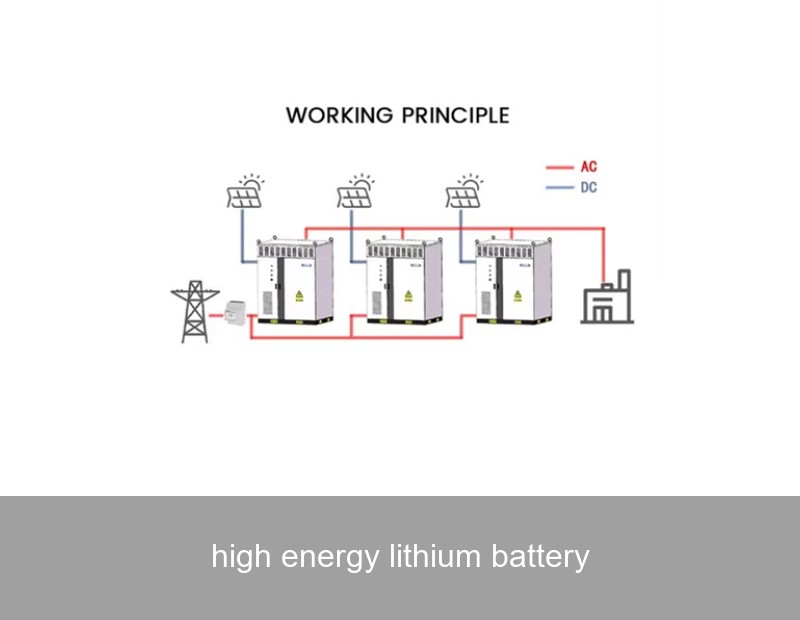
Modern containerized battery storage systems, like those deployed by utilities, are built with high energy lithium cells to provide grid-scale stability.
Real-World Impact: A Case Study from California
The theory is compelling, but what does it look like on the ground? Let's examine a real scenario in California, a leader in renewable adoption and grid innovation.
Phenomenon: California's grid operator, CAISO, frequently faces the "duck curve"—a steep ramp-up in electricity demand in the evening as solar production plummets. This requires quickly firing up natural gas "peaker" plants, which are expensive and carbon-intensive.
Data & Case: To mitigate this, utilities have turned to large-scale high energy lithium battery storage. One notable project is the Monolith Storage Facility in Kern County. This 100-megawatt (MW) / 400-megawatt-hour (MWh) system is designed explicitly for energy time-shifting. It soaks up excess solar power during the day and dispatches it over a critical 4-hour window in the evening. In its first year of operation, a facility of this scale can offset over 150,000 metric tons of CO2 by displacing peaker plant usage. The financials are just as impressive: by arbitraging energy prices (buying low when solar is abundant, selling high during the evening peak) and providing grid services, such projects achieve attractive returns while bolstering reliability.
Insight: This case demonstrates that high energy lithium battery systems are no longer just pilot projects; they are proven, bankable infrastructure assets. They solve a concrete grid problem with a clean, swift, and financially sound solution. For commercial and industrial entities, the same principle applies on a smaller scale. A manufacturing plant can use a Highjoule HiveStack system to avoid costly "demand charges" from the utility by smoothing out its power draw, achieving similar savings and sustainability benefits.
Beyond the Megawatt: High Energy Storage for Business and Home
The revolution isn't confined to utility-scale projects. The technology trickle-down is empowering businesses and homeowners to take control of their energy destiny.
For a medium-sized business—say, a cold storage warehouse or a data center—energy is a major operational cost. A high energy lithium battery system like Highjoule's HiveStack can be configured to:
| Use Case | How the Battery Helps | Business Outcome |
|---|---|---|
| Peak Shaving | Discharges during short periods of highest grid demand to cap power draw. | Reduces monthly demand charges by 20-40%, a direct bottom-line improvement. |
| Backup Power | Provides seamless, instantaneous power during an outage. | Prevents costly downtime and spoilage of goods; ensures business continuity. |
| Solar Self-Consumption | Stores excess solar energy produced midday for use at night. | Increases the utilization of on-site solar from ~30% to over 70%, maximizing ROI on panels. |
On the residential front, Highjoule's HomeGuard™ ESS brings this same high-energy LFP technology to the household. Paired with rooftop solar, it allows families to maximize their green energy use, achieve impressive energy independence, and secure their home against increasing power outages, all within a compact and safe package managed by an intuitive app.

Residential energy storage systems enable homeowners to store solar power for use day and night, increasing energy independence.
The Future Grid: Intelligent, Distributed, and Secure
The endpoint of this trend is a complete reimagining of the power grid. Instead of a one-way flow from centralized power plants, we are moving towards a decentralized, interactive network of "prosumers"—homes and businesses that both produce and consume energy. High energy lithium battery systems are the enabling hardware, but the brain is the energy management software.
This is where platforms like Highjoule's HiveMind™ become indispensable. They can aggregate thousands of distributed storage systems into a "virtual power plant" (VPP). This VPP can then act as a single, flexible resource for the grid operator, providing capacity during heatwaves or absorbing excess renewable generation—all while each participant earns revenue and enjoys greater resilience. It's a win-win-win for the consumer, the utility, and the planet.
Making the Choice: What to Look for in a System
If you're considering a high energy lithium battery system, whether for a factory, a store, or your home, the specifications can be daunting. Focus on these key aspects:
- Chemistry & Safety: Prioritize systems using stable, long-life chemistry like LFP. Ask for safety certifications (UL, IEC).
- Round-Trip Efficiency: This percentage (aim for >94%) tells you how much energy you get back for what you put in. Higher is better.
- Depth of Discharge & Cycle Life: Can you safely use 90%+ of the battery's capacity? How many charge/discharge cycles (e.g., 6,000+) is it guaranteed for? This defines its economic lifespan.
- Intelligence: Does it come with smart software that can automate operations for savings, or is it a simple, manual device?
- Warranty & Support: Look for a strong performance warranty (e.g., 10 years) and a provider with a global service network, like Highjoule's support centers across Europe and North America.
The transition to a renewable-powered world is unequivocally dependent on our ability to store energy intelligently. High energy lithium battery technology, especially when coupled with sophisticated energy management, is the key that unlocks this future. It turns the intermittent nature of sun and wind from a liability into a managed, powerful asset.
So, here's a question to ponder: As energy prices continue to fluctuate and climate impacts become more tangible, what will be the first step for your home or business in building a more resilient and cost-effective energy future?
 Inquiry
 Online Chat