


How Much Armoire Telecom? The Hidden Energy Cost of Our Connected World
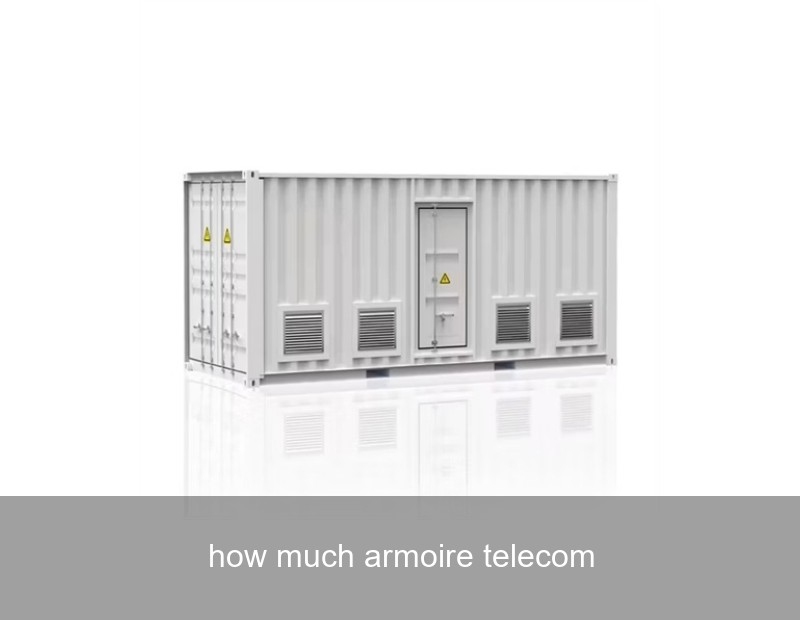
You've probably heard of the energy appetite of data centers, but have you ever stopped to think about the vast, distributed "armoire telecom" – the countless street cabinets, cell towers, and network nodes humming 24/7 to keep us connected? The question isn't just "how much armoire telecom" exists, but how much energy it consumes and, critically, how we can power it sustainably. As our reliance on digital infrastructure skyrockets, so does its energy footprint, making efficient and resilient power solutions not just an option, but a necessity for network operators across Europe and the US.
Table of Contents
The Phenomenon: The Unseen Grid of Telecom Cabinets
Walk down any urban or suburban street, and you'll see them: green, grey, or beige metal cabinets, often adorned with a telecom operator's logo. These "armoire telecom" units are the critical, yet overlooked, backbone of our connectivity. They house the electronics that amplify signals, switch data, and bring fiber-optic connections to our doorsteps. Each cabinet is a small, energy-dependent data center, requiring continuous power for its sensitive equipment and, crucially, constant cooling to prevent overheating. The sheer scale of this network is staggering—there are millions of these cabinets across Europe and the United States, forming a vast, power-hungry web.

Image Source: Unsplash - A typical streetscape of telecom infrastructure.
The Data: Quantifying the Energy Hunger
So, how much energy are we talking about? Let's break it down. A single modern telecom cabinet, especially one supporting fiber-to-the-home (FTTH) and 5G backhaul, can consume between 1.5 to 3 kilowatts (kW) of power, continuously. That might not sound like much, but multiplication is key. A mid-sized European telecom operator may manage over 100,000 such sites.
| Infrastructure Component | Estimated Power Consumption (per unit) | Key Power Challenges |
|---|---|---|
| Street Cabinet (FTTH/Copper) | 1.5 - 3 kW | 24/7 load, cooling needs, grid dependency |
| Macro Cell Tower Site | 5 - 10 kW | High peak demand, backup power critical |
| Edge Data Node | 10 - 25 kW | Heat density, power quality, uptime requirements |
According to a 2024 IEA report, data centers and telecommunications networks are among the fastest-growing electricity consumers in advanced economies, with their share of global electricity demand projected to double by 2026. This isn't just an economic cost; it's a sustainability imperative. Network operators are now facing intense pressure from regulators, shareholders, and consumers to decarbonize their operations. The old model of purely grid-dependent power, often backed by diesel generators for backup, is becoming financially and environmentally untenable.
The Case Study: A European Operator's Green Shift
Let's look at a real-world example. A major telecommunications provider in Germany, facing rising energy costs and stringent carbon reduction targets, embarked on a pilot project to modernize the power supply for its remote street cabinets. The challenge was specific: how to ensure 99.99% uptime for critical network nodes while reducing reliance on the grid and eliminating diesel generators.
The solution involved deploying integrated solar-plus-storage systems at hundreds of "armoire telecom" sites. Each site was equipped with:
- Rooftop or ground-mounted solar panels (4-6 kWp per cabinet).
- A high-efficiency, lithium-ion battery energy storage system (BESS) with 20-30 kWh capacity.
- An intelligent energy management system (EMS) to dynamically control power flow.
The results after 18 months were compelling:
- Grid Independence: Sites achieved 60-85% grid electricity reduction during daylight hours.
- Cost Savings: Energy costs per site decreased by an average of 40% annually.
- Resilience: Battery backup provided seamless power during grid outages, surpassing the performance of old diesel systems.
- Emission Cuts: Carbon footprint per site was reduced by approximately 4-5 tonnes of CO2 per year.

Image Source: Unsplash - Renewable energy integration for telecom sites.
The Solution: Smart Energy Storage for Network Resilience
The German case study underscores a fundamental shift: the "armoire telecom" is evolving from a passive power consumer to an active energy node. The core of this transformation is advanced Battery Energy Storage Systems (BESS). But not all BESS are created equal. For telecom applications, the system must be:
- Ultra-Reliable: Engineered for thousands of deep-cycle operations with minimal degradation.
- Intelligently Managed: Capable of integrating multiple inputs (grid, solar, generator) and prioritizing loads.
- Scalable & Modular: Able to be deployed across thousands of geographically dispersed sites with remote monitoring.
- Safe & Low-Maintenance: Built with robust safety protocols and requiring minimal onsite intervention.
Highjoule's Role: Powering the Connected Future
At Highjoule, we've been at the forefront of this energy transition for nearly two decades. We understand that the question "how much armoire telecom" ultimately leads to a more critical one: "how can we power it better?" Our HiveGrid Commercial & Industrial (C&I) energy storage systems are specifically engineered for challenges like those faced by telecom operators.
For a typical telecom cabinet or small cell site, our HiveGrid Modular solution is ideal. Its compact, outdoor-rated design integrates seamlessly with existing infrastructure. The built-in Highjoule EnergyOS™ software is the true differentiator—it intelligently manages energy flow to:
- Maximize consumption of on-site solar generation.
- Perform peak shaving to reduce grid demand charges.
- Provide instantaneous backup power during outages, ensuring network continuity.
- Enable participation in grid services (where markets allow), creating a new revenue stream.

Image Source: Unsplash - Advanced battery system monitoring and management.
What's Your Network's Energy Blueprint?
The journey from seeing telecom cabinets as simple cost centers to viewing them as manageable, even optimizable, energy assets is already underway. The data is clear, the technology is proven, and the regulatory and economic winds are blowing firmly in the direction of sustainability and resilience. The energy strategy for your network infrastructure is no longer a secondary concern—it's a core component of operational excellence and competitive advantage.
So, when you next ask "how much armoire telecom" is costing you, consider a deeper question: What would it mean for your business if every cabinet in your network could lower its energy costs, guarantee its own power, and contribute to your corporate sustainability goals—simultaneously? The answer to that question is where the future of telecommunications is being built.
 Inquiry
 Online Chat