


How Much Backup Do You Really Need for an Off-Grid System?
Imagine this: a winter storm knocks out the power lines in your remote mountain home. Or, you're running a critical agricultural operation where even a few hours of downtime means spoiled produce and lost revenue. The question isn't just about going off-grid; it's about resilience. How much backup is enough to ensure your lights stay on, your business runs, and your life remains uninterrupted? This isn't a one-size-fits-all answer. Calculating your true off-grid backup needs is a blend of science, practical energy management, and understanding your unique "energy personality." Let's demystify the process.
Table of Contents
The Phenomenon: From Niche to Necessity
Off-grid living and operations were once associated solely with remote cabins. Today, the trend has exploded. Driven by rising utility costs, a desire for energy independence, and increasing grid instability in some regions, homeowners, businesses, and entire communities are seeking self-sufficiency. In the US, the Department of Energy's Solar Futures Study highlights the critical role of storage in decarbonization. In Europe, the push for energy storage is central to the REPowerEU plan. The core challenge for all? Not just generating power (often via solar panels), but storing enough of it to cover consumption during periods of low generation—be it cloudy days, calm weeks, or peak demand events.
The Core Calculation: It's All About Kilowatt-Hours
Forget watts for a moment; think in kilowatt-hours (kWh). This is the unit of energy your backup battery bank must deliver. To determine "how much backup," follow this logical ladder:
- Audit Your Loads: List every appliance and device. Note their power rating (in watts) and estimated daily run time (in hours).
- Calculate Daily Energy Consumption: For each item: Watts × Hours Used ÷ 1000 = Daily kWh. Sum them all.
- Factor in "Days of Autonomy": This is the crucial variable. How many consecutive days without sun (or wind) do you want to cover? For a sunny climate, 2-3 days might suffice. For a storm-prone area, 5+ days is prudent.
- Account for System Efficiency and Depth of Discharge: Battery systems aren't 100% efficient, and you shouldn't drain them to zero. A common formula is:
Required Battery Bank Size (kWh) = (Daily kWh × Days of Autonomy) / (System Efficiency × Depth of Discharge)
| Appliance | Power (Watts) | Hours/Day | Daily Energy (kWh) |
|---|---|---|---|
| Refrigerator (Efficient) | 150 | 24 (cycling) | 3.6 |
| LED Lighting | 100 | 5 | 0.5 |
| Water Pump | 800 | 1 | 0.8 |
| Laptop & Router | 200 | 6 | 1.2 |
| Well Pump (1 HP) | 1500 | 0.5 | 0.75 |
| Total Daily Estimate | ~6.85 kWh | ||
For this 6.85 kWh/day home wanting 3 days of autonomy with 90% system efficiency and an 80% Depth of Discharge:
Required Battery Bank = (6.85 × 3) / (0.90 × 0.80) = 20.55 / 0.72 ≈ 28.5 kWh.
That's a substantial battery bank, highlighting why intelligent management is as important as raw size.
Key Factors That Inflate (or Shrink) Your Backup Needs
- Climate & Season: A Norwegian winter requires vastly more storage than a Spanish summer for the same solar array. You must plan for your worst-case season, not the average.
- Lifestyle & Load Management: Can you shift heavy loads (like washing machines, workshop tools) to sunny hours? This "load shifting" dramatically reduces the burden on your batteries.
- Backup Generation: Integrating a propane or biodiesel generator as a backup for extended cloudy periods can allow for a smaller, more cost-effective battery bank. The battery covers short-term gaps; the generator handles rare, long-duration events.
- Battery Chemistry: Lithium-ion batteries, like those used in Highjoule's EverSafe Series, offer a near 100% usable depth of discharge, high efficiency (~98%), and long cycle life. This means you need fewer physical kWh of storage compared to older lead-acid technologies, which might only allow 50% discharge.

Image: A modern lithium-ion home battery system, like Highjoule's EverSafe, provides high-density, safe backup power. (Source: Unsplash)
A Real-World Case Study: The Alpine Lodge, Colorado, USA
Let's ground our theory in reality. A boutique lodge in the Rocky Mountains, completely off-grid, faced a critical challenge: ensuring guest comfort and safety during winter storms that could block the sun for 4-5 days. Their old lead-acid battery bank (40 kWh nameplate, 20 kWh usable) constantly failed.
The Solution & Data: Highjoule engineers conducted a detailed audit, identifying a peak load of 12 kW and a refined daily need of 35 kWh in winter (including heating circulator pumps, ventilation, and commercial kitchen essentials). The goal was 5 days of autonomy with a generator used only after day 3 to conserve fuel.
A Highjoule Industrial MicroGrid system was installed, featuring:
- A 25 kW solar array
- A 48 kWh Highjoule EverSafe Lithium Ferro Phosphate (LFP) battery bank
- An intelligent energy management system (EMS) that prioritizes loads and automatically starts the backup generator only when battery levels drop below 20% after 72 hours of low solar.
The Result: The lodge achieved 99.9% power availability in its first winter. The battery bank handled 90% of all nighttime and short-term cloudy period loads. The generator runtime was reduced by over 70% compared to the prior system, slashing fuel costs and maintenance. The EMS's predictive algorithms, using weather data, even pre-charge the batteries ahead of forecasted storms. This case shows that "how much backup" is answered not just by capacity, but by intelligent control.
Beyond the Basics: The Highjoule Approach to Intelligent Backup
At Highjoule, we believe the question isn't just "how many kWh?" but "how smart are your kWh?" Oversizing a battery bank is an expensive solution. Our philosophy is to right-size and optimize.
Our EverSafe residential and GridMax commercial battery storage systems are built with industry-leading LFP chemistry for safety and longevity. They are the robust foundation. What truly sets them apart is the integrated Highjoule Energy Operating System (HEOS). This AI-driven platform does the heavy thinking:
- Predictive Load & Generation Forecasting: It analyzes weather patterns and your historical usage to predict solar yield and consumption.
- Automated Priority Scheduling: It seamlessly sheds non-essential loads during deficit periods and boosts them when surplus is available.
- Multi-Source Integration: It seamlessly orchestrates between solar, battery, grid (if available), and backup generator, ensuring the most efficient and cost-effective source is used at every moment.
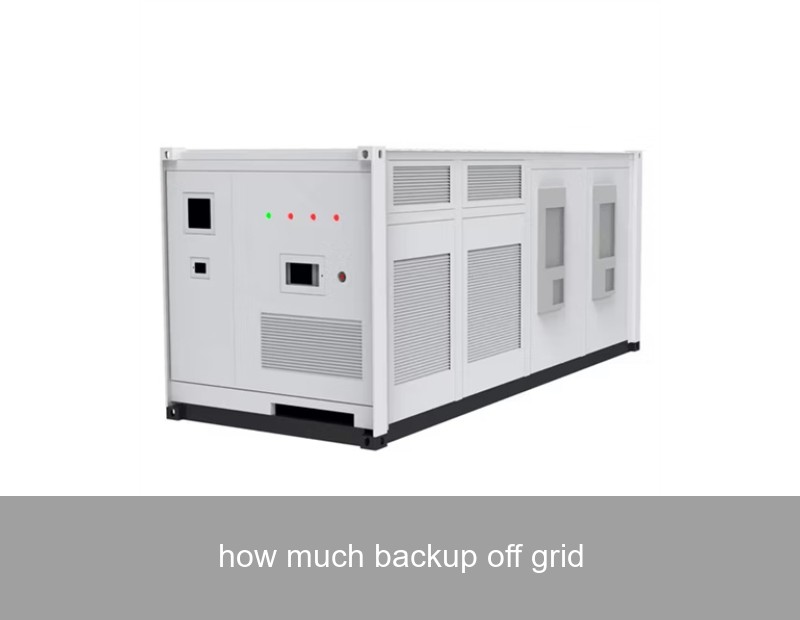
For a microgrid application—like a remote research station or agricultural cooperative—our containerized MegaJoule systems provide utility-scale storage that can be paired with large solar or wind farms, managed down to the individual circuit by HEOS.

Image: Containerized battery energy storage systems (BESS) enable large-scale off-grid and microgrid solutions. (Source: Unsplash)
Practical Planning for Your Off-Grid Project
So, where do you start on your journey to energy independence?
- Get Granular with Your Data: Use an energy monitor for at least a month, capturing all seasons if possible. Don't guess.
- Embrace Efficiency First: Investing in a high-efficiency heat pump, LED lighting, and Energy Star appliances reduces your backup needs more cost-effectively than adding extra battery modules.
- Plan for a Hybrid System: Consider a "battery-first, generator-backup" design. This is often the most resilient and economical architecture.
- Consult with Experts Who See the Whole Picture: Look for partners who don't just sell components but design integrated systems. Highjoule's global team provides end-to-end support, from initial feasibility studies using satellite data to system design, installation supervision, and remote monitoring via HEOS.
The journey to a reliable off-grid life is a calculated one. It moves from the simple question of "how much backup" to a more empowering one: How can I design an intelligent energy ecosystem that powers my life, no matter what's happening beyond my property line? What's the one load in your home or business that, if it stayed on during an outage, would change everything?
 Inquiry
 Online Chat