


How Much Delta 2 EcoFlow? Understanding Costs and the Value of Professional Energy Storage
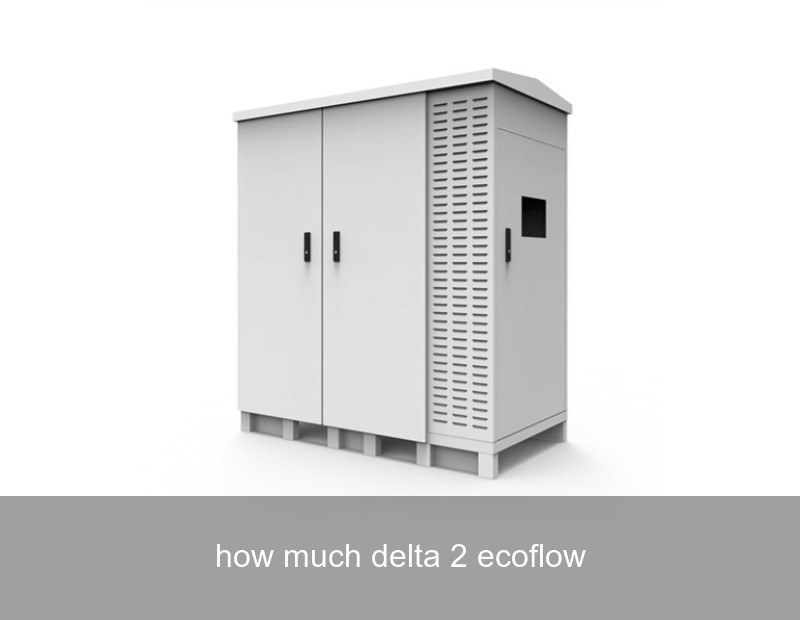
You're likely asking "how much is the Delta 2 EcoFlow?" because you're searching for reliable, portable power. It's a great question, and the answer is readily available online. But perhaps the more important question is: what are you really trying to power, and for how long? The quest for a portable power station often leads to a bigger realization about our energy needs. Let's explore the value of energy storage, from compact units to whole-property solutions, and how making the right choice depends on your specific goals.
The Portable Power Phenomenon
The market for portable power stations like the EcoFlow Delta 2 has exploded. For good reason! They offer a fantastic, user-friendly entry point into battery storage, perfect for weekend camping, tailgating, or as a backup for small essential devices during brief outages. The "how much" question is straightforward—these units have a set retail cost. However, their limitations become clear with larger, sustained demands. They are typically designed for occasional, mobile use rather than continuous, high-power output or whole-home backup.

Image Source: Unsplash
Beyond the Price Tag: Data on Energy Needs
To understand what kind of storage you need, let's look at data. A typical portable power station might offer 1-2 kWh of capacity. Now, consider the energy consumption of common household items:
| Appliance | Average Power Consumption | Runtime on 1 kWh |
|---|---|---|
| Refrigerator | 150-400 Watts | 2.5 - 6.5 hours |
| Residential HVAC (per hour) | 3000-5000 Watts | ~12-20 minutes |
| Well Pump | 700-1000 Watts | 1 - 1.4 hours |
| LED Lighting (Whole Home) | 100-300 Watts | 3 - 10 hours |
As you can see, powering a home through a multi-hour grid outage—let alone achieving energy independence—requires a system with significantly higher capacity, power output (in kW), and durability. According to the U.S. Department of Energy, integrating storage with on-site generation like solar is key to building resilience.
Case Study: A German Camping Business's Power Journey
A family-run "Campingplatz" in Bavaria started with several consumer-grade portable power stations for their rental cabins and on-site events. They constantly faced challenges: units depleting too fast, inability to run small water pumps simultaneously with lighting, and the logistical hassle of recharging multiple units daily.
Their solution was a professional, scalable battery storage system. They installed a 30 kWh integrated battery storage unit paired with a 20 kWp solar array on their service building. The results were transformative:
- Energy Cost Reduction: Achieved 70% grid independence during the summer season, slashing their operational costs.
- Operational Reliability: Provided stable, silent power to rental cabins and event areas, enhancing guest experience.
- Scalability: The modular design allows them to easily add more capacity as they expand.
This case highlights the transition from asking "how much for a portable unit?" to "what is the total value of a reliable, integrated energy system?"
Professional-Grade vs. Consumer-Grade Solutions
When your needs evolve beyond portability to resilience, the comparison shifts. Here’s the distinction:
- Consumer Portable Stations (e.g., EcoFlow Delta 2):
- Best For: Occasional, mobile, low-power use.
- Design Life: ~500-800 full cycles to 80% capacity.
- Integration: Limited, often standalone.
- Scalability: Manual, via external add-on batteries.
- Professional ESS (like Highjoule's systems):
- Best For: Continuous, stationary, whole-property backup and solar optimization.
- Design Life: 6,000+ cycles (15+ years daily use), with robust warranties and service plans.
- Integration: Seamless with solar inverters, home energy management systems, and the grid.
- Scalability: Inherently modular; capacity can be expanded with additional battery modules within a single system.
The International Energy Agency (IEA) notes that safety standards, lifecycle management, and grid services are critical factors for stationary storage that consumer devices aren't designed to address.
Highjoule's Integrated Approach to Energy Resilience
At Highjoule, with nearly two decades of experience since 2005, we design energy storage solutions for those whose needs have outgrown the portable category. We don't just sell a battery; we provide intelligent, integrated power ecosystems.

Image Source: Unsplash
Our H-Series Commercial & Industrial (C&I) systems and Nexus Home Energy Hub are engineered for durability and intelligence. They feature advanced lithium iron phosphate (LFP) battery chemistry for superior safety and longevity, and our proprietary energy management software dynamically optimizes power flow—prioritizing solar self-consumption, providing instantaneous backup during grid failures, and even participating in demand response programs where available.
For a microgrid application at a remote U.S. agricultural research facility, Highjoule deployed a 500 kWh containerized storage system coupled with solar. This not only eliminated diesel generator dependency but also stabilized the local microgrid, allowing critical research to continue uninterrupted. The system's remote monitoring and diagnostics, a core part of our service, ensure peak performance and proactive maintenance.
Making Your Energy Choice
So, where does this leave you? The question "how much Delta 2 EcoFlow?" is a starting point. The real journey is about assessing your energy profile:
- Are you powering a weekend hobby or securing your home/business?
- Do you need power for 4 hours or 4 days?
- Is your goal convenience, or true energy independence and cost management?
For the latter goals, a conversation with a professional provider like Highjoule becomes essential. We help you move from looking at a product's price to understanding your system's value over its entire lifetime.
What is the one appliance or system in your home or business that, if it lost power for 24 hours, would cause the most significant disruption or cost? Let's start the conversation about protecting it.
 Inquiry
 Online Chat