


How Much Energy Do Websites Use? The Digital Carbon Footprint Explained
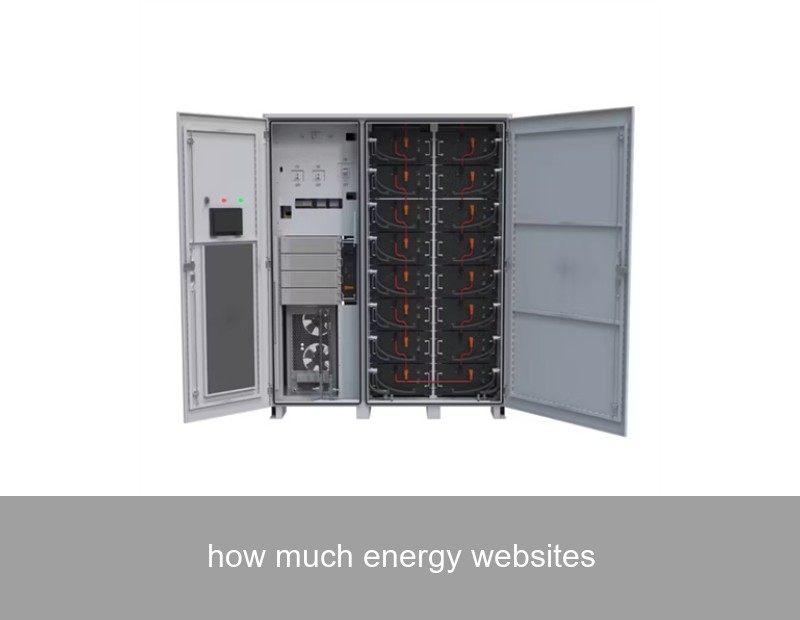
Have you ever stopped to think about the energy cost of your online life? Every search, every streamed video, and every scroll through social media requires electricity—a lot of it. This article dives into the critical question: how much energy do websites truly consume, and what does this mean for our planet and our power grids? We'll move from the surprising reality of data center demands to tangible solutions, including how advanced energy storage is becoming a key player in creating a sustainable digital future.
Table of Contents
- The Hidden Phenomenon: Your Click Has a Weight
- By the Numbers: Quantifying the Web's Appetite for Power
- Case Study: A Data Center's Journey to Resilience and Sustainability
- The Storage Solution: Balancing the Digital Grid
- How Highjoule Powers a Sustainable Digital Ecosystem
- What's Your Website's Energy Profile?
The Hidden Phenomenon: Your Click Has a Weight
We perceive the internet as a cloud—ethereal and weightless. But the infrastructure that makes it possible is profoundly physical. A simple Google search travels through networks to a massive data center, where rows of servers work tirelessly to fetch your answer. These facilities, the beating hearts of our digital world, are insatiable consumers of electricity for computing and, crucially, for cooling. The phenomenon is clear: our growing reliance on digital services directly increases global electricity demand. This creates a dual challenge: ensuring grid reliability and mitigating the associated carbon emissions.
By the Numbers: Quantifying the Web's Appetite for Power
Let's put some hard data to this invisible load. According to the International Energy Agency (IEA), data centers and transmission networks accounted for about 1-1.5% of global electricity use in 2022, a figure that is set to rise with the AI boom. To make it more relatable:
- A single data center can use enough electricity to power 50,000 homes.
- One website page view can generate an average of 1.76 grams of CO2, according to some estimates. For a site with 100,000 monthly page views, that's 2,112 kg of CO2 annually.
- The carbon footprint of the global IT sector is comparable to that of the aviation industry.
This energy hunger isn't just an environmental issue; it's a business continuity risk. Power outages or grid instability can take critical online services offline in an instant, leading to massive financial and reputational damage.

Image Source: Unsplash (Photographer: @alexandre_debieve)
Case Study: A Data Center's Journey to Resilience and Sustainability
Consider a real-world example from the European market. A hyperscale data center operator in Frankfurt, Germany—a major internet hub—faced twin pressures: soaring regional electricity costs and a corporate mandate to achieve 24/7 carbon-free energy. Their grid connection was reliable, but peak demand charges were crippling, and renewable sources like their onsite solar arrays were intermittent.
The Challenge: Reduce operational costs, ensure zero downtime during grid fluctuations, and increase the utilization of self-generated solar power beyond 35%.
The Solution & Results: The operator deployed a containerized battery energy storage system (BESS) with a capacity of 4 MWh. This system was integrated with their energy management software to perform:
- Peak Shaving: The BESS discharged during daily grid peak hours, reducing demand charges by over 18% annually.
- Solar Smoothing & Time-Shifting: Excess solar energy generated at midday was stored and used in the evening, increasing the direct use of renewables to over 60%.
- Backup Power: Providing seamless bridging power for critical loads during any grid disturbance.
Within two years, the project not only delivered a strong ROI but also significantly enhanced the facility's sustainability rating, making it more attractive to environmentally-conscious enterprise clients.
The Storage Solution: Balancing the Digital Grid
The case study above highlights the indispensable role of modern battery storage. For energy-intensive facilities wondering how much energy do websites and their infrastructure need, the next question must be: "How can we manage that demand intelligently?" Advanced Battery Energy Storage Systems (BESS) are the answer. They act as a buffer, absorbing cheap or excess renewable energy and releasing it when it's needed most. This:
| Function | Benefit for Digital Infrastructure |
|---|---|
| Load Shifting & Peak Shaving | Dramatically reduces electricity costs by avoiding high tariff periods. |
| Renewable Integration | Maximizes the use of onsite solar/wind, reducing Scope 2 emissions. |
| Grid Services & Frequency Regulation | Provides stability to the local grid, preventing outages that could cause downtime. |
| Uninterruptible Power Supply (UPS) | Offers milliseconds-switch backup power, far superior to traditional diesel generators. |
How Highjoule Powers a Sustainable Digital Ecosystem
This is where Highjoule's expertise becomes critical. Since 2005, we have been at the forefront of designing and deploying intelligent storage solutions for precisely these challenges. For commercial, industrial, and utility-scale clients, including data center operators, we provide more than just hardware.
Our HiveMind AI-powered energy management platform is the brain of the operation. It predicts energy usage patterns, grid prices, and renewable generation to autonomously optimize the charge/discharge cycles of our Nexus Series BESS. This ensures our clients' facilities are not only more resilient and cost-effective but are actively contributing to a more stable and greener grid. Whether it's for a large data center campus in Texas or a microgrid supporting a remote telecom hub in Scandinavia, Highjoule's systems are engineered for reliability, safety, and maximum financial return.

Image Source: Unsplash (Photographer: @growtika)
What's Your Website's Energy Profile?
So, how much energy do websites you own or rely on consume? While developers can optimize code and use efficient hosting (like providers powered by renewables and storage), the broader responsibility extends to the physical infrastructure. The journey to a sustainable digital economy is a shared one.
As a business leader, facility manager, or sustainability officer, have you evaluated the energy resilience and carbon footprint of your critical digital operations? Could your organization benefit from transforming its energy consumption from a fixed cost into a managed, strategic asset?
 Inquiry
 Online Chat