


How Much GoodPower Solar Can Truly Generate for Your Home or Business?
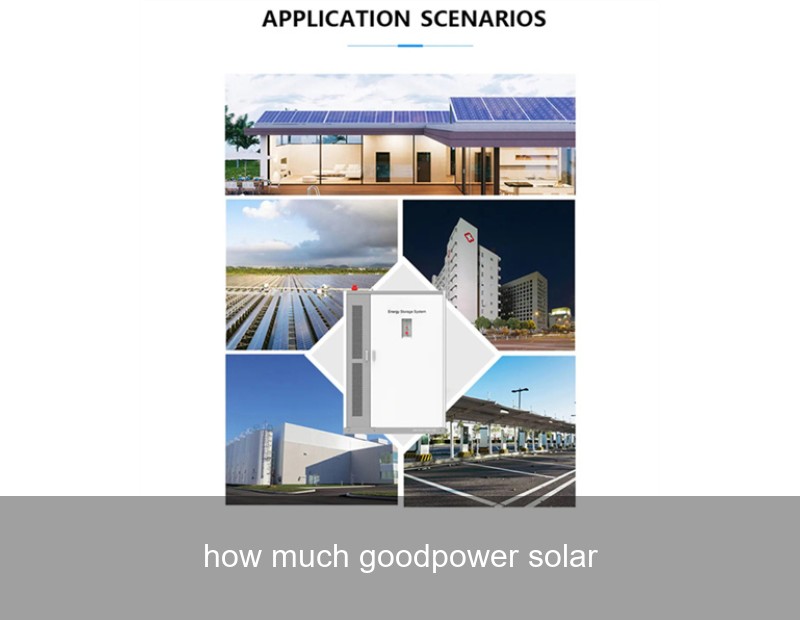
You've likely heard the promise: install solar panels, and you'll generate clean, free electricity for decades. But when you look at your actual energy bills or the needs of your business, the pressing question becomes more specific: how much "GoodPower" solar—reliable, cost-saving, grid-independent energy—can you really expect? The answer goes beyond panel wattage. It's about intelligent system design, pairing with storage, and leveraging smart energy management to maximize the good, usable power you get from every ray of sunshine. This is where modern solar transitions from a simple generator to a resilient power asset.
Table of Contents
- The Phenomenon: More Panels Don't Always Mean More Usable Power
- The Data: Quantifying the "GoodPower" Gap
- The Case Study: A California Winery's Journey to True Energy Independence
- The Solution: Engineering Systems for Maximum GoodPower
- Highjoule's Role: Delivering Intelligent Solar-Storage Synergy
- What's Your GoodPower Potential?
The Phenomenon: More Panels Don't Always Mean More Usable Power
Many homeowners and business operators experience a common frustration. They install a sizable solar array, only to find a significant portion of the energy it produces isn't available when they need it most. You might be exporting vast amounts to the grid at midday (often for low feed-in tariffs) while still drawing expensive power from the utility in the evening. This mismatch between solar production and consumption patterns creates a "GoodPower Gap." The raw kilowatt-hours (kWh) your panels generate is only part of the story. GoodPower is the portion you can actually use or store for self-consumption, directly reducing your bills and increasing your resilience.
Image Source: Unsplash - Visualizing the typical solar production curve versus a home's energy demand.
The Data: Quantifying the "GoodPower" Gap
Let's look at some real numbers. According to the U.S. Department of Energy, the average capacity factor for solar PV across the United States is about 25%. This means a 10 kW system produces roughly 10 kW * 24 hrs * 365 days * 0.25 = ~21,900 kWh per year. However, without storage, a typical household might only directly consume 30-50% of that energy on-site, depending on its daily schedule. The rest is exported.
The financial impact is stark. In regions like California with time-of-use (TOU) rates, the cost of grid power can peak at over $0.50 per kWh in the evening, while the credit for exported solar at noon might be as low as $0.08 per kWh. You're essentially trading high-value power for low-value credit.
| Scenario | Solar Production (Annual) | Direct Self-Consumption (Without Storage) | "GoodPower" Utilization Rate | Key Limitation |
|---|---|---|---|---|
| Residential (Daytime Empty) | 10,000 kWh | 3,000 - 4,000 kWh | 30-40% | Production/consumption timing mismatch |
| Commercial (Daytime Operation) | 100,000 kWh | 60,000 - 70,000 kWh | 60-70% | Evening/weekend operations, demand charges |
| With Solar + Storage | 10,000 kWh | 7,000 - 9,000 kWh | 70-90%+ | System design & intelligence |
The Case Study: A California Winery's Journey to True Energy Independence
Consider the real-world example of a mid-sized winery in Sonoma County, California. Their operations included refrigeration, lighting, and processing equipment, leading to a consistent energy demand with peaks in the late afternoon and evening. They had a 200 kW solar array but faced two major issues:
- High Demand Charges: Utility bills were heavily impacted by short periods of peak grid draw, even with solar.
- Evening Power Shortfall: Critical refrigeration loads ran after sunset, requiring expensive grid power.
Their solar system alone, while sizable, was only meeting about 55% of their total electricity needs and did little to mitigate demand charges. The "GoodPower" yield was insufficient.
The Solution & Outcome: The winery integrated a Highjoule Industrial Battery Energy Storage System (BESS) with their existing solar. The 500 kWh battery system was configured for dual purposes: 1) Peak shaving to cut demand charges, and 2) Storing excess solar for use in the evening. The Highjoule energy management system (EMS) intelligently decided when to charge from solar, when to discharge, and when to briefly draw from the grid to optimize economics.
- Overall grid electricity consumption reduced by 82%.
- Demand charges reduced by over 90%.
- Solar self-consumption rate rose from ~40% to over 95%.
- Projected payback period: Under 5 years.
This case clearly shows that the question isn't just "how much solar?" but "how much solar is transformed into reliable, valuable GoodPower?"
The Solution: Engineering Systems for Maximum GoodPower
Maximizing GoodPower requires a system-level approach. Here are the key components:
- Right-Sized Solar PV: Based on your historical load profile, not just roof space.
- Integrated Battery Storage: The essential bridge that captures excess daytime production for use during peak times or at night.
- Smart Energy Management System (EMS): The "brain" that makes real-time decisions to optimize for cost savings, self-consumption, or grid services.
- Quality Components & Professional Installation: Ensures longevity, safety, and performance as advertised.

Image Source: Unsplash - A modern Battery Energy Storage System (BESS) unit.
Highjoule's Role: Delivering Intelligent Solar-Storage Synergy
At Highjoule, we've focused on closing the GoodPower Gap since 2005. We understand that a solar installation is only as good as the value it delivers daily. Our products and services are designed to maximize your GoodPower yield:
- Highjoule H Series Residential Systems: Scalable battery storage solutions (like the H-Core 10.5 kWh module) that seamlessly integrate with new or existing solar. Our intuitive app lets homeowners prioritize self-consumption, backup power, or cost savings, ensuring they get the most GoodPower from their investment.
- Highjoule Industrial & Commercial BESS: Modular, containerized or skid-mounted systems that pair with large-scale solar PV. They are engineered to tackle demand charge management, provide backup power for critical operations, and enable participation in grid-balancing programs, turning your solar array into a revenue-optimizing asset.
- Highjoule Microgrid Controller: For campuses, remote sites, or communities, this technology seamlessly blends solar, storage, and other distributed energy resources (DERs) to create a stable, independent microgrid—maximizing local GoodPower consumption and resilience.
Our approach starts with a detailed energy analysis. We model your consumption, solar production, and local utility rates to design a system that doesn't just generate kWh, but delivers the highest possible financial return and energy security. As the National Renewable Energy Laboratory (NREL) notes, the value of solar-plus-storage significantly exceeds the sum of its parts, especially in managing grid volatility and providing resilience.
What's Your GoodPower Potential?
So, how much GoodPower solar can your home or business generate? It's a dynamic number that depends on your location, energy habits, local utility policies, and—most critically—the intelligence of the energy system you install. The era of passive solar is over. The new standard is active, intelligent energy management that captures, stores, and deploys every possible kilowatt-hour to your benefit.
Are you ready to move beyond just measuring solar panel output and start measuring the true, usable GoodPower your property can achieve? What would an 80% or higher self-consumption rate do for your operational costs or household budget?
 Inquiry
 Online Chat