


Windsun Energy: How Much Can It Power Your Home or Business?
Imagine a world where your energy bills are predictable, your power is clean, and your reliance on the traditional grid is a choice, not a necessity. This is the promise of windsun energy—a powerful combination of wind and solar power. But the most common and crucial question we hear is: "Windsun energy, how much?" How much power can it generate? How much can it save you? How much does it truly impact your energy independence? This article dives deep into these questions, moving beyond theory into real-world data and practical insights for homeowners and businesses in Europe and the US.
Table of Contents
- The Phenomenon: From Weather Dependency to Energy Asset
- The Data: Quantifying Windsun's Potential
- The Case Study: A German Dairy Farm's Success Story
- The Insight: It's Not Just Generation, It's Intelligent Management
- Highjoule's Role: Your Partner in Maximizing Windsun ROI
- Your Next Step: From Question to Clarity
The Phenomenon: From Weather Dependency to Energy Asset
For decades, wind and sun were seen as unpredictable forces. A sunny day was good for solar, a windy day for turbines, but calm nights or cloudy periods meant falling back on the grid. This intermittency is the core challenge—and the core opportunity. The true breakthrough isn't in harnessing just wind or just solar, but in combining them. Windsun hybrid systems leverage the natural synergy of these resources: solar often peaks during midday, while wind can blow strongly at night and in colder seasons. This complementary nature smooths out the generation curve, providing a more consistent and reliable renewable energy flow throughout the year.
This shift transforms weather from a dependency into a diversified portfolio of energy assets. But to truly answer "how much," we need to move from the conceptual to the concrete.
The Data: Quantifying Windsun's Potential
So, how much energy can a windsun system produce? The answer is highly site-specific, but we can build a clear picture with averages. Let's break it down for a typical commercial-scale installation in a favorable European location, like Northern Germany or the UK coast.
| Component | Capacity | Estimated Annual Yield (kWh) | Key Factors |
|---|---|---|---|
| Solar PV Array | 100 kWp | 85,000 - 100,000 kWh | Solar irradiance, panel orientation, shading |
| Wind Turbine | 50 kW | 120,000 - 150,000 kWh | Average wind speed at hub height, turbulence |
| Combined Windsun System | 150 kW | 205,000 - 250,000 kWh | Synergistic generation profile, reduced downtime |
As the table shows, the combined system isn't just additive; it's synergistic. The total annual yield often exceeds the simple sum of individual averages because when solar is low (winter, mornings/evenings), wind often compensates. According to the International Renewable Energy Agency (IRENA), hybrid renewable systems can increase capacity factors—the ratio of actual output to maximum possible output—by 20-40% compared to single-source systems in many locations.
But this generated energy is only half the story. The real question for any energy manager is: How much of this power can I actually use, and how much does that save me? This is where the conversation evolves from generation to utilization.

Image: A visual representation of a windsun hybrid system. Source: Unsplash (Credit: American Public Power Association)
The Case Study: A German Dairy Farm's Success Story
Let's make this tangible. Consider a real-world application: a mid-sized dairy farm in Schleswig-Holstein, Germany. The farm had high, consistent energy demands for milking machines, cooling tanks, and general operations, with a sharp increase in costs during the 2022 energy crisis.
Challenge: High grid dependency, volatile electricity prices, and a desire for sustainable operations.
Solution: Installation of a customized 85 kW solar carport system paired with a 30 kW mid-size wind turbine. Crucially, the system was integrated with a Highjoule H2-Stack Commercial Battery Energy Storage System (BESS) with 240 kWh of storage capacity and our intelligent energy management software (EMS).
Results after 18 months:
- On-site renewable energy consumption: Increased from 35% (solar only) to over 82% with the windsun+BESS hybrid.
- Grid electricity purchases: Reduced by 76% annually.
- Payback period: Estimated at 6.8 years, significantly accelerated by high grid prices and German feed-in premiums for hybrid systems.
- CO2 reduction: Approximately 112 tonnes per year.
The Highjoule BESS was the linchpin. It stored excess solar power from midday and wind power from nighttime storms, then discharged it during peak consumption hours or when generation was low. This maximized self-consumption, turning the question from "how much energy is generated" to "how much value is captured." Our EMS dynamically decided the optimal time to store, use, or even sell back to the grid, based on weather forecasts and real-time pricing.
The Insight: It's Not Just Generation, It's Intelligent Management
The dairy farm case reveals the core insight: The value of windsun energy is determined not by its theoretical potential, but by your system's ability to capture and deliver it when needed. A megawatt-hour generated at 3 AM is only valuable if you can use it at 7 AM when your operations start. This is the critical role of advanced battery storage and smart software.
Without storage, a significant portion of your renewable energy might be exported to the grid at low rates, missing the opportunity to offset high-cost grid power later. The National Renewable Energy Laboratory (NREL) in the US notes that pairing storage with variable renewables can increase the economic value of that renewable energy by 20-50%, depending on market structures. So, when you ask "windsun energy, how much?", you must also ask "how much storage and intelligence do I pair with it?"
Highjoule's Role: Your Partner in Maximizing Windsun ROI
This is where Highjoule's nearly two decades of expertise come into play. We don't just supply components; we provide integrated, intelligent power solutions. For windsun projects, our value proposition is clear:
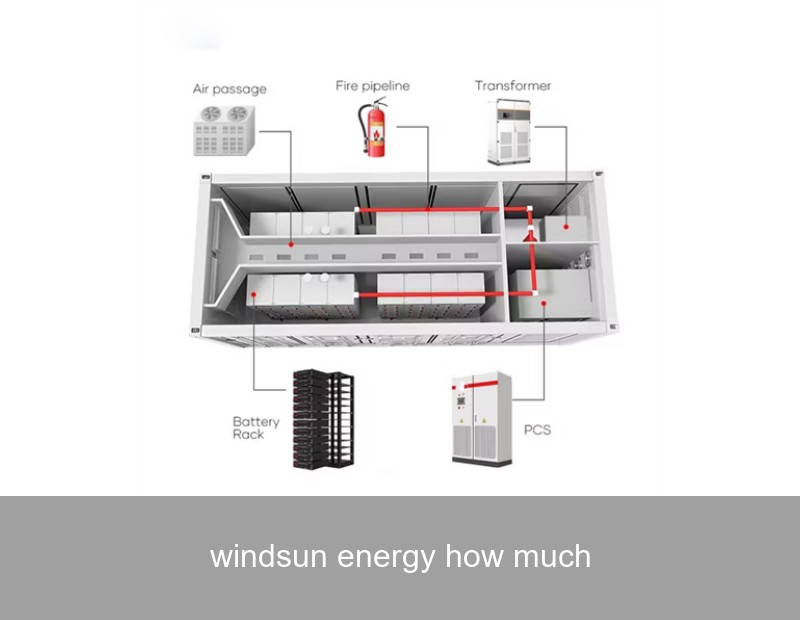
- Highjoule H2-Stack BESS: Our modular, containerized battery systems are designed for resilience and scalability. Using lithium iron phosphate (LFP) chemistry, they offer superior safety, long cycle life (over 6,000 cycles), and seamless integration with both new and existing renewable installations.
- Intelligent Energy Management System (EMS): The brain of the operation. Our AI-driven software forecasts generation and load, optimizes charge/discharge cycles for cost savings, and can participate in grid services (where available), creating an additional revenue stream.
- End-to-End Project Support: From initial site assessment and feasibility modeling—where we precisely answer "how much energy for YOUR location?"—to system design, installation support, and long-term monitoring.
For a utility-scale microgrid project in California, Highjoule's technology integrated a 2 MW solar PV field with several small wind turbines. Our EMS continuously balances the variable inputs, manages a 4 MWh BESS, and ensures stable power for a remote research facility, demonstrating the system-level thinking required for modern renewable integration.

Image: Advanced battery storage systems are key to unlocking windsun potential. Source: Unsplash (Credit: ThisisEngineering)
Your Next Step: From Question to Clarity
The question "windsun energy, how much?" is the perfect starting point. It leads to a more profound exploration of your energy profile, goals, and local conditions. The ultimate answer is not a single number but a tailored strategy that combines generation, storage, and intelligence.
So, what is the first, most critical data point you need to begin answering this question for your own home or business? Is it your site's specific solar and wind resource assessment, or a detailed analysis of your hourly energy consumption patterns over the past year?
 Inquiry
 Online Chat