


How Much Pure Light Power Can Your Solar Panels Really Generate?
You've looked at your electricity bill, seen the sun shining on your roof, and asked the golden question: "How much pure light power can I actually harness?" It's a smart question. While solar panels are a fantastic investment, understanding their real-world energy yield is key to maximizing your return and achieving true energy independence. This isn't just about the wattage on the spec sheet; it's about how much consistent, usable power you get day after day, year after year. Let's break down the factors that turn sunlight into savings and explore how pairing your system with the right technology, like intelligent storage from Highjoule, unlocks the full potential of every sunbeam.
Table of Contents
- The Promise vs. The Reality: It's More Than Just Peak Sun
- Key Factors That Determine Your Solar Power Output
- Real Numbers: A Case Study from California
- Beyond Generation: The Critical Role of Energy Storage
- The Highjoule Solution: Intelligent Storage for Pure Light Power
- Practical Steps to Maximize Your Solar Yield
The Promise vs. The Reality: It's More Than Just Peak Sun
Most homeowners know the basics: solar panels convert sunlight into electricity. A typical residential solar panel might be rated at 400 watts. In ideal laboratory conditions—known as Standard Test Conditions (STC)—that panel would produce 400 watts of pure light power when hit with perfect, intense light. But your roof isn't a lab. The real-world output is a dance between the sun's generosity and your local environment's constraints. The gap between theoretical "nameplate" capacity and actual generation is where your energy and financial outcomes are truly decided.
Key Factors That Determine Your Solar Power Output
To accurately estimate "how much," you need to consider this interconnected web of variables:
- Geographic Location & Solar Insolation: This is your solar budget. A home in Phoenix, Arizona, receives significantly more annual sunlight than one in London, UK. Tools like the NREL PVWatts Calculator use historical weather data to estimate production for your exact address.
- Roof Orientation and Tilt: In the Northern Hemisphere, south-facing roofs capture the most energy. East and west-facing setups produce about 15-20% less. The optimal tilt angle matches your latitude.
- Shading: Even partial shading from a chimney, tree, or vent pipe can disproportionately reduce the output of an entire panel string, a problem modern optimizers can mitigate.
- Panel Efficiency & Degradation: High-efficiency panels (22%+) generate more power in the same space. Remember, all panels degrade slightly each year (typically 0.5-0.8%), meaning output slowly decreases over their 25+ year lifespan.
- Temperature: Ironically, solar panels prefer cooler weather. Their efficiency drops as they get hotter—a factor crucial in hot climates.
- System Health & Maintenance: Dust, pollen, and debris can create a thin film that reduces light absorption. Regular checks ensure your system operates at peak performance.
Estimating Your Output: A Simple Formula
You can get a rough estimate with this formula:
Daily Energy (kWh) = System Size (kW) × Peak Sun Hours × System Efficiency (0.75-0.85)
"Peak Sun Hours" is not daylight hours; it's the equivalent number of hours per day when sunlight intensity averages 1,000 W/m². For example, Southern California has about 5.5 peak sun hours, while Germany averages around 2.5.
Real Numbers: A Case Study from California
Let's move from theory to a documented real-world scenario. Consider a residential project in Sacramento, California, with a 7.2 kW DC system (18 x 400W panels).
| Factor | Detail | Impact on Output |
|---|---|---|
| Location | Sacramento, CA | ~5.2 avg. daily peak sun hours |
| Roof | South-facing, 20-degree tilt | Near-ideal orientation |
| Shading | Minimal (professional site audit) | Negligible losses |
| System Size | 7.2 kW | Nameplate capacity |
The Calculation & Reality: Using the formula: 7.2 kW × 5.2 hours × 0.82 (efficiency factor) = ~30.7 kWh per average day. Annualizing this (30.7 kWh/day * 365) gives an estimated 11,200 kWh per year. Actual monitored first-year production for this system was 10,940 kWh—a remarkable 97.7% alignment with the estimate, showcasing the value of professional design. This output covers a significant portion of a typical home's usage, but what happens to the surplus power generated at midday?

Image: Monitoring real-time production is key to understanding your system's performance.
Beyond Generation: The Critical Role of Energy Storage
This case study reveals the next-layer question: "I'm generating this pure light power, but am I using it optimally?" Often, the answer is no. Without storage, excess midday solar energy is exported to the grid, often at a low feed-in tariff, only for homeowners to buy back expensive power in the evening when the sun is down. This is where the equation for value shifts dramatically. The true metric becomes self-consumption—the percentage of your solar energy you use directly. Increasing self-consumption from, say, 30% to 80% is the single biggest lever for maximizing savings and resilience.
The Highjoule Solution: Intelligent Storage for Pure Light Power
This is precisely where Highjoule's expertise transforms your solar investment. As a global leader in advanced energy storage since 2005, we don't just provide batteries; we provide intelligent systems that ensure every kilowatt-hour of your precious solar generation is used on your terms.
Our HES (Highjoule Energy Stack) for residential and commercial applications is designed with this core principle. It's more than a battery; it's an integrated energy management platform. The HES features:
- Advanced Lithium Iron Phosphate (LFP) Chemistry: Renowned for safety, longevity (10,000+ cycles), and stable performance, ensuring your storage backbone lasts for decades.
- AI-Powered Energy Management Software: Our system learns your consumption patterns, weather forecasts, and utility rate schedules (like time-of-use tariffs common in California and Europe) to autonomously decide when to store solar energy, power your home, or export to the grid for maximum financial return.
- Scalable & Modular Design: Start with what you need and expand capacity seamlessly as your energy needs grow, protecting your initial investment.
- Grid Services & Backup Power: In the event of an outage, the HES can automatically disconnect and keep your critical loads running, turning your solar array into a personal microgrid.
For our Sacramento case study, adding a 10 kWh Highjoule HES could increase the home's direct solar consumption from ~35% to over 80%, effectively shielding the homeowner from peak evening rates and providing peace-of-mind backup power. For commercial and industrial clients, our C&I ESS solutions deliver the same intelligent management at scale, enabling demand charge reduction and participation in grid-balancing programs.

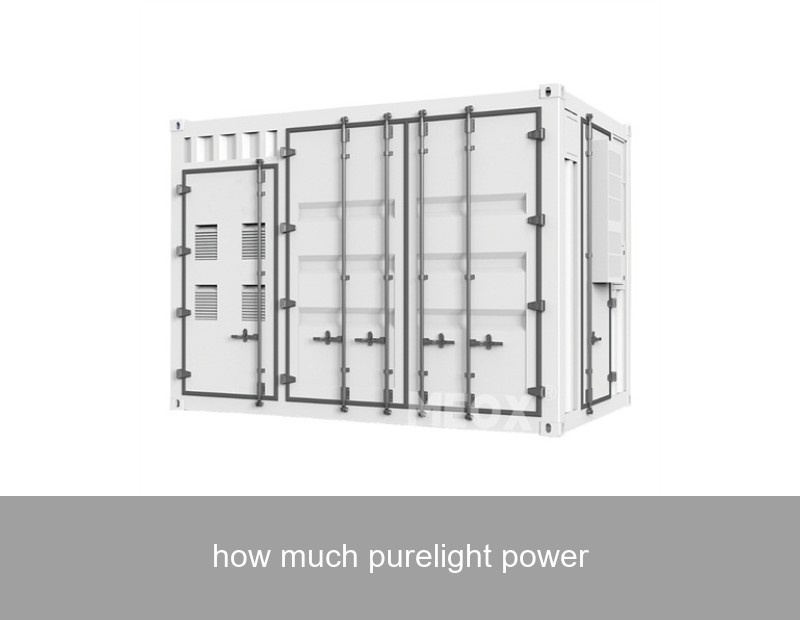
Image: A modern, sleek home battery system like the Highjoule HES integrates seamlessly into a home.
Practical Steps to Maximize Your Solar Yield
So, what can you do today to answer "how much pure light power" for your property?
- Get a Professional Audit: Use a certified installer who uses tools like drone-based shading analysis and detailed modeling software.
- Think Generation + Storage from Day One: Even if you phase the purchase, design your solar system with future storage integration in mind. This ensures compatibility and optimal wiring.
- Demand Smart Management: Look for systems that offer detailed monitoring and intelligent control, not just basic battery functionality. This is where the long-term value is created.
- Consider Your Entire Energy Ecosystem: Pair your solar and storage with efficient appliances, and if applicable, EV charging. An intelligent system like Highjoule's can coordinate all these loads for ultimate efficiency.
According to the U.S. Department of Energy, the levelized cost of solar has dropped dramatically, but the next frontier of savings lies in smart integration and storage.
The Final, Most Important Question
We've explored the factors that determine solar generation and how storage unlocks its true value. Now, we turn the question to you: What specific energy goal—be it slashing your utility bill, achieving near-total energy independence, or ensuring backup power for your business—is driving your interest in capturing every bit of pure light power you can? Defining that goal is the first step in designing a system that truly delivers.
 Inquiry
 Online Chat