


How Much Does Sigenergy Cost in China, and What Are the Global Alternatives?
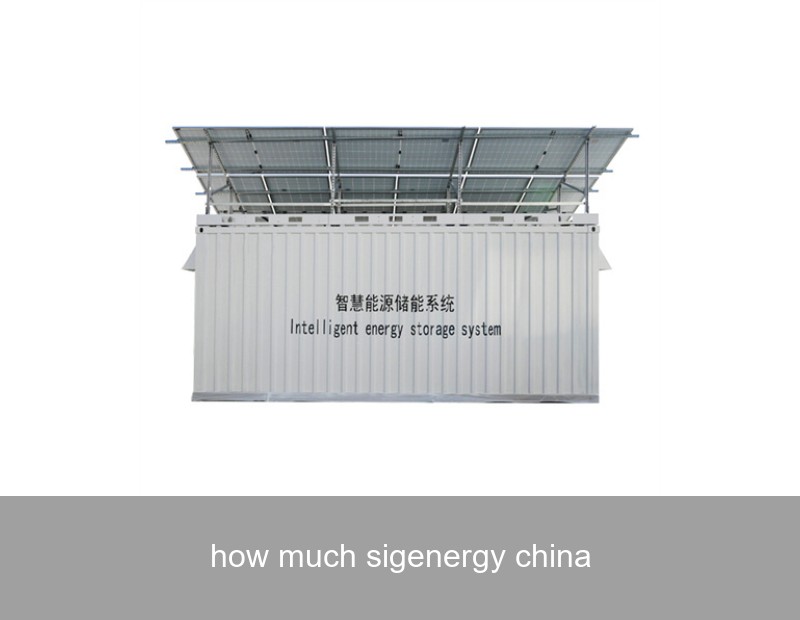
If you're researching energy storage solutions, you've likely come across the name Sigenergy. As a rising player from China, their innovative "S3" all-in-one system has sparked considerable interest. Naturally, one of the first questions that comes to mind is: how much does Sigenergy cost in China? While precise pricing fluctuates with components, installation, and local subsidies, understanding the cost landscape is crucial. More importantly, it opens a broader conversation: what are the key factors in choosing a resilient, high-performance energy storage system (ESS) for your home or business, whether you're in Europe, the US, or elsewhere? Let's dive in.
Table of Contents
The Price Puzzle: Sigenergy in Context
Direct, publicly listed prices for complete, installed Sigenergy systems are rare. In the Chinese market, prices are often quoted per kilowatt-hour (kWh) of battery capacity and can vary widely. As of early 2024, estimates for integrated systems like the Sigenergy S3 can range from $400 to $700 per kWh for the equipment in China, before installation and supporting hardware like additional solar panels. This positions it competitively within the premium segment of the Chinese market.
However, for international customers in Europe or the US, the "landed cost" changes significantly. You must factor in:
- International Shipping & Logistics: Transporting heavy, lithium-ion batteries across oceans adds cost and complexity.
- Import Duties & Compliance: Tariffs and regulations, such as the EU's Battery Directive or US standards, can impact final price.
- Local Certification: Systems must meet strict regional safety and grid codes (like UL 9540 in the US, VDE-AR-E 2510-50 in Germany), which may require modifications.
- Installation & Support Network: A local, certified installer is essential for warranty, safety, and performance. The availability of such a network for an imported brand is a critical consideration.
So, while the initial Chinese equipment price is a data point, the total project cost and long-term value depend on a robust local ecosystem.
Beyond Sticker Price: The Real Cost of Ownership
Focusing solely on upfront cost is a common pitfall. A smart energy investment is evaluated over its 10-15 year lifespan through the lens of Total Cost of Ownership (TCO). Here’s what truly matters:
1. System Efficiency & Energy Yield
Efficiency determines how much of your stored energy you can actually use. A system with 90% round-trip efficiency loses only 10% of the power you put into it. A less efficient system silently increases your effective cost per usable kWh every single day.
2. Battery Degradation & Warranty
Lithium-ion batteries degrade over time. A key metric is the warranty-backed end-of-warranty capacity retention. A promise of 70% capacity after 10 years is very different from 80% after 15 years. This directly impacts your long-term energy assets.
| Factor | Cheaper System Risk | Quality System Advantage |
|---|---|---|
| Cycle Life | May use lower-grade cells, degrading faster | Uses automotive-grade LiFePO4 cells for longer life |
| Thermal Management | Passive cooling, leading to faster degradation in heat/cold | Active liquid or climate-controlled cooling for stable performance |
| Warranty | Basic, shorter-term, or pro-rated | Comprehensive, long-term, often with performance guarantee |
3. Intelligence & Software
Can your system autonomously optimize for time-of-use rates, participate in grid services, or manage multiple power sources? Intelligent software, like Highjoule's AegisAI™ platform, turns a battery into a revenue-generating or cost-avoiding asset. Without smart management, you're leaving money on the table.

Image: A modern industrial facility utilizing solar and storage for energy resilience. Source: Unsplash
Case Study: European Industrial Energy Flexibility
Let's look at a real-world application. A mid-sized food processing plant in Northern Germany faced high peak demand charges and volatile energy prices. Their goal: reduce operational costs and ensure backup power for critical refrigeration.
- Challenge: Annual electricity bill of €580,000, with nearly 30% attributed to peak demand charges.
- Solution: Installation of a 500 kWh / 750 kW containerized battery energy storage system (BESS), integrated with existing rooftop solar.
- Smart Operation: The system was programmed to "peak shave" – discharging during the plant's highest consumption periods to flatten the load. It also charged from the grid during low-price, high-renewable periods.
- Result: A 22% reduction in annual electricity costs, saving over €125,000 per year. The system also provides seamless backup power, protecting against spoilage during grid outages. The investment payback period is calculated at under 5 years, not including the value of enhanced resilience.
This case, inspired by real IRENA innovation landscape reports, highlights that the value of storage isn't in its price tag, but in its intelligent application within local market structures.
Highjoule: Your Global Partner in Advanced Storage
This is where Highjoule's nearly two decades of experience come into focus. Founded in 2005, we design and manufacture advanced storage solutions not just as hardware, but as integrated, intelligent energy assets for global markets.
Our Technology Edge
Highjoule systems are engineered for performance and longevity:
- High-Density LiFePO4 Batteries: We utilize non-toxic, long-life Lithium Iron Phosphate chemistry, renowned for its safety and cycle life, exceeding 8,000 cycles in our commercial systems.
- Adaptive Thermal Core™: Our proprietary active cooling system maintains the battery at its ideal temperature year-round, maximizing lifespan and performance in diverse climates from Arizona to Scandinavia.
- AegisAI™ Energy Management System: This cloud-connected platform continuously learns your energy patterns and optimizes system operation for economic return, grid services participation, and self-consumption of solar.
Tailored Solutions for Every Need
We understand that a one-size-fits-all approach doesn't work. That's why we offer a scalable portfolio:
- Residential (H-Series): Sleek, modular systems from 5 kWh to 30 kWh, designed for seamless integration with home solar and smart panels, giving homeowners independence and control.
- Commercial & Industrial (C/I-Series): Scalable rack and container solutions from 50 kWh to multi-MWh. These are the workhorses for peak shaving, demand charge management, and backup power for businesses, factories, and farms.
- Microgrid & Utility (M-Series): Large-scale, grid-forming storage systems that enable renewable integration, enhance grid stability, and power off-grid communities.
Our deep understanding of European and North American regulations, grid codes, and incentive programs (like the EU's energy storage framework or the US Investment Tax Credit) ensures a smooth, compliant, and optimized deployment.

Image: A modern home equipped with solar panels and a wall-mounted battery storage system. Source: Unsplash
Choosing Your Energy Future
So, while asking "how much does Sigenergy cost in China?" is a logical starting point, the more powerful questions are: What is the total value of an energy storage system over its lifetime? Does my provider have a proven track record and local support in my region? Can the system intelligently adapt to my specific needs and the evolving energy market?
At Highjoule, we believe your energy storage should be a resilient, profitable, and sustainable investment for decades. We invite you to move beyond a simple price comparison. What specific energy challenge—be it soaring bills, unreliable power, or a sustainability goal—are you looking to solve today? Let's discuss how a smart, Highjoule storage solution can be tailored to meet that challenge head-on.
 Inquiry
 Online Chat