


How Much Power Can a 28W Solar Panel Really Generate? A Practical Guide
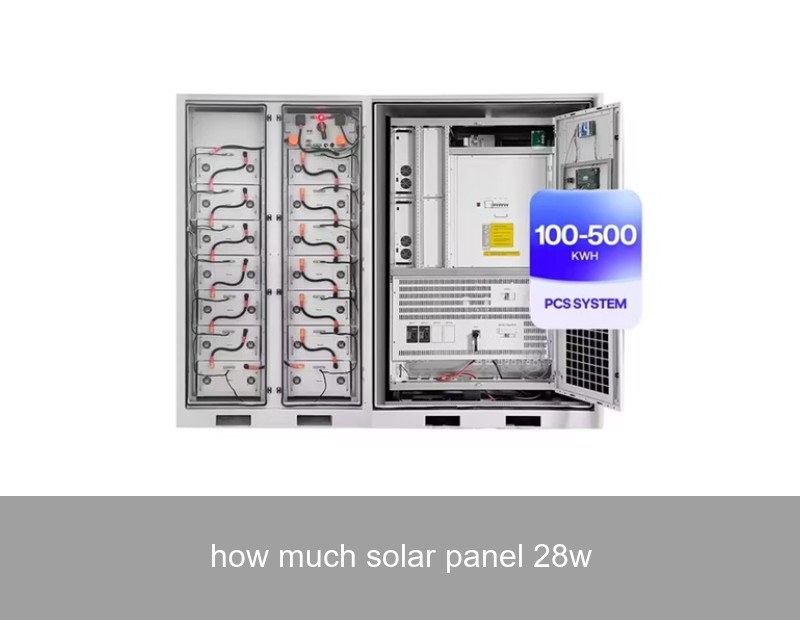
You're considering a small solar solution, perhaps for a shed, a boat, a camping setup, or to power a specific gadget. You've seen compact panels labeled "28W" and are rightly asking: how much solar panel 28w power can it actually deliver for my needs? The wattage on the label is just the beginning. The real-world energy harvest depends on a dance between sunlight, environment, and technology. As a leader in smart energy storage, Highjoule understands that every watt counts, whether you're powering a single device or an entire home. Let's demystify the potential of a 28W panel and explore how it fits into a broader, smarter energy ecosystem.
Table of Contents
- The 28W Promise vs. Reality
- Key Factors That Dictate Your 28W Panel's Output
- Real-World Math: From Watts to Watt-Hours
- Practical Applications: What Can a 28W Solar Panel Run?
- Beyond the Panel: The Critical Role of Energy Storage
- Case Study: Off-Grid Monitoring in the Scottish Highlands
- Future-Proofing Your Small-Scale Solar Investment
The 28W Promise vs. Reality
A 28W (watt) solar panel is designed to produce 28 watts of electrical power under Standard Test Conditions (STC). These lab conditions—full sun at a specific angle and temperature—are like a perfect, never-changing summer day. Think of it as the panel's peak performance score. But here's the catch: your backyard, rooftop, or campsite is not a lab. The actual, usable power you get is almost always less. This gap between "nameplate rating" and "real-world yield" is the first thing every savvy energy user learns. It's not about the panel being faulty; it's about the dynamic nature of our planet's solar resource.
Key Factors That Dictate Your 28W Panel's Output
To understand how much solar panel 28w energy you'll collect, you must consider four key players:
- Sunlight Intensity (Irradiance): This is the big one. A cloudy day in London delivers far less energy than a clear day in Arizona. The panel's output drops nearly linearly with sunlight intensity.
- Panel Orientation and Tilt: The angle matters immensely. A panel lying flat will capture less energy than one angled directly toward the sun. For fixed installations, the tilt is often set roughly equal to the location's latitude for optimal yearly production.
- Temperature: Solar panels are unique—they dislike extreme heat. As panel temperature rises above 25°C (77°F), their efficiency and voltage output drop. A hot, sunny day can see a 10-15% power reduction just from heat.
- Cleanliness and Shading: Even a small shadow from a branch or a layer of dust can dramatically reduce the output of a panel, as it can block entire cell strings.

Image: A small solar panel in a residential setting. Source: Unsplash
Real-World Math: From Watts to Watt-Hours
Watts measure power at an instant. Energy is what you use over time, measured in watt-hours (Wh). This is the crucial calculation. Let's estimate the daily energy a 28W panel can generate in a reasonably sunny European or US location.
Formula: Panel Wattage × Peak Sun Hours × System Efficiency = Daily Watt-Hours
- Panel Wattage: 28W
- Peak Sun Hours: This isn't daylight hours. It's the equivalent number of hours of full sun. In Southern Europe (e.g., Spain), it might be 4.5-5.5. In Northern Europe (e.g., Germany) or the Northern US, it could be 3-4. Let's use a conservative 4 hours for our example.
- System Efficiency: Losses from heat, wiring, and the charge controller. A good estimate is 75% (or 0.75).
Calculation: 28W × 4 hours × 0.75 = 84 Wh per day.
So, under these conditions, you can expect roughly 84 watt-hours of energy daily. That's your energy budget.
Practical Applications: What Can a 28W Solar Panel Run?
Now, what does 84 Wh buy you? Here’s a practical table to visualize its capability:
| Device | Typical Power Draw | Estimated Daily Run Time on 84 Wh |
|---|---|---|
| LED String Lights | 5W | ~16 hours |
| Smartphone Charger | 10W | 8-10 full charges |
| 12V RV/Car Fan | 20W | ~4 hours |
| Wi-Fi Router | 15W | ~5.5 hours |
| Small Water Pump | 25W | ~3.3 hours |
It's perfect for trickle-charging batteries, powering low-energy sensors, or running small, intermittent loads. However, it cannot run energy-hungry appliances like kettles (1500W), microwaves (1000W), or standard refrigerators (100-200W continuously).
Beyond the Panel: The Critical Role of Energy Storage
The sun doesn't shine at night, but you might need power then. This is where the true magic of modern solar systems happens: energy storage. A 28W panel is often paired with a battery to store the 84 Wh generated during the day for use anytime. This transforms a daytime trickle into a reliable power source.
This is precisely where Highjoule's expertise becomes invaluable. While we are renowned for our large-scale commercial and residential Battery Energy Storage Systems (BESS), the core principles of efficiency, safety, and smart management scale down. The technology in our flagship Highjoule H3 Home Energy Hub—like advanced lithium-ion chemistry, sophisticated Battery Management Systems (BMS), and AI-driven energy optimization—is born from the same R&D that makes small-scale off-grid systems reliable. Pairing your panel with a quality battery and an efficient charge controller is what unlocks full, 24/7 utility from every single watt your panel produces.
Case Study: Off-Grid Monitoring in the Scottish Highlands
Let's look at a real-world application. A conservation charity in the Scottish Highlands needed to power a remote wildlife monitoring station. The setup included a 28W solar panel, a 12V 100Ah deep-cycle battery (1200Wh capacity), and a charge controller, powering a cellular trail camera and environmental sensors drawing an average of 8W.
- Location: Scottish Highlands (approx. 2.5 peak sun hours in winter, 5 in summer).
- Daily Winter Energy Generation (Est.): 28W × 2.5h × 0.75 = ~52 Wh.
- Daily Device Consumption: 8W × 24h = 192 Wh.
The math shows a deficit in winter. However, the large battery bank acts as a "energy savings account." The system fully charges the battery during sunny summer days, building a reserve that is drawn down during consecutive cloudy winter days. The intelligent charge controller prevents over-discharge, protecting the battery. This setup, monitored remotely, has operated for over two years without maintenance, providing critical data. It's a perfect micro-example of how much solar panel 28w can achieve when integrated into a correctly sized and managed system. Scaling this principle up is what Highjoule does for homes and businesses globally.

Image: Utility-scale solar farm. Source: Unsplash
Future-Proofing Your Small-Scale Solar Investment
Starting with a 28W panel is a fantastic entry into solar. But what if your needs grow? The modular nature of solar is its strength. You can add more panels in parallel to increase your daily watt-hour budget. The critical component then becomes your storage and management system. Investing in a scalable, smart battery system from the outset can save cost and complexity later.
For instance, a homeowner might start with a small panel for a garden office, then expand to a full rooftop array. Integrating that new solar capacity with an existing Highjoule storage system is seamless. Our systems are designed with this flexibility in mind, allowing customers to start their energy independence journey and expand it confidently, backed by industry-leading expertise and safety standards.
So, while the question "how much solar panel 28w" yields a specific energy number, the more profound question is: How will you store, manage, and utilize that energy to create true resilience and independence for your specific application?
 Inquiry
 Online Chat