


Hybrid Energy Storage Cabinet 4 MW: The Cornerstone of Modern Grid Stability
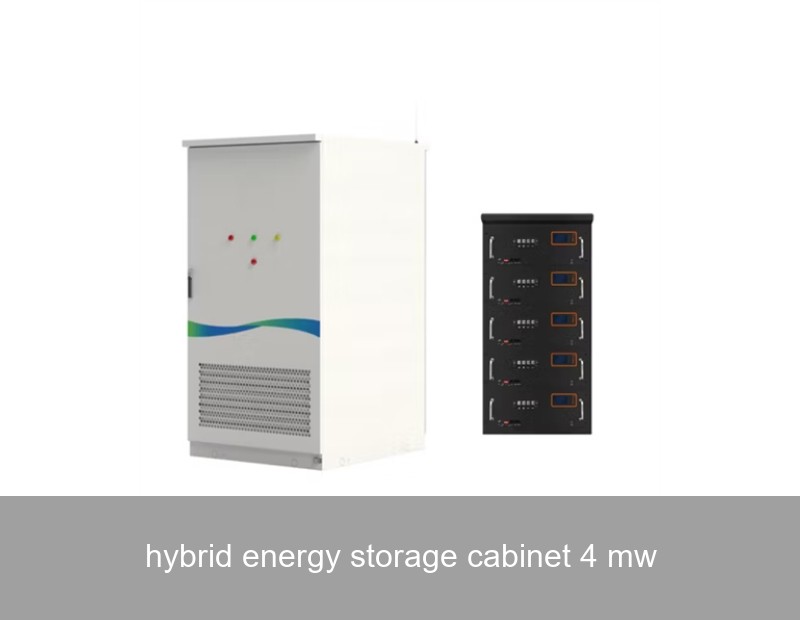
Imagine a power grid strained by the intermittent nature of renewable energy. One moment, solar panels are flooding the lines with excess power; the next, a cloud passes, and the supply dips. This volatility isn't just a technical headache—it's a multi-billion dollar challenge for grid operators and large-scale energy consumers. The solution? Hybrid energy storage cabinet 4 MW systems. These powerful, integrated units are rapidly becoming the essential buffer, merging different storage technologies to deliver unprecedented reliability and efficiency. For commercial, industrial, and utility-scale applications, a 4 MW hybrid cabinet isn't just equipment; it's a strategic asset for energy independence and financial resilience.
Table of Contents
- The Grid Challenge: Why Intermittency Demands a New Solution
- What is a 4 MW Hybrid Energy Storage Cabinet?
- Technology Breakdown: The Best of Both Worlds in One Cabinet
- Real-World Impact: A Case Study from California
- The Highjoule Approach: Engineering for Simplicity and Performance
- The Future Outlook: Where Does Hybrid Storage Go Next?
The Grid Challenge: Why Intermittency Demands a New Solution
Renewables are the undisputed champions of clean energy. However, their variability creates a phenomenon grid engineers call "ramping." When the sun sets or the wind stops, traditional power plants (like natural gas "peakers") must ramp up generation incredibly quickly to fill the gap. This is costly, inefficient, and carbon-intensive. According to a 2023 report by the National Renewable Energy Laboratory (NREL), high penetrations of solar can create a steep "duck curve," requiring massive, flexible resources to maintain balance. The data is clear: as renewables grow, so does the need for fast-responding, high-power stabilization.
This is the precise problem a hybrid energy storage cabinet 4 MW system is designed to solve. Think of it as the ultimate shock absorber for the electrical grid, but one that also captures wasted energy and puts it to profitable use.
What is a 4 MW Hybrid Energy Storage Cabinet?
At its core, a hybrid energy storage system combines two or more storage technologies within a single, coordinated platform. A 4 MW hybrid cabinet refers to a containerized or cabinet-based system with a power rating of 4 megawatts (MW). The "hybrid" aspect typically pairs high-energy density battery storage (like lithium-ion) with high-power, rapid-cycling technology (often supercapacitors or advanced flywheels).
Here’s the simple analogy: Lithium-ion batteries are like a marathon runner—great for storing large amounts of energy over longer periods. Supercapacitors are like a sprinter—exceptional at delivering massive bursts of power in milliseconds. A hybrid cabinet intelligently deploys the sprinter for sudden grid spikes and the marathon runner for sustained discharge, optimizing the lifespan and performance of both.

Modern, cabinet-based storage solutions are engineered for dense power delivery and easy integration.
Technology Breakdown: The Best of Both Worlds in One Cabinet
Let's look under the hood of a typical 4 MW system. It's far more than just batteries in a box.
| Component | Primary Technology | Role in the 4 MW Hybrid System | Key Benefit |
|---|---|---|---|
| Energy Core | Lithium-Ion (LFP) Battery | Provides the bulk energy storage (e.g., 4-8 MWh capacity). Handles load shifting, backup power, and longer-duration grid services. | High energy density, proven technology, cost-effective for multi-hour storage. |
| Power Core | Supercapacitor Bank | Provides instantaneous power (MW-level) for frequency regulation, voltage support, and absorbing/releasing power in sub-second intervals. | Ultra-fast response, virtually unlimited cycle life, protects batteries from stressful high-power cycles. |
| Brain | Advanced Power Conversion System (PCS) & Energy Management System (EMS) | The intelligent controller. It decides in milliseconds whether to pull from the battery, the supercapacitor, or both to meet grid or site demands. | Maximizes efficiency, extends asset life, and enables seamless integration with renewables and the grid. |
This synergy is what sets a hybrid system apart. By letting each technology do what it does best, the system achieves higher overall efficiency, significantly longer lifespan (by reducing stress on the batteries), and a lower total cost of ownership over 15+ years.
Real-World Impact: A Case Study from California
Data and theory are compelling, but nothing beats a real-world example. Consider the challenge faced by a large data center operator in Silicon Valley, California. Their facility required absolute power quality to prevent million-dollar downtime events. They also faced exorbitant demand charges from the utility and wanted to participate in the state's lucrative frequency regulation market.
The Solution: The operator deployed a 4 MW / 6 MWh hybrid energy storage system, featuring a cabinet-based design for modularity. The system was directly integrated with their on-site solar PV array.
The Results (12-Month Period):
- Demand Charge Reduction: Sliced peak grid demand by 18%, saving over $450,000 annually.
- Grid Services Revenue: Generated approximately $300,000 by providing fast-frequency response to the California Independent System Operator (CAISO).
- Backup Reliability: Provided seamless transition during two minor grid disturbances, preventing potential IT load interruptions.
- Solar Optimization: Increased on-site consumption of solar generation from 65% to over 90%, maximizing their renewable investment.
This case demonstrates the multi-revenue, multi-benefit nature of a modern hybrid energy storage cabinet 4 MW system. It's not a single-tool solution; it's an integrated energy asset.
The Highjoule Approach: Engineering for Simplicity and Performance
At Highjoule, with nearly two decades of experience since 2005, we've seen the evolution of storage from a novel concept to a grid-critical technology. Our H-Series Hybrid Storage Cabinet is engineered specifically for the 2 MW to 10 MW scale, with the 4 MW configuration being a workhorse for commercial and industrial applications.
What makes the Highjoule solution different?
- Pre-Integrated Design: Our 4 MW cabinet arrives as a fully tested, plug-and-play unit. It integrates our proprietary LFP battery modules, supercapacitor array, and the Highjoule GridSynergy™ EMS in a single, footprint-optimized enclosure. This drastically reduces installation complexity and time-to-operation.
- Adaptive Hybrid Logic: Our EMS doesn't just follow pre-set rules. It uses machine learning to adapt to your specific load patterns, weather forecasts, and market signals, constantly optimizing for cost or revenue.
- Focus on Safety & Serviceability: The cabinet is designed with multi-layer safety systems (thermal propagation prevention, gas detection, and fire suppression). More importantly, it's built for easy service, with front-access modules that minimize maintenance downtime.
For a microgrid project in Southern Europe or an industrial plant in the U.S. Midwest, the Highjoule cabinet provides a standardized, yet highly customizable, building block for energy resilience.

Solar farms paired with hybrid storage cabinets can deliver firm, dispatchable renewable power.
The Financial Logic: More Than Just Backup Power
Viewing a 4 MW hybrid energy storage cabinet solely as a cost is a critical mistake. The modern perspective is to see it as a revenue-generating or cost-avoidance asset. Here’s how the financial model typically stacks up:
- Capital Expenditure (CapEx): The upfront cost of the system and installation.
- Operational Revenue/Cost Savings (OpEx):
- Demand Charge Management (often the fastest payback)
- Energy Arbitrage (buying cheap/store, using/selling when expensive)
- Grid Service Payments (frequency regulation, capacity markets)
- Renewable Firming & Time-Shift (increasing the value of solar/wind)
- Backup Power (avoiding cost of downtime)
With the right market access and intelligent software—like the Highjoule GridSynergy™ platform—a 4 MW system can achieve a compelling return on investment (ROI) in 3-7 years in many European and U.S. markets, while providing decades of service.
The Future Outlook: Where Does Hybrid Storage Go Next?
The trajectory is towards even greater intelligence and diversification. We're beginning to see trials with hybrid systems that incorporate multiple battery chemistries (e.g., LFP for cycling, sodium-ion for bulk storage) alongside power-dense components. The role of artificial intelligence in predicting grid needs and optimizing dispatch will become standard. Furthermore, as electric vehicle fleets expand, hybrid energy storage cabinet 4 MW systems will be pivotal in managing the charging load of depots, turning a potential grid burden into a flexible grid resource.
The question for any large energy consumer or generator is no longer if storage is needed, but what kind and how soon. A hybrid system offers a future-proof answer by delivering the flexibility needed for the grid of tomorrow, today.
Is your organization currently analyzing its site's load profile to identify the peak demand charges that a hybrid storage system could mitigate, and what is the single largest barrier you perceive in implementing such a solution?
 Inquiry
 Online Chat