


Understanding the Cost of a 700 kWh per Month Solar Kit for Off-Grid Living
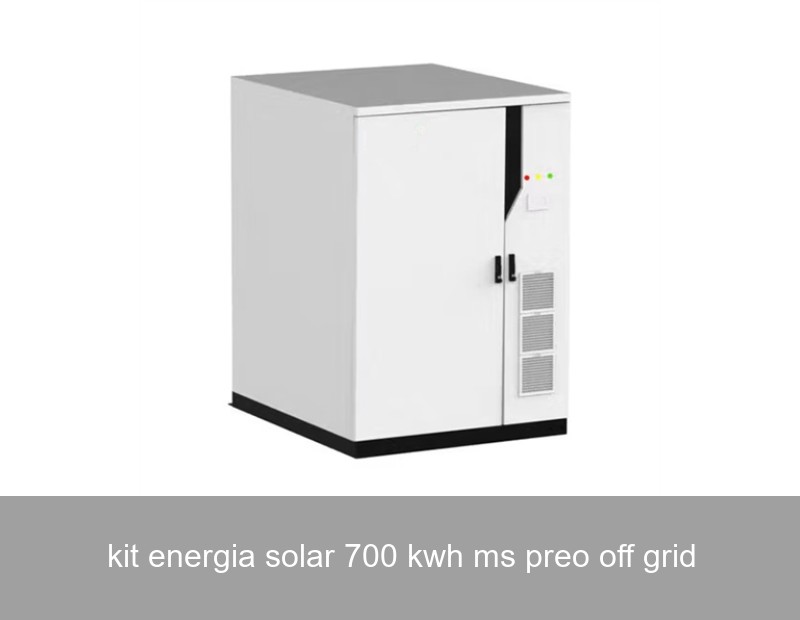
Dreaming of complete energy independence? For many homeowners and businesses across Europe and the US, the idea of an off-grid solar system capable of covering a substantial 700 kWh per month energy usage is the ultimate goal. But the big question always looms: what's the real price for such a robust off-grid setup? The answer isn't a simple number on a tag. It's a fascinating equation involving component quality, system intelligence, and long-term value. Let's demystify the factors that determine the investment for a true energy-independent lifestyle.
Table of Contents
- The Phenomenon: The Rising Demand for True Off-Grid Power
- Breaking Down the "Kit": More Than Just Panels and Batteries
- The Real Cost Factors: From Hardware to Intelligence
- A Real-World Case: A European Agri-Business Goes Off-Grid
- The Highjoule Approach: Sustainable, Intelligent Power Solutions
- Making Your Decision: Key Questions to Ask
The Phenomenon: The Rising Demand for True Off-Grid Power
Gone are the days when off-grid solar was just for remote cabins. Today, we see a surge in demand from diverse sectors: rural residences seeking resilience, agricultural operations needing reliable power for irrigation and cold storage, and even commercial facilities looking to insulate themselves from grid volatility and rising tariffs. The driver isn't just economics; it's a desire for control and sustainability. A system sized for 700 kWh per month (approximately 23-25 kWh per day) is a significant undertaking, designed for properties with substantial energy needs, from large family homes with electric vehicles to small-to-medium operational sites.
Breaking Down the "Kit": More Than Just Panels and Batteries
When we talk about a solar kit for this scale, we're discussing a fully integrated power plant. It's a symphony of components working in unison:
- Solar Photovoltaic (PV) Array: The fuel source. To generate 700+ kWh monthly, you typically need a 6-8 kWp system, depending on your location's solar irradiance (e.g., Southern Europe vs. Northern US).
- Battery Energy Storage System (BESS): Your energy bank. This is the cornerstone of off-grid living, storing excess solar for use at night and during cloudy periods. For 700 kWh/month consumption, a usable storage capacity of 20-40 kWh is often required to cover multiple days of autonomy.
- Inverter/Charger: The brain and muscle. This critical device converts DC from panels and batteries to AC for your appliances, and also manages the charging of the batteries from multiple sources.
- Balance of System (BoS): Mounting, wiring, switchgear, and most importantly, advanced energy management software that optimizes every kilowatt-hour.

Credit: Unsplash / American Public Power Association. A modern off-grid installation requires careful integration of panels and storage.
The Real Cost Factors: From Hardware to Intelligence
The price of your off-grid system is a sum of its parts, but not all parts are created equal. Let's examine the pillars of cost.
Solar Array & Power Conversion
High-efficiency monocrystalline panels will yield more energy in a smaller space, which can be crucial. The inverter technology is even more pivotal. A basic inverter will convert power, but a sophisticated multi-mode inverter with grid-forming capability can seamlessly manage your microgrid, prioritize loads, and integrate backup generators if needed.
The Heart of Off-Grid: Energy Storage (BESS)
This is where the largest variance in cost and performance lies. The choice of battery chemistry—primarily Lithium Iron Phosphate (LFP) vs. older lead-acid—defines your system's lifespan, depth of discharge, and safety.
| Battery Factor | Impact on Cost & Performance |
|---|---|
| Chemistry (LFP) | Higher upfront cost, but 3-4x longer cycle life (6000+ cycles), nearly 100% depth of discharge, and superior safety. Lower total cost of ownership. |
| Usable Capacity | For 700 kWh/month, plan for 2-3 days of autonomy. A 30 kWh usable battery is a common benchmark. |
| System Scalability | Can you easily add more battery modules later? Modular design future-proofs your investment. |
Balance of System & Intelligence
This is the unsung hero. A well-designed system with smart monitoring and predictive energy management can boost overall efficiency by 15-25%. It learns your consumption patterns, weather forecasts, and optimizes charging/discharging to extend battery life and ensure reliability. Skimping here can lead to inefficiency and premature component failure.
A Real-World Case: A European Agri-Business Goes Off-Grid
Consider the case of "Vineyard Valle Verde" (a pseudonym for a real client) in rural Spain. Their monthly consumption averaged 720 kWh, powering irrigation systems, cooling for a small winery, and residential needs. Unstable grid power threatened their operations.
Their solution was a tailored off-grid system featuring a 9 kWp solar array paired with a 40 kWh LFP battery storage system. The key was an advanced inverter with dual MPPT trackers and intelligent load management. The system was designed to prioritize the cooling facility during peak heat, ensuring product quality was never compromised.
The Outcome: After 18 months of operation, the vineyard achieved 99.8% energy self-sufficiency. They calculated a simple payback period of under 7 years, factoring in avoided grid connection upgrade fees and annual tariff increases. More importantly, they secured their production against blackouts. You can explore similar transformative impacts of solar in agriculture through resources from the International Renewable Energy Agency (IRENA).
The Highjoule Approach: Sustainable, Intelligent Power Solutions
At Highjoule, with nearly two decades of experience since 2005, we understand that an off-grid system is a long-term partnership. Our products are engineered not just to meet a specification, but to deliver resilience and value over a 20+ year lifecycle.
For a 700 kWh per month off-grid application, we don't just sell a generic kit. We design a solution. Our HPS Series (Highjoule Power System) integrates ultra-high-efficiency bifacial solar modules, our proprietary HJ-ESS (Energy Storage System) with LFP chemistry, and the intelligent Neuron energy management platform. The Neuron platform acts as the central nervous system, providing real-time analytics, remote control, and adaptive algorithms that maximize self-consumption and protect your battery investment.

Credit: Unsplash / ThisisEngineering. Professional-grade BESS units, like those from Highjoule, are built for safety and long-term reliability.
This integrated approach ensures that every component communicates perfectly, eliminating compatibility issues that often plague pieced-together systems. For commercial and industrial clients, our Microgrid Controller can even integrate a backup generator, creating a truly hybrid, fail-safe power environment. We believe the true preço (price) is measured in levelized cost of energy (LCOE) over decades, not just initial outlay.
Making Your Decision: Key Questions to Ask
So, as you contemplate your journey to energy independence, move beyond asking "what's the price per watt?" Instead, consider these critical questions:
- Total Cost of Ownership: What will this system cost me over 15 years, including potential battery replacements?
- Scalability: Can I easily expand storage or solar if my needs grow?
- Software & Monitoring: Does the system offer granular insights and control over my energy flows?
- Warranty & Support: Does the provider offer a comprehensive, long-term warranty and accessible technical support in my region?
For authoritative, third-party information on system sizing and technology, the U.S. Department of Energy's Solar Guide is an excellent resource.
Given that your ideal off-grid system is a deeply personal infrastructure project, what is the one operational risk—a spoiled harvest, a halted production line, a frozen home—that energy independence would most meaningfully eliminate for you?
 Inquiry
 Online Chat