


LiFePO Baterije: How Much Do They Really Cost, and What Determines Their Value?
If you're researching energy storage for your home, business, or off-grid project, you've undoubtedly come across LiFePO4 batteries. And your first question is likely the most practical one: "LiFePO baterije, how much?" It's a fair starting point, but the answer is more nuanced than a simple price tag. The initial purchase price is just one piece of the puzzle. To truly understand the cost, we need to dive into what makes LiFePO4 (Lithium Iron Phosphate) technology a standout choice and how factors like longevity, safety, and total system efficiency translate into long-term value. As a leader in advanced energy storage, Highjoule is here to demystify the costs and help you see the full picture of your investment.
What Are LiFePO4 Batteries? The Foundation of Modern Storage
LiFePO4 is a type of lithium-ion battery chemistry that uses iron phosphate (FePO4) as its cathode material. Since our founding in 2005, Highjoule has witnessed the evolution of battery tech, and LiFePO4 has emerged as a frontrunner for stationary storage. Why? Its chemical structure offers inherent stability. Unlike other lithium chemistries, it's far more resistant to thermal runaway, making it exceptionally safe for residential and commercial installations. This safety doesn't come at the expense of performance. These batteries offer a compelling blend of a long cycle life (often 6,000+ cycles to 80% depth of discharge), high efficiency, and excellent performance across a wide temperature range. When you ask "how much," you're investing in this robust package of benefits.
Key Factors Influencing LiFePO4 Battery Cost
The price of a LiFePO4 battery system isn't arbitrary. It's built from several critical components, each adding to the value and, consequently, the cost. Let's break down the main cost drivers:
- Capacity (kWh): This is the most obvious factor. A 5kWh battery for a home backup will cost less than a 100kWh unit for industrial load-shaving. Prices are often quoted per kWh, but this rate usually decreases with larger systems.
- Power Rating (kW): How much power the battery can deliver at once. A system designed to start heavy machinery needs a higher power rating than one just offsetting nightly base loads, affecting the inverter and battery cell design.
- Brand & Quality: Reputable manufacturers like Highjoule invest in premium-grade cells, rigorous testing, and sophisticated Battery Management Systems (BMS). This ensures safety, longevity, and performance, which justifies a higher initial cost over uncertified, generic alternatives.
- System Integration & Intelligence: Is it just a battery bank, or a smart energy system? Advanced systems with integrated energy management software, grid-forming capabilities, and seamless hybrid inverter compatibility offer greater value and control.
- Installation & Balance of System (BOS): This includes wiring, safety disconnects, mounting, and professional installation. A complex commercial installation will have higher BOS costs than a simple residential retrofit.
| Application | Typical Capacity Range | Estimated Total Cost Range* | Primary Cost Drivers |
|---|---|---|---|
| Residential Solar Self-Consumption | 5 - 15 kWh | $4,000 - $15,000 | Capacity, inverter compatibility, smart features |
| Commercial Peak Shaving | 50 - 200 kWh | $25,000 - $100,000+ | Scale, power rating, commercial-grade hardware, grid interconnection fees |
| Off-Grid / Microgrid | 20 - 500+ kWh | $15,000 - $250,000+ | Large capacity, redundancy, advanced system control, often includes generator integration |
*Costs are indicative and vary significantly by region, project specifics, and market conditions. Always request a detailed quote.
Breaking Down the Price: A Real-World Example from Bavaria
Let's move from theory to practice. Consider a common scenario in Southern Germany: A family-owned bakery in Bavaria wants to reduce its grid dependency and stabilize energy costs. They have a 30kW rooftop solar array but often export excess power at low rates in the afternoon and buy it back at high rates in the morning during baking hours.
They installed a Highjoule H-Stack Commercial 100kWh system. The total turnkey cost was approximately €45,000. This included the battery modules, a Highjoule bi-directional inverter, system controller, professional installation, and grid compliance certification.
The Result? The system now stores the midday solar surplus. It then powers the bakery's ovens and refrigeration during the expensive morning peak. According to data from the German Energy Agency (DENA), such commercial storage systems can achieve levelized cost of storage (LCOS) between €0.08 - €0.15 per kWh over their lifetime, often beating grid peak prices. For this bakery, the system reduced their grid peak demand by over 70% and is projected to pay for itself in under 7 years through savings and optimized self-consumption—and the LiFePO4 cells are warrantied for 10 years or 6,000 cycles.

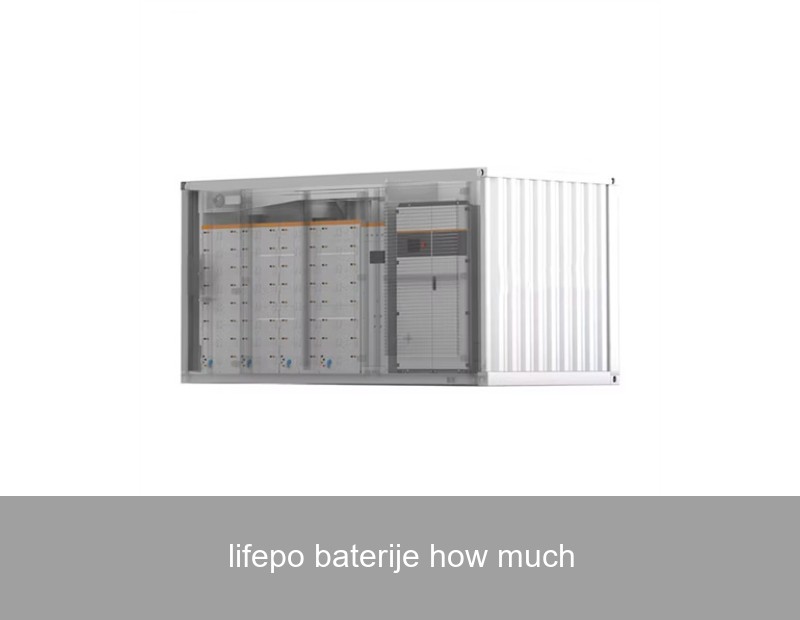
Image: A modern battery storage installation in a commercial/industrial setting, similar to Highjoule's deployments.
The Long-Term Value Proposition: It's About Cost-Per-Cycle
Asking "LiFePO baterije, how much?" is like asking "How much does a car cost?" A used economy car costs less than a new luxury SUV, but their long-term value differs vastly. The true metric for battery value is cost-per-cycle.
Imagine two batteries for your home:
- Option A (Cheaper, Lower Quality): Costs €4,000 but is only rated for 2,000 cycles before significant degradation. Option B (Highjoule Residential, Higher Quality): Costs €6,500 but is rated for 7,000 cycles.
Option A's cost per usable cycle is €2.00. Option B's is less than €0.93. Over a 20-year period, the higher-quality battery provides significantly more usable energy at a lower long-term cost, not to mention greater reliability. This is the core of Highjoule's design philosophy: building systems that deliver sustainable value over decades, not just low upfront cost.
Engineered for Value: Highjoule's Smart LiFePO4 Solutions
At Highjoule, we don't just sell batteries; we deliver integrated, intelligent power solutions. Our product lines are designed to address the very cost factors discussed, maximizing your return on investment.
For residential users, our HomePower Series features modular LiFePO4 batteries with scalable capacity from 5kWh to 30kWh. They come with our proprietary AI-driven energy management system, which learns your consumption patterns and automatically optimizes for self-consumption, time-of-use savings, or backup preparedness. You're paying for intelligence that squeezes every cent of value from your system.
For commercial and industrial (C&I) clients, the H-Stack Commercial system is a powerhouse. With capacities from 50kWh to multi-MWh configurations, it's engineered for demanding applications like peak shaving, demand charge reduction, and renewable integration. Its robust BMS and liquid cooling option ensure peak performance and longevity even in high-cycling, high-power environments, protecting your capital investment. According to a 2023 NREL report on storage costs, intelligent software and system integration are key drivers in reducing the overall lifecycle cost of storage projects, a principle central to our C&I designs.

Image: A modern home equipped with solar panels and a battery storage system, representing the residential market.
Making the Right Choice for Your Needs
So, how do you navigate the "how much" question? Start by defining your goals. Is it emergency backup for essential loads? Maximizing solar self-consumption? Reducing a commercial demand charge? Your goal dictates the required capacity, power, and intelligence.
Next, look beyond the sticker price. Examine the warranty (both years and cycle count), the depth of discharge rating, round-trip efficiency, and the reputation of the manufacturer. A reliable partner like Highjoule provides transparent specifications and lifetime cost projections.
Finally, consider the software. Can the system adapt to changing utility rates? Can it integrate with existing solar or future expansions? This software layer is often what turns a simple battery into a true asset.
Your Energy Future: A Question of Perspective
The journey to answering "LiFePO baterije, how much?" ultimately leads to a more profound question: What is the true cost of *not* having control over your energy? Is it the vulnerability of a power outage, the frustration of volatile electricity bills, or the missed opportunity to leverage your solar investment fully? With the right LiFePO4 system, you're not buying a commodity; you're investing in resilience, predictability, and sustainability.
What specific energy challenge is driving you to explore storage today, and how could a solution designed for total lifecycle value change your calculation?
 Inquiry
 Online Chat