


Lithium Ion Battery Hazmat Class: Your Guide to Safe and Compliant Energy Storage
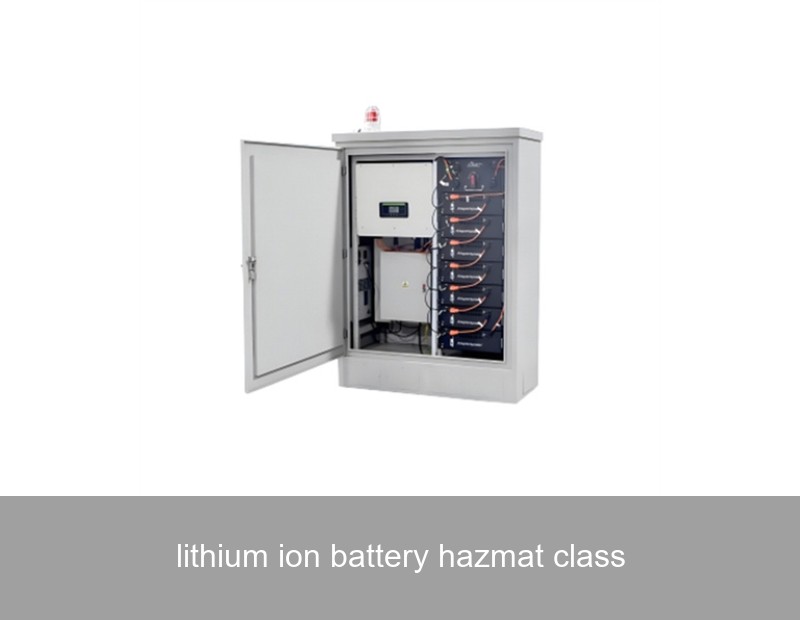
If you're involved in renewable energy, logistics, or simply use a smartphone, you've likely encountered the term "lithium-ion battery hazmat class." It sounds technical, even alarming. But what does it truly mean for businesses deploying solar-plus-storage systems or shipping essential components? In essence, this classification is a critical safety protocol, not a prohibition. Understanding it is key to unlocking the immense potential of lithium-ion batteries while ensuring safety every step of the way. As a global leader, Highjoule integrates this deep understanding of safety regulations into the very core of our commercial and industrial battery energy storage systems (BESS), ensuring our solutions are not only high-performing but also compliant and secure from installation to end-of-life.
Why Are Lithium Batteries Class 9 Hazardous Materials?
Globally, lithium-ion batteries are classified as Class 9 Miscellaneous Hazardous Materials under the UN numbering system (specifically, UN 3480 for batteries alone, and UN 3481 for batteries contained in equipment). This classification, governed by bodies like the U.S. Department of Transportation (DOT) and the International Air Transport Association (IATA), exists for one primary reason: they pose a risk that must be managed under specific conditions.
The Core Issue: Thermal Runaway
Unlike gasoline (flammable liquid) or acid (corrosive), the hazard of lithium-ion batteries is more complex. It stems from a chain reaction called thermal runaway. Imagine a small internal short circuit, physical damage, or manufacturing defect causing a cell to overheat. This heat can propagate to neighboring cells, releasing flammable electrolyte and toxic gases, leading to intense fire that is difficult to extinguish. The Class 9 designation acknowledges this unique, miscellaneous hazard—a risk that is wonderfully managed in daily use but requires careful handling in bulk transport and storage.

Image Source: U.S. Department of Energy - Illustrating the thermal runaway process.
The Data Behind the Designation
The need for this classification is underscored by data. The FAA Office of Security and Hazardous Materials Safety records numerous incidents annually related to lithium batteries in transport. For instance, their data shows that between 2010 and 2020, lithium battery incidents were a contributing factor in several air cargo-related events, prompting stricter regulations. This isn't to scare, but to highlight that the rules are built on real-world experience and are essential for safety.
A Real-World Case: The Logistics Challenge
Let's consider a European solar developer, "EcoVolt GmbH," based in Germany. In 2022, they ordered a 2 MWh containerized BESS from a manufacturer in Asia to support a local microgrid. The batteries, classified as UN 3480, had to be shipped by sea and road.
The Challenge: Navigating the maze of IATA/IMDG shipping regulations, ensuring proper packaging (tested and certified), completing exhaustive documentation (Shipper's Declaration for Dangerous Goods), and marking/labeling every package correctly. A single paperwork error could lead to port refusal, costly delays, or worse, an unsafe condition.
The Outcome: By working with a logistics partner specialized in hazmat class 9 goods and a manufacturer (like Highjoule) that provides full compliance documentation, EcoVolt successfully deployed the system. The project now offsets peak grid demand by 1.8 MW, but the initial hurdle was regulatory, not technical. This case underscores that for any cross-border energy project, understanding lithium ion battery hazmat class is as crucial as understanding kilowatt-hours.
Navigating Regulations: Shipping, Storage & Handling
So, what do these regulations entail? Here’s a simplified breakdown for key markets.
Key Shipping Rules (US & EU)
| Aspect | Key Requirement | Governing Body/Regulation |
|---|---|---|
| Classification & Labeling | Proper UN number (3480, 3481), Class 9 hazard label, handling labels. | DOT 49 CFR (US), ADR (EU Road), IMDG Code (Sea), IATA DGR (Air) |
| Packaging | Must be UN-certified, meet specific construction and testing standards (e.g., UN 38.3 test summary). | Same as above |
| Documentation | Dangerous Goods Declaration, Safety Data Sheet (SDS). | Mandatory for all transport modes. |
| Quantity Limits | Strict limits for air transport; more flexible for sea/road but with segregation rules. | Particularly stringent under IATA regulations. |
Safe Storage & Handling Best Practices
- Storage Environment: Store in a cool, dry, well-ventilated area away from combustible materials. Temperature monitoring is recommended.
- Physical Protection: Protect from crushing, stacking, or piercing. Use original or approved packaging for spare cells/modules.
- Electrical Safety: Terminals should be protected from short-circuiting (using caps or non-conductive tape).
- Fire Preparedness: Class D fire extinguishers (for metal fires) or large quantities of water for cooling are recommended—standard ABC extinguishers may not be effective. The NFPA 855 standard is the key benchmark for stationary storage installation fire safety in the U.S.
Beyond Compliance: How Smart Design Mitigates Risk
While regulations manage the transport of the "raw" hazard, the true innovation lies in designing systems that inherently minimize risk. This is where the expertise of a seasoned provider becomes invaluable.
The Highjoule Approach: Safety by Design
At Highjoule, we believe compliance is the baseline, not the end goal. Our IntelliBESS product line for commercial and utility-scale applications is engineered to address the root causes of the Class 9 designation:
- Advanced Battery Management System (BMS): Our proprietary BMS doesn't just monitor voltage and temperature; it uses predictive algorithms to detect cell-level anomalies long before they escalate, providing an early warning system against thermal runaway.
- Passive Fire Protection & Cell Isolation: Our modular design includes fire-resistant barriers between modules and passive venting systems to manage off-gassing. In the unlikely event of a cell failure, the design aims to isolate it to a single module.
- Streamlined Logistics Support: We provide complete "cradle-to-site" compliance documentation and guidance for our clients, turning the complex hazmat class 9 shipping process into a managed, turnkey service. This ensures our systems arrive safely and on schedule, ready for seamless integration with your solar PV or grid infrastructure.

Image Source: Highjoule - A containerized IntelliBESS unit, showcasing robust, safety-focused design.
The Future Outlook: Safer Chemistries & Smarter Systems
The landscape is evolving. While lithium-ion remains dominant, new chemistries like Lithium Iron Phosphate (LFP) are gaining traction for their superior thermal and chemical stability, inherently reducing the "hazmat" risk profile. Furthermore, solid-state batteries on the horizon promise to eliminate flammable liquid electrolytes altogether. At Highjoule, our R&D pipeline actively evaluates these technologies, not just for performance, but for their impact on lifecycle safety and regulatory burden. The question for project developers is no longer just "what's the cost per kWh?" but also "what's the total cost of safety and compliance ownership?"
Given that the safe integration of these powerful systems is paramount, what specific safety or regulatory hurdle has been the most surprising in your own renewable energy projects?
 Inquiry
 Online Chat