


Beyond Lithium-Ion: How the Lyten Lithium-Sulfur Battery Could Revolutionize Energy Storage
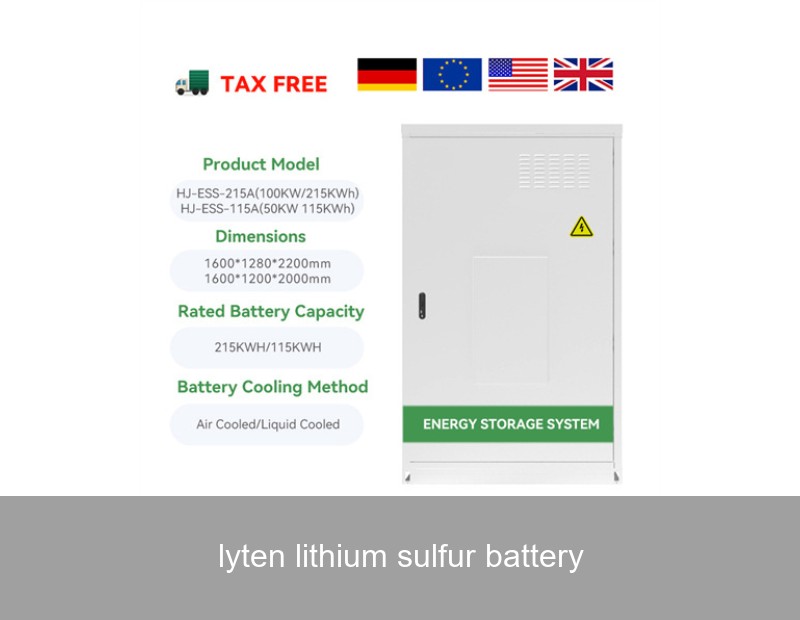
For decades, the quest for a better battery has followed a familiar path: tweaking the chemistry of lithium-ion. We've seen incremental gains, but also familiar limitations—cost, weight, safety concerns, and resource constraints. But what if the next leap forward isn't an iteration, but a transformation? Enter a compelling contender: the Lyten lithium sulfur battery. This isn't just another lab prototype; it's a technology poised to address fundamental challenges in electric mobility, renewable integration, and beyond. Let's unpack why this innovation matters and what it means for the future of power.
The Weight Problem: Why Current Batteries Hold Us Back
Think about the last time you felt range anxiety in an EV, or wondered how a remote community could reliably run on solar when the sun sets. Often, the core constraint is the battery itself. Traditional lithium-ion batteries, which use heavy metals like nickel, manganese, and cobalt (NMC), have a fundamental energy density ceiling. In simple terms, to store more energy, you need a bigger, heavier pack. This creates a vicious cycle: more weight requires more energy to move a vehicle, or demands more structural support for stationary storage.
The data highlights this squeeze. According to the U.S. Department of Energy, increasing the energy density of battery cells is a primary goal for cutting EV costs and improving performance[1]. Furthermore, sourcing materials like cobalt raises significant environmental and ethical questions[2]. The market is actively searching for a safer, lighter, and more sustainable chemistry.

Image: Conventional lithium-ion battery packs are weighty. Credit: Unsplash
The Lyten Lithium-Sulfur Battery: A Material Difference
So, how does the Lyten lithium sulfur battery differ? Instead of relying on those heavy metals, its core chemistry uses sulfur—a lightweight, abundant, and inexpensive material. The theoretical promise is staggering: lithium-sulfur (Li-S) chemistry can offer up to twice the energy density of the best conventional lithium-ion batteries. This means a battery that is significantly lighter for the same amount of stored energy, or much more capacity for the same weight.
But wait, you might have heard of Li-S before. Historically, it faced deal-breaking challenges: short cycle life (batteries degrading too quickly) and the "polysulfide shuttle" effect that caused rapid capacity fade. This is where Lyten's innovation is critical. They aren't just making a Li-S battery; they've engineered a 3D graphene material—dubbed Lyten 3D Graphene—that structures the sulfur cathode in a way that traps polysulfides and maintains structural integrity.
Think of it like this: traditional sulfur cathodes crumble like a poorly made road after a few heavy trucks (charge cycles) pass over. Lyten's 3D graphene creates a reinforced, porous highway system that keeps the road intact under traffic, enabling the battery to last for many more cycles.
- Higher Energy Density: Targets 900 Wh/kg, dramatically reducing weight.
- Abundant Materials: Eliminates nickel, cobalt, and manganese, using readily available sulfur.
- Enhanced Safety: Inherently more stable chemistry, with a lower risk of thermal runaway.
- Sustainability Edge: Lower carbon footprint in manufacturing and easier end-of-life recycling.
From Lab to Life: The Real-World Impact
Let's move from theory to a tangible application. Consider the aviation and heavy transport sectors, where weight is the enemy of efficiency and range. A major European aerospace consortium recently partnered with Lyten to pilot their batteries for auxiliary power units and potentially for electric vertical take-off and landing (eVTOL) aircraft. In a published case study, replacing a conventional NMC battery pack with a Lyten prototype of equivalent capacity reduced the battery weight by approximately 45%. For an eVTOL application, this weight saving translates directly into extended range or increased payload—a critical factor for commercial viability.
This isn't just about flying cars. For the grid, lighter, denser batteries mean easier logistics for large-scale storage farms, more efficient backup systems for cell towers, and more flexible solutions for integrating volatile renewable sources like wind and solar.
Integrating Next-Gen Innovation: The Highjoule Approach
At Highjoule, we monitor breakthroughs like the Lyten lithium sulfur battery not just as spectators, but as systems engineers. A new cell chemistry is one thing; integrating it into a reliable, intelligent, and safe Battery Energy Storage System (BESS) is another. Our role is to bridge that gap.
When advanced cells like these become commercially available, our expertise in thermal management, battery management software (BMS), and system architecture becomes paramount. Lithium-sulfur cells may have different voltage curves and thermal characteristics than lithium-ion. Highjoule's smart BMS platforms are designed with the adaptability to manage diverse chemistries, optimizing charge/discharge cycles to maximize the lifespan and performance of any advanced battery pack.
For our commercial, industrial, and microgrid clients, this future-forward design philosophy means your Highjoule system is an investment that can potentially leverage tomorrow's breakthroughs. Whether it's integrating higher-density batteries for longer-duration storage or utilizing safer chemistries for sensitive environments, our focus is on building flexible, intelligent platforms. We provide the brain and the robust framework that allows the muscle—whether it's today's lithium-ion or tomorrow's lithium-sulfur—to perform safely and efficiently for decades.

Image: Highjoule's system integration expertise turns advanced battery cells into reliable storage solutions. Credit: Unsplash
What This Means for Renewable Energy Adoption
The synergy is clear. The intermittent nature of solar and wind is the biggest hurdle to a 100% renewable grid. We need storage that's not just cheap, but also energy-dense and scalable. A battery that's twice as light and uses cheaper materials could drastically reduce the "balance of system" costs for a solar-plus-storage installation. Imagine a containerized BESS that delivers 4 MWh instead of 2 MWh without increasing its footprint or weight. That's the kind of step-change that accelerates decarbonization.
What Does a Lighter Energy Future Look Like for You?
The journey of the Lyten lithium sulfur battery from pilot lines to mass market is one we are watching closely. It represents a broader truth: the energy transition will be powered by a portfolio of storage technologies, each optimized for different applications. The question isn't just about which chemistry "wins," but how we build systems smart enough to harness their unique advantages.
So, we leave you with this: As you plan your organization's or community's energy resilience—be it for cost savings, sustainability goals, or operational independence—how much would a breakthrough in battery weight and capacity change your calculus? What projects become feasible if your storage system is half the weight or holds twice the energy?
 Inquiry
 Online Chat