


Understanding Malaysia Solar Panel Price: A Guide to True Value and ROI
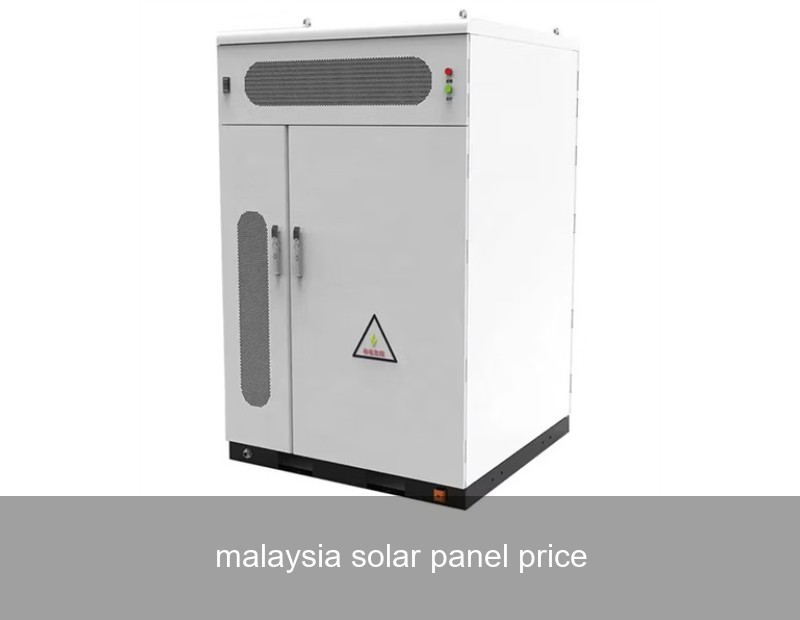
If you're a homeowner or business leader in Malaysia researching solar energy, you've undoubtedly asked the central question: "What is the Malaysia solar panel price?" A quick online search might leave you with more confusion than clarity, as quotes can vary wildly. The initial sticker price is just the tip of the iceberg. The real story lies beneath—in system quality, long-term performance, and the intelligent integration of storage. As a global leader in advanced energy storage, Highjoule understands that the true cost of solar isn't just what you pay today, but the value and resilience you secure for decades. Let's demystify the factors shaping the Malaysia solar panel price and explore how to maximize your return on investment.
The Solar Price Puzzle: More Than Just a Sticker Shock
You contact a few installers. One quotes RM 20,000, another RM 35,000 for a seemingly similar 5kW system. Why the huge difference? This common experience highlights a critical issue: comparing solar systems on price alone is like comparing cars by their weight. It ignores the engine, efficiency, safety features, and warranty. The Malaysia solar panel price is a composite figure influenced by hardware quality, design complexity, installer expertise, and crucially, whether it includes a pathway to energy independence through storage.
Breaking Down the Cost: What's Behind Malaysia's Solar Panel Price?
To make an informed decision, we need to dissect the typical quote. The cost structure generally falls into two main buckets: hardware and "soft costs."
Hardware Costs (The Panels & Inverters)
This is the most visible part. Prices vary based on technology and origin.
- Solar Panels (Modules): Tier-1 monocrystalline panels (higher efficiency, longer lifespan) command a premium over polycrystalline or thin-film options. A difference of a few hundred ringgit per panel can significantly impact total system performance over 25 years.
- Inverters: This is the brain of your system. A basic string inverter is cheaper, but a microinverter or hybrid inverter system (which allows for easier battery addition) costs more upfront while offering superior energy harvest, especially in shaded conditions, and future-proofing.
| Component | Lower-Cost Option | Higher-Value Option | Impact on Long-Term ROI |
|---|---|---|---|
| Solar Panels | Standard Polycrystalline | High-Efficiency Monocrystalline (e.g., PERC) | Generates 10-20% more power in the same space, better low-light performance. |
| Inverter | Basic String Inverter | Hybrid Inverter / Microinverters | Enables easy battery integration, minimizes single-point failure, optimizes per-panel output. |
| System Add-on | PV System Only | Integrated Battery Storage | Unlocks self-consumption, backup power, and grid services, drastically increasing utility savings. |
The "Soft Costs": Installation, Permits, and Financing
Often overlooked, these can constitute 30-40% of the total price in some markets. They include:
- Installation Labor & Engineering: A certified, experienced crew ensures a safe, durable, and code-compliant installation. Cheaper labor might mean cut corners.
- Permitting & Grid Connection Fees: Costs associated with SEDA (Sustainable Energy Development Authority) applications and TNB (Tenaga Nasional Berhad) interconnection.
- System Design & Project Management: A custom design that optimizes roof layout and shading analysis is worth the investment.
The Hidden Game-Changer: System Efficiency & Long-Term Value
Here's the key insight: The cheapest system per watt installed can be the most expensive over its lifetime. A less efficient system might require more panels to meet your needs (increasing structural and space costs). A system without storage capability exports most of its daytime production to the grid at a lower feed-in tariff (FiT) rate, only for you to buy back expensive power at night. This is where the conversation must evolve from Malaysia solar panel price to Malaysia solar-plus-storage value.

Image Source: Unsplash (Representative image of a quality solar installation)
A Real-World Case: The Penang Industrial Park Success Story
Let's look at real data. A medium-sized manufacturing facility in Penang was evaluating solar quotes. The lowest bid was for a 500kW system with mid-tier panels and string inverters at RM 1.8 million. A higher bid of RM 2.3 million included premium high-efficiency panels and a Highjoule HI-Stack 500 battery energy storage system (BESS).
The Outcome:
- Low-Bid System: Reduced daytime grid consumption by ~60%. However, evening shifts relied entirely on the grid. Annual savings: ~RM 280,000.
- Highjoule-Integrated System: By storing excess solar energy in the HI-Stack BESS, the facility achieved 85% self-consumption of its solar generation and provided critical load backup during grid outages. It also participated in a demand response program. Annual savings: ~RM 450,000 + additional grid service revenue.
Beyond the Price Tag: Smart Storage is the True Key to Value
Solar panels are generators; they produce when the sun shines. An advanced battery storage system, like those from Highjoule, transforms your solar array into a 24/7 power asset. For the Malaysian market, with its growing energy demand and occasional grid instability, this is a game-changer.
- Maximize Self-Consumption: Store cheap, clean solar energy for use at night, slashing your bill.
- Ensure Power Resilience: Keep essential loads running during outages—a critical feature for businesses and families alike.
- Future-Proof Your Investment: As grid tariffs evolve, your system can adapt, potentially providing grid-stabilization services.
Highjoule's Approach: Delivering Value Beyond the Initial Quote
Since 2005, Highjoule has been at the forefront of intelligent energy storage. We partner with leading solar installers across Europe, the US, and Southeast Asia to provide integrated solutions. When you see a quote featuring Highjoule technology, you're not just buying a battery; you're investing in a comprehensive ecosystem:
- The HI-Stack Series: Our scalable, modular lithium iron phosphate (LFP) battery systems are designed for safety, longevity (10,000+ cycles), and seamless integration with major inverter brands.
- Smart Energy Management System (EMS): The true brain. Our AI-driven EMS optimizes every kilowatt-hour—deciding when to store, when to consume, and when to export based on weather forecasts, usage patterns, and tariff structures.
- Global Support & Warranty: We provide robust product warranties and remote monitoring, ensuring your system delivers promised returns for decades.

Image Source: Unsplash (Representative image of a modern home battery installation)
Our expertise, drawn from thousands of global deployments, helps our partners design systems where the Malaysia solar panel price becomes part of a larger, more valuable equation. For deeper insights into technology comparisons, resources like NREL's lifecycle cost analyses are invaluable.
Your Next Step in the Solar Journey
So, when you receive your next solar quote, move beyond the bottom line. Ask your installer:
- What is the projected 25-year energy yield of this specific panel model?
- Does this inverter allow for straightforward battery addition in the future?
- Can you provide a financial model comparing a PV-only system vs. a PV+storage system over 10 years?
- Do you partner with established storage providers like Highjoule to deliver integrated solutions?
 Inquiry
 Online Chat