


Mechanical Storage of Energy: The Physical Backbone of a Renewable Grid
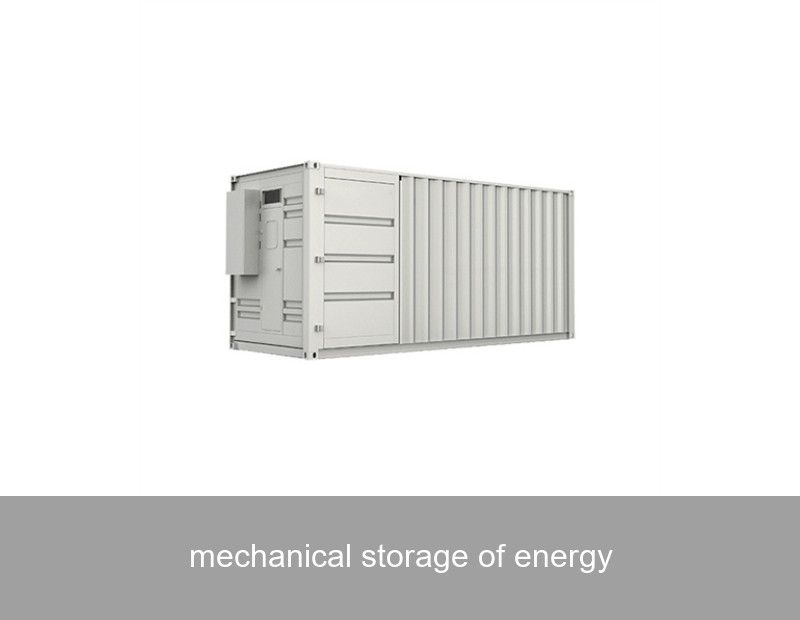
When we think about storing energy for a rainy (or non-windy) day, batteries often steal the spotlight. But there's a powerful, physical, and often massive counterpart working behind the scenes: mechanical storage of energy. This technology doesn't rely on complex chemistry. Instead, it uses fundamental forces of physics—gravity, motion, and pressure—to bank electricity. As our grids evolve with more solar and wind, understanding these physical storage giants becomes crucial. They provide the grid stability and long-duration backup that are essential for a reliable, sustainable energy future.
The Modern Grid's Hidden Challenge: Intermittency
Here's the phenomenon we're facing: Solar panels stop at sunset, and wind farms can go quiet for days. This intermittency creates a dangerous mismatch. The U.S. Energy Information Administration (EIA) notes that variable renewable generation can lead to significant grid frequency fluctuations and even curtailment (wasting excess clean energy) if not managed. The data is stark—in California's CAISO grid, over 1.5 million MWh of solar and wind energy was curtailed in 2022. That's enough to power over 100,000 homes for a year, literally thrown away because we couldn't store it.
This is where energy storage steps in as the indispensable solution. While lithium-ion batteries are fantastic for rapid, short-duration response, managing the multi-hour or even multi-day gaps in renewable generation requires a different scale. This is the natural domain where mechanical storage technologies excel, offering durability, massive capacity, and longer operational lifespans.

Image: The massive upper reservoir of the Dinorwig pumped hydro facility in Wales, a classic example of large-scale mechanical storage. Source: Wikimedia Commons (Public Domain)
Key Types of Mechanical Energy Storage
Let's break down the main workhorses of physical energy storage. Each converts electrical energy into mechanical potential and back again, acting like a colossal, rechargeable physical battery.
Pumped Hydro Storage (PHS)
Think of it as a giant water battery. It's the undisputed champion of installed capacity, accounting for over 90% of the world's global energy storage capacity. Here's how it works:
- Charging (Storage): Use cheap, excess electricity (e.g., midday solar) to pump water from a lower reservoir to a higher one.
- Discharging (Generation): Release water from the upper reservoir through turbines to generate electricity during peak demand.
The U.S. Department of Energy's Global Energy Storage Database lists facilities like the Bath County Pumped Storage Station in Virginia, which boasts a capacity of 3,003 MW—that's akin to three large nuclear power plants that can be switched on in minutes.
Flywheel Energy Storage (FES)
This is the sprinter of the group. A flywheel stores energy as rotational kinetic energy. A motor spins a heavy rotor in a low-friction enclosure to very high speeds. To discharge, the spinning rotor drives a generator.
- Best For: Frequency regulation, ultra-fast response (milliseconds), and short-duration bridging (seconds to minutes).
- Key Advantage: Extremely high cycle life with minimal degradation, perfect for absorbing and injecting power to keep grid frequency stable.
Compressed Air Energy Storage (CAES)
Imagine using excess electricity to compress air and store it underground in salt caverns or depleted gas fields. When power is needed, the pressurized air is heated, expanded, and drives a turbine. Advanced adiabatic systems (AA-CAES) also capture the heat from compression to reuse during expansion, boosting efficiency. The U.S. Department of Energy highlights CAES as a critical technology for long-duration (10+ hours) storage.
Gravity-Based Storage
A newer, innovative approach. Companies are developing systems that use electric cranes to stack massive concrete blocks into a tower (storing energy) and then lower them to generate power via regenerative braking. Others use weights in deep mine shafts. The principle is simple: potential energy = mass x gravity x height.
The Highjoule Approach: Integrating Mechanical & Electrochemical Storage
At Highjoule, we view the energy storage landscape holistically. No single technology is a silver bullet. The future grid needs a symphony of solutions, each playing its part. While we are renowned for our advanced, intelligent battery energy storage systems (BESS) like the Highjoule H-Series for Commercial & Industrial applications and the integrated HomePower solution for residences, our expertise extends to system design that incorporates and complements mechanical storage.
For instance, a utility-scale solar farm might pair with a nearby pumped hydro facility for bulk, seasonal shifting. But what about the second-to-second frequency regulation and the rapid ramp-up needed as the sun sets before the hydro turbines fully engage? This is where a Highjoule BESS comes in. Our systems, managed by the NeuroGrid AI platform, can provide instantaneous response, smooth out inter-hour variability, and optimize the entire asset stack—whether it's PV, mechanical storage, or conventional generation. We enable hybrid storage plants where flywheels handle frequency, batteries manage the 1-4 hour peak shaving, and CAES or PHS takes over for the long haul.

Image: A hybrid renewable energy farm. Integrating such assets requires a mix of storage technologies. Source: Unsplash (License: Free to use)
Case Study: The "Battery of the Black Forest" & Grid Stability in Germany
Let's look at a real-world example of mechanical storage in action. Germany's ambitious Energiewende (energy transition) has led to renewables frequently supplying over 50% of the country's electricity. This success brings the challenge of managing surplus wind power in the north and delivering it to industrial centers in the south.
The Phenomenon: Northern German wind farms often produce more power than the local grid can absorb, especially at night, leading to negative electricity prices and curtailment.
The Mechanical Storage Solution: The Rødby CAES project in Denmark (a key part of the interconnected German/Danish grid) and Germany's own pumped hydro stations in the Alps act as critical pressure valves. For example, the Goldisthal pumped storage plant (1,060 MW capacity) can absorb vast amounts of excess wind energy by pumping water uphill. It then generates during the high-demand, high-price periods the next day.
The Data & Insight: According to a study by the Fraunhofer Institute, during one week in 2023 with high wind output, German pumped hydro facilities provided over 40 GWh of net storage discharge, effectively shifting a massive block of renewable energy. This physical storage is complemented by a growing fleet of battery storage systems, like those Highjoule provides for frequency containment reserve (FCR) services. The insight is clear: a layered approach is key. Mechanical storage handles the bulk energy "warehousing," while distributed, fast-responding batteries like Highjoule's provide the precise "logistics" for grid stability.
The Future Outlook for Energy Storage
The path forward isn't about one technology winning. It's about creating resilient, multi-technology ecosystems. Innovations in mechanical storage, like advanced adiabatic CAES and new gravity systems, promise lower costs and broader geographical applicability. Concurrently, battery technology continues to advance in energy density and cycle life.
The most efficient future grid will be built on intelligent platforms that can orchestrate these diverse assets. This is precisely the vision behind Highjoule's NeuroGrid AI—to be the central nervous system that decides, in real-time, whether to store the next megawatt-hour in a battery, use it to compress air, or pump water, based on price signals, grid needs, and weather forecasts.
As we push for net-zero goals, the question for grid operators and energy developers is no longer simply "should we add storage?" It's becoming: "What is the optimal mix of mechanical, electrochemical, and other storage technologies for our specific grid needs, geography, and renewable portfolio to ensure reliability and maximize return on investment?" How is your organization planning to build this balanced storage strategy for the decades ahead?
 Inquiry
 Online Chat