


Finding a Megawatt Company for Sale: Your Strategic Guide to the Energy Storage Market
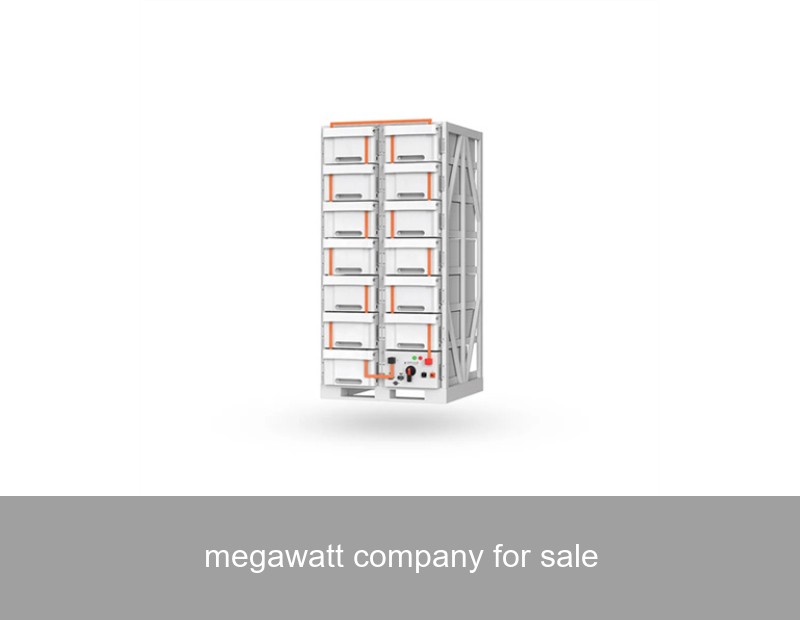
Have you ever wondered what powers the future of energy resilience? As grid demands soar and renewable integration becomes imperative, a new class of assets is emerging on the business landscape: the megawatt company for sale. These aren't just any companies; they are specialized entities, often built around substantial battery energy storage systems (BESS) or integrated solar-plus-storage portfolios, capable of delivering power on a massive, grid-scale level. For investors, utilities, and energy developers, acquiring such a company represents a direct pathway to owning critical infrastructure that balances grids, generates revenue, and accelerates the energy transition. This article delves into the strategic considerations, market dynamics, and technological expertise needed to successfully navigate this high-stakes opportunity.
Table of Contents
- The Megawatt-Scale Imperative: More Than Just a Power Plant
- Key Drivers Making Storage Assets Prime Acquisition Targets
- Due Diligence Beyond the Balance Sheet: The Technology Audit
- Case Study: Acquiring a 50MW Portfolio in the ERCOT Market
- Highjoule: Your Partner in Evaluating and Enhancing Storage Assets
- The Future of Megawatt M&A: Integration and Intelligence
The Megawatt-Scale Imperative: More Than Just a Power Plant
When we talk about a megawatt company for sale, we're referring to an enterprise whose core value is tied to its ability to store and dispatch electricity at a scale that materially impacts the local or regional grid. A single megawatt (MW) of battery storage can power approximately 200-300 homes for an hour. Now, imagine portfolios of 20MW, 100MW, or even 500MW. These are substantial infrastructure assets. Unlike a traditional power plant, a BESS is agile; it doesn't generate energy but time-shifts it, providing crucial services like frequency regulation, peak shaving, and backup power. The value proposition is multifaceted, creating revenue streams from energy arbitrage (buying low, selling high), capacity markets, and grid service contracts.

Image: A utility-scale battery storage installation. Source: Unsplash (Credit: American Public Power Association)
Key Drivers Making Storage Assets Prime Acquisition Targets
The market for these companies is heating up, and it's not by accident. Several powerful forces are converging:
- Policy Tailwinds: Legislation like the U.S. Inflation Reduction Act (IRA) provides unprecedented investment tax credits (ITC) for standalone storage, dramatically improving project economics and attracting capital.
- Grid Modernization Needs: Aging infrastructure and the intermittent nature of renewables like solar and wind create volatility. Grid operators are actively seeking storage resources for stability, creating a guaranteed demand.
- Economic Viability: As battery pack costs have fallen (over 80% since 2013 according to BloombergNEF), the return on investment for storage projects has become compellingly clear.
- Corporate Sustainability Goals: Large corporations are procuring gigawatts of clean energy and need storage to ensure their power is reliable and truly green, driving Power Purchase Agreements (PPAs) for storage.
Due Diligence Beyond the Balance Sheet: The Technology Audit
Evaluating a megawatt company for sale requires deep technical due diligence. The financials tell only part of the story. The true value—and risk—lies in the hardware and software.
| Due Diligence Area | Critical Questions to Ask | Potential Risk if Overlooked |
|---|---|---|
| Battery Health & Degradation | What is the current State of Health (SoH) of the battery packs? What is the historical degradation curve vs. warranty? | Future revenue shortfalls, unexpected capital expenditure for replacement. |
| Energy Management System (EMS) | Is the EMS proprietary or third-party? Can it adapt to evolving market rules and optimize for multiple value streams? | Suboptimal revenue, inability to participate in new grid service markets. |
| Balance of Plant & Safety | Are thermal management systems robust? What fire suppression and safety protocols are in place? Is there a history of faults or incidents? | Operational downtime, safety hazards, reputational damage, and insurance premium increases. |
| Long-Term Service Agreement (LTSA) | What are the terms with the OEM or integrator? Are performance guarantees tied to availability or throughput? | Uncertain long-term operational costs, disputes over performance penalties. |
Case Study: Acquiring a 50MW Portfolio in the ERCOT Market
Let's examine a real-world scenario. In 2023, a mid-sized energy developer was evaluating the acquisition of a privately-held company owning a 50MW / 100MWh distributed storage portfolio in Texas (ERCOT). The seller projected strong revenues based on energy arbitrage during high-price events.
The Phenomenon: ERCOT is known for its price volatility, making it a prime market for storage. However, revenue is highly dependent on precise, fast-responding dispatch.
The Data & The Problem: During technical due diligence, commissioned by the buyer, engineers found that the portfolio's legacy EMS was reacting to price signals with a 5-minute latency. In ERCOT's 5-minute settlement market, this meant the systems were consistently dispatching too late, missing the highest price peaks. Analysis showed a 22% revenue shortfall compared to what was possible with state-of-the-art dispatch software.
The Solution & Outcome: The buyer used this finding to negotiate a 15% reduction in the purchase price. Post-acquisition, they immediately initiated a technology retrofit program, replacing the EMS across the portfolio. This case underscores that in a megawatt company for sale, the underlying technology platform is not an IT cost—it is the core revenue generation engine.
Highjoule: Your Partner in Evaluating and Enhancing Storage Assets
This is where deep industry expertise becomes non-negotiable. At Highjoule, with nearly two decades of experience since 2005, we don't just sell storage systems; we provide the intelligence and technology that make them valuable long-term assets. For an investor or acquirer, partnering with a technology provider like Highjoule during the due diligence phase can uncover critical insights.
Our H-IQ Cloud Platform is a prime example of the technology that defines a modern, high-value storage asset. It's an AI-driven energy management system that doesn't just react to markets—it forecasts and optimizes in real-time across energy, capacity, and ancillary service markets simultaneously, maximizing the value of every megawatt-hour stored. When evaluating a megawatt company for sale, assessing whether its software has such capabilities is key.
Furthermore, our modular and scalable BESS solutions, from commercial to utility-scale, are designed with longevity and safety in mind. If an acquisition target's hardware is underperforming or nearing end-of-life, Highjoule can provide a seamless upgrade path, often allowing for phased retrofits that preserve existing infrastructure while boosting performance and safety. We offer comprehensive long-term service and performance guarantees, turning operational risk into predictable operational expenditure for the new owner.

Image: Advanced energy management system control room. Source: Unsplash (Credit: ThisisEngineering)
The Future of Megawatt M&A: Integration and Intelligence
The next wave of megawatt company for sale transactions will likely involve even more sophisticated, integrated assets. Think of storage portfolios coupled with behind-the-meter solar, electric vehicle charging corridors, or even green hydrogen production. The value will be in the intelligent orchestration of these distributed energy resources (DERs) as a virtual power plant (VPP).
Acquirers will need to ask: Does this company's technology stack enable this future? Can it aggregate and optimize diverse assets? According to a report by the National Renewable Energy Laboratory (NREL), VPPs could meet 10-20% of peak grid demand by 2030, representing a massive market shift. The companies built on flexible, intelligent platforms like Highjoule's H-IQ will be best positioned to capitalize on this trend and become the most sought-after assets.
Ready to Power Your Next Move?
The opportunity to acquire a megawatt company for sale is more than a financial transaction; it's a strategic investment in the backbone of the new energy economy. But success hinges on seeing beyond the megawatt nameplate and understanding the technology heartbeat within. As you consider your next step in this dynamic market, what specific technical or operational challenge in the due diligence process keeps you up at night?
 Inquiry
 Online Chat