


Morita Solar Charge Controller: The Heart of Your Efficient Off-Grid Power
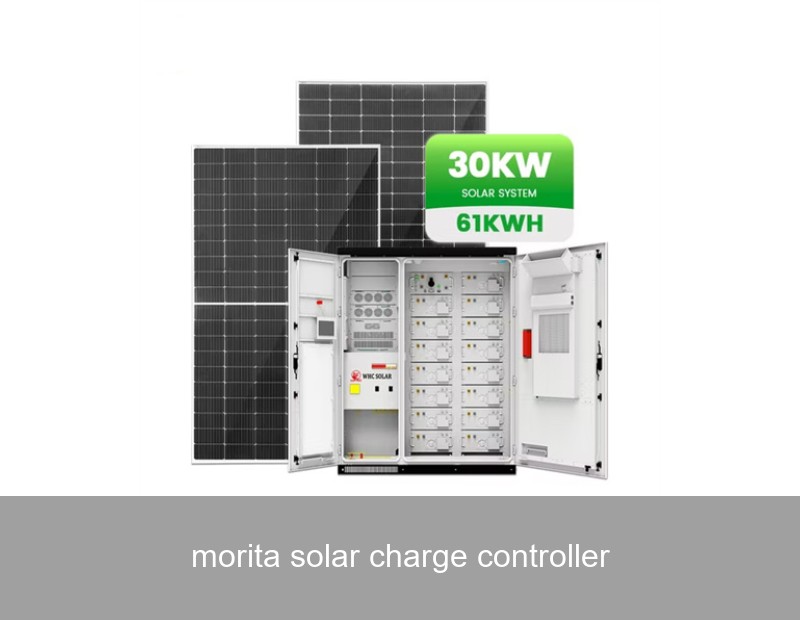
Have you ever wondered what ensures the smooth, safe, and long-lasting operation of your solar panels and battery bank? The unsung hero is often the solar charge controller. In this deep dive, we focus on a key player in the market: the Morita solar charge controller. Renowned for its durability and smart features, it's a cornerstone for reliable renewable energy systems, especially in demanding off-grid and backup power scenarios. For homeowners, businesses, and communities looking to maximize their solar investment, understanding this critical component is the first step toward true energy independence.
Table of Contents

Image Source: Unsplash - A professional solar installation showcasing system components.
What is a Morita Solar Charge Controller?
At its core, a solar charge controller is the essential gatekeeper between your solar panels and your battery storage. Think of it as a sophisticated traffic cop for electricity. The Morita solar charge controller excels in this role. It regulates the voltage and current flowing from the solar array to the batteries, preventing overcharging—which can severely damage batteries and create safety hazards—and also blocks reverse current at night. Morita's controllers are particularly noted for their robust build quality, wide operational temperature ranges, and intelligent algorithms tailored for various battery chemistries, from lead-acid to advanced lithium-ion.
Why the Right Charge Controller is Critical
The phenomenon is clear: a poorly managed solar charge drastically reduces system efficiency and lifespan. Without regulation, a 48V battery bank could be subjected to voltages exceeding 60V on a hot, sunny day.
Let's look at the data. According to the National Renewable Energy Laboratory (NREL), proper charge control can extend the life of a lead-acid battery bank by up to 50%. For a commercial system, that's the difference between a battery replacement in 5 years or 7.5 years, representing tens of thousands in savings. This is where precision engineering, like that found in Morita controllers, pays direct dividends.
The Cost of Getting It Wrong
- Reduced Battery Life: Overcharging causes excessive heat and gassing, drying out batteries.
- Lost Energy: Undercharging (or lack of adequate bulk/absorption phases) leaves batteries perpetually undercharged, losing usable capacity.
- System Failure: A catastrophic failure of a cheap controller can lead to a dead battery bank or even a fire risk.
Types & Key Features of Modern Controllers
Primarily, you'll encounter two types: PWM (Pulse Width Modulation) and MPPT (Maximum Power Point Tracking).
| Feature | PWM Controllers | MPPT Controllers (e.g., Morita MPPT Series) |
|---|---|---|
| Efficiency | ~70-80% | 94-99% |
| Best For | Smaller systems where panel & battery voltages match | Larger systems, cold climates, or when panel voltage is higher than battery voltage |
| Energy Harvest | Lower, especially in suboptimal conditions | Up to 30% more energy harvested |
| Cost | Lower upfront cost | Higher upfront, but superior ROI |
Morita's advanced MPPT controllers are a game-changer. They constantly track the maximum power point of your solar array, squeezing out every possible watt, even on cloudy days or in partial shade. This intelligence is crucial for maximizing return on investment in regions with variable weather, like much of Europe and the Northern US.
Real-World Impact: A Case Study from California
Let's move from theory to practice. A mid-sized organic vineyard in Sonoma County, California, faced unreliable grid power during fire-prevention shutoffs. They installed a 45kW off-grid solar system with a 120kWh lithium-ion battery bank to power critical irrigation and processing facilities.
The Challenge: Initial system designs using standard controllers showed a 15% energy loss during the peak harvest season's intense heat, risking insufficient battery recharge.
The Solution: The system integrator recommended and installed high-capacity Morita solar MPPT charge controllers, known for their high-temperature efficiency and precise lithium-ion charging profiles.
The Data-Driven Result: Monitoring over one year showed:
- 22% more energy harvested compared to the original design projections during summer months.
- Battery state-of-health remained at 99% due to optimal charging cycles.
- The system successfully provided 100% off-grid power during 12 separate grid outages, totaling over 300 hours.
This case study highlights that the choice of component isn't just about specs; it's about real-world resilience and economic performance. For complex commercial and industrial applications, partnering with an expert in system integration is key.

Image Source: Unsplash - Solar panels in an agricultural setting, similar to the case study.
Choosing and Integrating Your Controller
Selecting a Morita solar charge controller, or any controller, isn't done in isolation. It must be part of a harmonized system. This is where the expertise of a global provider like Highjoule becomes invaluable. Since 2005, Highjoule has specialized in designing and providing intelligent, integrated storage solutions.
Our approach goes beyond simply supplying a component. We ask: What is your total energy load? What battery chemistry are you using? What are your peak sun hours? The answers determine not just the controller, but the entire system architecture. For instance, our Highjoule H-Power Commercial Series often incorporates top-tier MPPT charge controllers within a pre-engineered, smart energy management platform. This ensures seamless communication between solar input, battery storage, and your facility's load, optimizing every kilowatt-hour.
Highjoule's Integrated Services
- Custom System Design: Tailoring solutions for residential, commercial, industrial, and microgrid applications.
- Technology Agnostic Advisory: Recommending best-fit components, like Morita controllers, based on project-specific needs.
- Smart Energy Management: Our systems feature advanced software that provides real-time monitoring, diagnostics, and control, getting the most out of your charge controller and batteries.
- Global Support: With expertise in markets from Europe to the US, we understand local regulations, incentives, and climate challenges.
The Future of Solar Charge Management
The role of the charge controller is evolving from a simple regulator to the brain of a decentralized energy node. Future iterations, as seen in leading R&D from institutions like the Fraunhofer Institute, will feature enhanced grid-support functions, peer-to-peer energy trading capabilities, and even more sophisticated AI-driven predictive charging based on weather forecasts and usage patterns.
This evolution aligns perfectly with Highjoule's vision of creating sustainable, resilient, and intelligent power networks. Whether it's a home seeking backup power, a factory aiming for peak-shaving, or a remote community building a microgrid, the principle remains: efficiency at every point, starting with how you capture the sun's energy, is non-negotiable.
So, as you plan your journey toward energy independence, we leave you with this question: Is your current solar energy system managed by a component that maximizes its potential, or is it a weak link waiting to be strengthened?
 Inquiry
 Online Chat