


Beyond Motolite Battery for Solar Panel: A Guide to Advanced Energy Storage
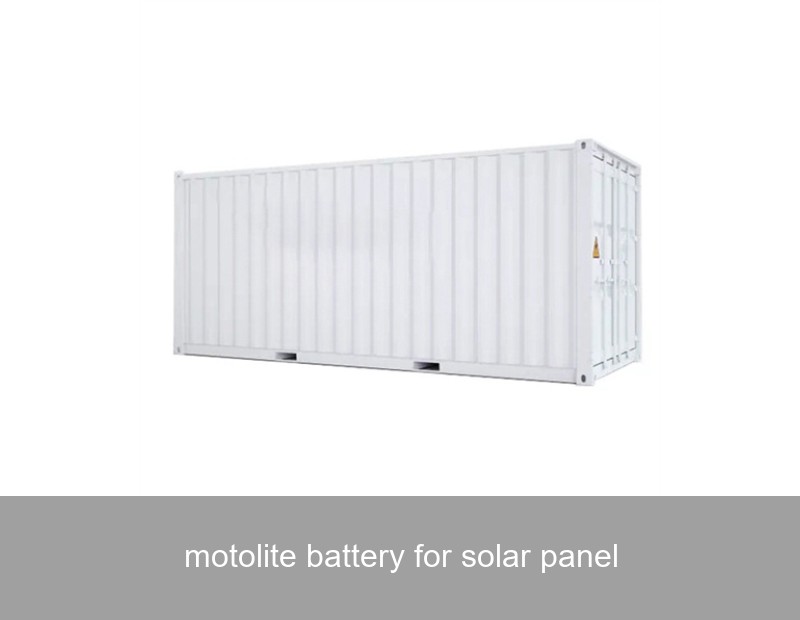
If you're researching "Motolite battery for solar panel," you're clearly on the path to energy independence. It's a common starting point, especially in regions where Motolite is a trusted name in automotive and standby power. However, when it comes to powering your home or business with solar energy, the choice of battery is the cornerstone of your system's performance, safety, and longevity. This article will explore why dedicated solar batteries outperform repurposed solutions and how modern energy storage systems, like those from Highjoule, are designed to maximize your renewable investment.
Table of Contents
- The Phenomenon: The Allure of Familiar Brands
- The Data: Why Solar Storage is a Different Game
- The Case Study: A U.S. Business's Transition
- The Highjoule Solution: Engineered for Solar
- Making the Right Choice for Your System
The Phenomenon: The Allure of Familiar Brands
It's natural to gravitate towards brands we know. For many, Motolite represents reliability in keeping cars starting and lights on during short-term outages. The idea of using a similar, lead-acid-based Motolite battery for solar panel systems seems logical. This approach, often called "banking" automotive or deep-cycle batteries, was more common in early off-grid setups. The phenomenon is driven by upfront cost perception and brand familiarity. But here's the critical question: is a battery designed for short, high-current bursts (like starting an engine) or even for basic backup truly suited for the daily, deep-charging and discharging cycle of a solar energy system?

Image Source: Unsplash - A modern home battery system designed for daily solar cycling.
The Data: Why Solar Storage is a Different Game
The core difference lies in the chemistry and construction designed for specific use cases. Let's break down the key metrics:
| Battery Parameter | Typical Lead-Acid (e.g., Automotive/Flooded) | Dedicated Solar Battery (e.g., Li-ion, LFP) |
|---|---|---|
| Depth of Discharge (DoD) | ~50% (Discharging deeper significantly shortens life) | 90-100% (Designed for deep, daily use) |
| Cycle Life | 200-500 cycles (to 50% DoD) | 6,000+ cycles (to 90% DoD) |
| Round-Trip Efficiency | 70-80% (More energy lost as heat) | 95-98% (More of your solar power is usable) |
| Maintenance | Regular water topping, ventilation required | Sealed, maintenance-free |
| Warranty | Often 1-2 years | Typically 10+ years |
As the data shows, using a non-optimized Motolite battery for solar panel arrays means you're effectively using only a fraction of its nominal capacity to preserve its life, requiring more batteries for the same storage, more frequent replacements, and losing more of your precious solar energy to inefficiency. According to the National Renewable Energy Laboratory (NREL), lithium-ion phosphate (LFP) batteries, a leading solar technology, have become the benchmark for safety, longevity, and cost-effectiveness over the system's lifetime.
The Case Study: A U.S. Business's Transition
Consider the real-world example of a small dairy farm in Wisconsin, USA. In 2018, they installed a 20kW solar array with a large bank of lead-acid batteries for night-time operations. Their challenges were frequent: battery maintenance, capacity degradation after two years, and insufficient power for critical cooling systems during cloudy periods. By 2022, they decided to upgrade.
They replaced the entire bank with a single Highjoule HES-25 commercial energy storage system (25kWh capacity, LFP chemistry). The results were transformative:
- Operational Cost: Eliminated 4 hours of monthly maintenance.
- Energy Utilization: Round-trip efficiency increased from ~75% to 97%, making nearly all stored solar energy usable.
- Reliability: The system seamlessly powered critical loads during a 14-hour grid outage, preserving milk inventory.
- Financials: Despite higher initial investment, the projected lifetime cost over 15 years is 40% lower due to zero maintenance and no need for replacement batteries.
This case underscores that the total cost of ownership, not just upfront price, defines a wise solar storage investment.
The Highjoule Solution: Engineered for Solar
At Highjoule, we've been designing energy storage solutions since 2005 with one principle: the battery must be an intelligent, integrated part of the energy ecosystem, not just a passive container. Our products are built from the ground up for the rigorous demands of solar cycling, offering advantages that general-purpose batteries cannot.
For residential and small commercial applications, our Highjoule HomePower series features modular LFP batteries with built-in smart energy management. They communicate seamlessly with your inverter, optimizing charge/discharge cycles based on weather forecasts, usage patterns, and tariff rates. This intelligence maximizes self-consumption of solar power and protects the battery's health.
For larger-scale needs, our Highjoule GridTie Pro systems offer scalable storage from 50kWh to multi-megawatt hours. These are the solutions powering microgrids and industrial facilities, providing not just backup, but also services like peak shaving and grid stabilization. Unlike a simple Motolite battery for solar panel setups, our systems include advanced thermal management, state-of-the-art battery management systems (BMS) for safety, and remote monitoring capabilities.

Image Source: Unsplash - Utility-scale solar and storage integration.
Key Highjoule Service Differentiators:
- Site-Specific Design: We analyze your energy profile to size the system correctly, preventing under or over-investment.
- Global Compliance: Our systems are certified to meet strict safety standards in the EU (CE, VDE) and North America (UL, IEC).
- Long-Term Partnership: Backed by our industry-leading 15-year warranty and 24/7 performance monitoring.
Making the Right Choice for Your System
So, how do you move beyond the initial search for a Motolite battery for solar panel configurations? Ask these questions:
- What is my primary goal? (Full energy independence, backup for outages, reducing electricity bills?)
- What is the total daily energy (kWh) I need to store?
- Am I looking for a 3-year solution or a 15+ year investment?
- Does my installer have expertise in integrating advanced storage systems?
Choosing a battery is about matching technology to purpose. The U.S. Department of Energy emphasizes that storage is key to solar integration and resilience. In Europe, with its high energy prices and strong renewable targets, the shift towards intelligent, long-life storage is even more pronounced.
Your Energy Future
The journey to solar energy is exciting. While starting with a familiar concept like a Motolite battery for solar panel systems is understandable, the evolution of technology offers far superior solutions. Today's solar batteries are intelligent assets that pay for themselves over time through unmatched reliability, efficiency, and durability.
What specific energy challenge in your home or business could a smart, high-cycle battery system solve that a conventional one cannot?
 Inquiry
 Online Chat