


MSDS Lithium Ion Battery UN3481: Your Essential Guide to Safe and Compliant Energy Storage
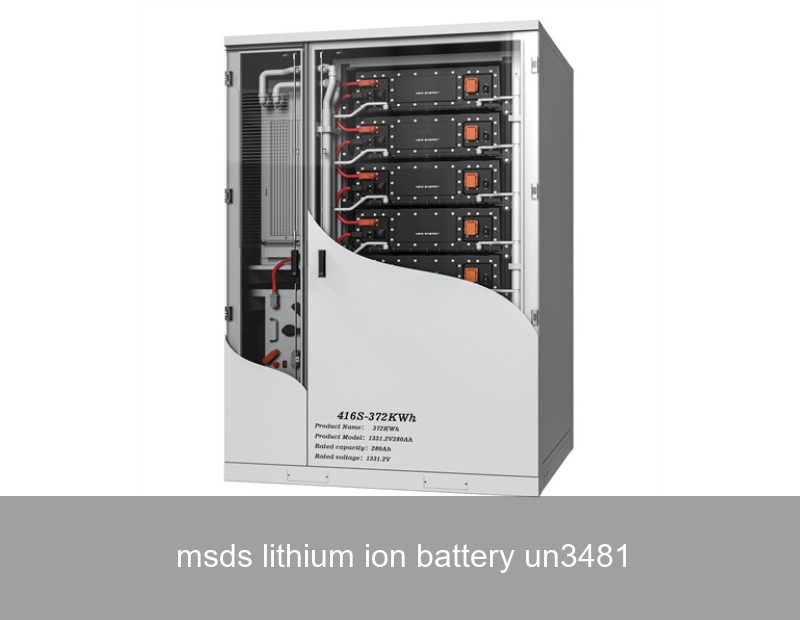
If you're sourcing, handling, or deploying lithium-ion battery energy storage systems (BESS) in Europe or the US, you've likely encountered the alphanumeric code UN3481 and the term MSDS (Material Safety Data Sheet). More than just regulatory jargon, these are the cornerstones of safety, compliance, and responsible innovation in our industry. As a product technology expert at Highjoule, I see firsthand how a deep understanding of these protocols transforms from a compliance checkbox into a critical component of system design, risk management, and long-term project success. Let's demystify what MSDS for UN3481 lithium-ion batteries really means for your commercial, industrial, or residential storage project.
Table of Contents
- What Exactly is UN3481 & The MSDS?
- Why MSDS & UN3481 Compliance Isn't Optional
- Decoding a Lithium-Ion Battery MSDS: Key Sections for Project Developers
- From Paper to Practice: A Real-World Case Study
- The Highjoule Approach: Safety and Compliance Engineered In
- Looking Ahead: The Evolving Landscape of Battery Safety
What Exactly is UN3481 & The MSDS?
Let's break it down simply. UN3481 is the United Nations (UN) Model Regulations code specifically for "Lithium ion batteries contained in equipment" or "Lithium ion batteries packed with equipment." This classification standardizes the identification of these items for safe transport globally, dictating specific packaging, labeling, and documentation requirements to mitigate risks like short circuits and thermal events during logistics.
An MSDS (now often called Safety Data Sheet or SDS under the Globally Harmonized System) is a comprehensive technical document that provides critical information about a chemical product—in this case, the lithium-ion battery cell or pack. It details its properties, physical, health, and environmental hazards, safe handling procedures, and emergency measures. For a lithium-ion battery system like those Highjoule designs, the MSDS is a foundational document that informs everything from our installation manuals to our emergency response protocols.
Why MSDS & UN3481 Compliance Isn't Optional
Ignoring these protocols is not an option. The phenomenon is clear: as lithium-ion battery deployments skyrocket, so does the scrutiny on their lifecycle safety. The data underscores this urgency. The US Federal Aviation Administration (FAA) reports hundreds of incidents involving lithium batteries in transport annually. Meanwhile, regulatory bodies like the European Chemicals Agency (ECHA) enforce strict SDS requirements under regulations like REACH.
Beyond avoiding fines or shipment seizures, proper MSDS and UN3481 adherence is a mark of professionalism. It protects your personnel, secures your insurance coverage, and safeguards your project's reputation. A compliant battery system is a reliable, bankable asset. This is why at Highjoule, we don't just provide an MSDS as an afterthought; it's an integral output of our product development process, reflecting the built-in safety features of our IntelliBESS commercial and industrial storage solutions.
Decoding a Lithium-Ion Battery MSDS: Key Sections for Project Developers
An MSDS can be dense. Here’s what you, as a project stakeholder, should focus on:
- Section 2: Hazards Identification: Clearly states the classification (like UN3481) and signal words (e.g., "Danger").
- Section 9: Physical and Chemical Properties: Lists key specs like energy density and operating voltage—crucial for system design compatibility.
- Section 10: Stability and Reactivity: Explains conditions to avoid (e.g., high temperature, short circuit). This directly informs our thermal management system design.
- Section 7: Handling and Storage: Provides guidelines for safe installation and long-term storage. This section is the basis for Highjoule's detailed site preparation guides.
| MSDS Section | Key Information for You | Highjoule's Practical Application |
|---|---|---|
| Transport (Sec. 14) | UN Number, Packing Group | Ensures certified, compliant logistics for every global shipment. |
| First-Aid (Sec. 4) | Response to exposure or thermal incident | Forms the core of our onsite operator training modules. |
| Accidental Release (Sec. 6) | Containment and clean-up procedures | Informs the emergency response plan we develop with clients. |
From Paper to Practice: A Real-World Case Study
Let's move from theory to a tangible example. Consider a recent 2 MWh battery storage project we completed for a mid-sized manufacturing plant in Bavaria, Germany. The client needed peak shaving and backup power but had stringent internal safety protocols and limited space adjacent to their main facility.
Phenomenon & Challenge: The proposed installation site was near a sensitive production area. The local fire safety authority required a detailed risk assessment, with specific references to battery chemistry, potential off-gas composition, and fire suppression requirements before issuing a permit.
Data & Solution: Our team didn't just submit a generic MSDS. We provided a comprehensive package centered on the MSDS for our LFP (Lithium Iron Phosphate) battery modules, which carry a lower inherent risk profile than other chemistries. The MSDS data on thermal runaway onset temperature and off-gas composition allowed our engineers to model thermal propagation. We paired this with the Highjoule IntelliBESS system's integrated multi-sensor gas detection and early warning ventilation system, which was specifically calibrated using the MSDS hazard data.
Outcome: The transparent, data-driven presentation of safety features—all traceable to the MSDS—satisfied the authority's concerns. The permit was granted without delay. The system is now operational, saving the plant an estimated €85,000 annually in energy costs while providing a compliant, safety-first storage asset. This case highlights how proactive MSDS management de-risks the entire project lifecycle.

Image: Professional oversight is key to compliant energy storage deployment. (Source: Unsplash, representative image)
The Highjoule Approach: Safety and Compliance Engineered In
At Highjoule, founded in 2005, our philosophy is that true safety isn't bolted on; it's engineered from the cell level up. Our product development process begins with cell selection from Tier-1 suppliers who provide full, auditable MSDS documentation. This data feeds directly into our proprietary IntelliGuard™ BMS (Battery Management System), which is programmed with precise voltage, temperature, and gas detection thresholds based on the chemical hazards identified.
For our clients—be it a utility-scale microgrid project in California or a residential community storage solution in Sweden—this translates to peace of mind. When you receive a Highjoule system, you don't just get hardware and software. You receive a complete compliance dossier, including model-specific MSDS, UN38.3 test summaries, and UN3481 transport documentation, all tailored to your region's regulations (like the EU's Battery Directive or US OSHA requirements). We turn complex regulatory requirements into a seamless part of your project's delivery.
Looking Ahead: The Evolving Landscape of Battery Safety
The standards around MSDS and UN3481 are not static. With the EU's new Battery Regulation, we're moving towards digital product passports that will likely integrate and expand upon MSDS data, providing a lifetime record for sustainability and safety. Furthermore, advancements in solid-state and other next-generation chemistries will bring new MSDS profiles to understand.
As an industry leader, Highjoule's R&D team is already engaged with these evolving standards, ensuring our next-generation storage solutions are not only more powerful and efficient but also inherently safer and fully documented for the regulatory landscape of tomorrow.
Given the critical role that precise MSDS and UN3481 compliance plays in your project's timeline, budget, and safety, what specific challenge are you facing in the documentation or safety validation phase of your current or planned energy storage deployment?
 Inquiry
 Online Chat