


Understanding Off-Grid Solar ESS Price: A Smart Investment for Energy Independence
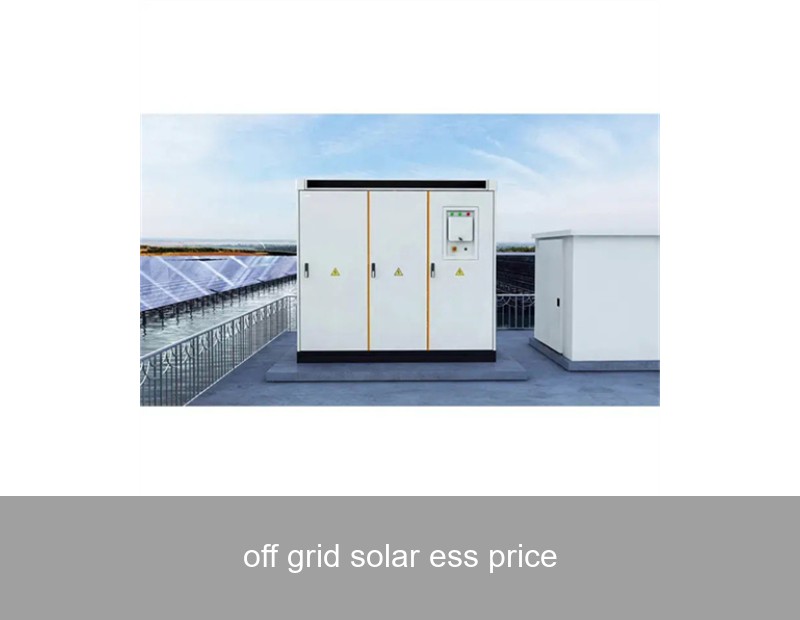
Have you ever dreamed of truly unplugging from the utility grid, powered entirely by the sun? For homeowners, remote businesses, and forward-thinking communities, off-grid living is no longer a rustic fantasy but a technologically sophisticated reality. The heart of this transformation is the Off-Grid Solar Energy Storage System (ESS). But when considering the leap, one question inevitably takes center stage: what determines the off-grid solar ESS price, and is it worth the investment? Let's demystify the costs and value behind cutting-edge energy independence.
Table of Contents
- The Real Breakdown of an Off-Grid Solar ESS Price
- Key Factors That Drive Your System's Cost
- From Cost to Value: A Californian Homestead Case Study
- Looking Beyond the Price Tag: Intelligence is Key
- How Highjoule Optimizes Your Off-Grid Investment
- Is Your Energy Independence Priced Right for the Future?
The Real Breakdown of an Off-Grid Solar ESS Price
It's a common misconception to equate the "price" solely with a battery cabinet. A fully functional off-grid system is an integrated ecosystem. The total off-grid solar ESS price typically encompasses several core components:
- Solar Panels: Your energy harvesters.
- Battery Storage: The heart of the ESS, storing excess solar energy for use at night or during cloudy periods.
- Inverter/Charger: The brain, converting DC solar power to AC for your home and managing battery charging/discharging.
- Balance of System (BOS): Mounting, wiring, switchgear, and critical safety components.
- Installation & Engineering: Professional design, permitting, and labor.
While battery costs have famously dropped (over 90% since 2010, according to BloombergNEF), the sophistication of the inverter technology and system integration now represents a significant and valuable portion of the cost. A cheap system might power your lights; a smart system powers your entire life reliably.
Key Factors That Drive Your System's Cost
Why can one homeowner's quote be $15,000 and another's $50,000? These variables are crucial:
| Factor | Impact on Off-Grid Solar ESS Price | Consideration |
|---|---|---|
| Daily Energy Consumption (kWh) | High | Larger battery capacity and solar array needed. |
| Peak Power Demand (kW) | High | Requires a more powerful inverter, impacting cost. |
| Required Days of Autonomy | High | More battery storage for consecutive cloudy days. |
| Battery Chemistry | Medium-High | Lithium Iron Phosphate (LFP) offers longer life & safety vs. older lead-acid. |
| Site Complexity & Location | Medium | Remote sites increase logistics and installation costs. |
From Cost to Value: A Californian Homestead Case Study
Let's move from theory to reality. Consider the Miller family in the Sierra Nevada foothills, California. Facing unreliable grid connections and prohibitive costs ($100,000+) to extend utility lines, they opted for an off-grid solution.
- Challenge: Power a 2,200 sq. ft. all-electric home year-round, including a water pump and essential appliances.
- Solution: A 24kW solar array paired with a 40kWh lithium iron phosphate (LFP) battery system, managed by a robust hybrid inverter.
- Off-Grid Solar ESS Price (Approx.): $55,000 - $65,000 fully installed.
- Financial Rationale: Compared to the $100k+ line extension, the system paid for itself in avoided costs from day one. Furthermore, by eliminating monthly utility bills (averaging $200-$300 in rural areas), they achieve a return on investment in under 10 years, with a system designed to last 15+ years.
- Intangible Value: Uninterrupted power during intense wildfire-related Public Safety Power Shutoffs (PSPS), a growing concern in the Western US as noted by the U.S. Department of Energy.

Image Source: Unsplash (Representative of an off-grid residential setting)
This case highlights that the off-grid solar ESS price must be evaluated against the cost of alternatives and the value of resilience.
Looking Beyond the Price Tag: Intelligence is Key
In an off-grid scenario, every watt-hour is precious. The difference between a frustrating power failure and seamless living often lies in the system's "brain" – the energy management software. Advanced systems don't just store energy; they predict it, allocate it intelligently, and give you complete visibility and control. This operational intelligence is what transforms a capital expense into a reliable, long-term asset.
How Highjoule Optimizes Your Off-Grid Investment
This is where Highjoule's 18+ years of expertise fundamentally changes the equation. We understand that the true off-grid solar ESS price is the total cost of ownership over decades. Our solutions are engineered for this.
For robust off-grid applications, Highjoule's HPS Series Commercial & Industrial ESS and scalable HRS Residential Solutions are built on LFP chemistry, renowned for safety and longevity. Crucially, they are governed by our proprietary Energy Management System (EMS) platform. Think of it as an autopilot for your energy ecosystem: it learns your consumption patterns, forecasts solar generation based on weather data, and prioritizes loads to ensure critical operations never go dark. It maximizes the utility of every dollar invested in your hardware.

Image Source: Unsplash (Representative of an energy management interface)
Our global team provides end-to-end support—from custom design and simulation to commissioning and remote monitoring—ensuring your off-grid system delivers on its promise of independence, not just as a purchase, but as a complete, worry-free energy solution.
Is Your Energy Independence Priced Right for the Future?
The conversation about off-grid solar ESS price is evolving from "How much does the box cost?" to "What is the value of guaranteed, clean power on my terms?" With climate volatility increasing grid instability and technology costs continuing to trend favorably, the economic and resilience argument strengthens each year.
What specific energy security challenge—be it remote location, unreliable infrastructure, or a desire for absolute sustainability—is making you reconsider the true price of the power you depend on?
 Inquiry
 Online Chat