


Off Grid vs On Grid Solar System: Choosing the Right Path to Energy Independence
Have you ever watched your electricity bill climb and wondered, "What if I could break free?" For homeowners and businesses across Europe and the US, solar power is the clear answer. But the journey begins with a fundamental choice: an off grid vs on grid solar system. This decision isn't just about panels on your roof; it's about defining your relationship with the energy grid, your resilience, and your long-term savings. Let's demystify these two paths, using real-world data and insights, to help you navigate toward a smarter, more sustainable energy future.
Table of Contents
- The On-Grid System: Your Collaborative Energy Partner
- The Off-Grid System: Your Fortress of Energy Independence
- Head-to-Head: A Detailed Comparison
- Real-World Insights: A Californian Case Study
- Beyond the Binary: The Rise of Smart, Resilient Hybrid Systems
- Your Energy, Your Choice: What's Your Priority?
The On-Grid System: Your Collaborative Energy Partner
An on-grid (or grid-tied) solar system is the most common choice, particularly in urban and suburban areas. It's designed to work in harmony with the public electricity grid. Think of it as a two-way street: your solar panels generate power during the day, often producing more than you need. This excess energy doesn't go to waste; it's fed back into the grid.
This interaction is managed through a process called net metering. In many regions, your utility company will credit you for the surplus electricity you export, effectively spinning your meter backwards. When the sun isn't shining, you seamlessly draw power from the grid. It's a elegant, efficient partnership.
Key Advantages of Grid-Tied Systems
- Lower Initial Investment: No need for large, expensive battery banks.
- Net Metering Benefits: Potentially offset your entire electricity bill with credits.
- High Reliability: The grid acts as a boundless "battery," ensuring power 24/7.
- System Simplicity: Fewer components mean generally easier maintenance.
However, this collaboration has a catch: grid dependency. When the grid goes down, a standard on-grid system must automatically shut off for safety reasons, leaving you in the dark even on a sunny day. This vulnerability is pushing many to reconsider their options.
The Off-Grid System: Your Fortress of Energy Independence
An off-grid solar system is a self-contained power plant. It operates entirely independently from the utility grid. This is the solution for remote cabins, agricultural operations, or anyone seeking complete energy autonomy and resilience.
The critical component here isn't just the solar panels—it's the energy storage system (ESS). Since there's no grid to fall back on, every watt of solar energy produced must be consumed immediately or stored for later use. This requires a robust battery bank, a charge controller, and often a backup generator for prolonged periods of poor weather.

The Heart of Off-Grid: Battery Storage Technology
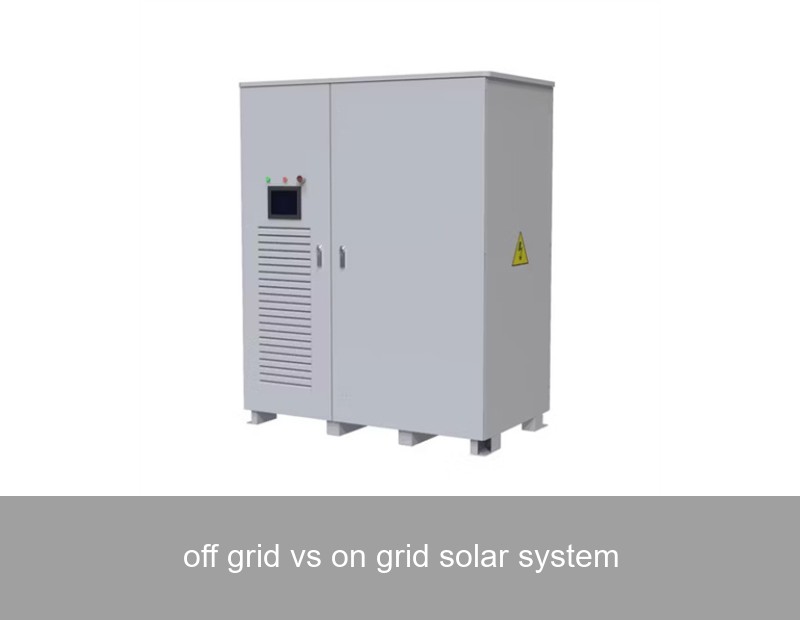
The success of an off-grid system lives and dies by its battery. Traditional lead-acid batteries are being rapidly superseded by Lithium Iron Phosphate (LFP) battery technology, which offers longer lifespan, deeper safe discharge cycles, and superior thermal stability. This is where specialized knowledge and quality hardware become non-negotiable. Companies like Highjoule have built their expertise on designing integrated storage solutions that maximize the efficiency and longevity of off-grid systems. Our HES Series (Home Energy Storage) and C&I ESS (Commercial & Industrial Energy Storage Systems) are engineered with advanced battery management systems (BMS) to provide reliable, safe, and intelligent power for the most demanding off-grid applications.
Head-to-Head: A Detailed Comparison
| Feature | On-Grid Solar System | Off-Grid Solar System |
|---|---|---|
| Connection to Utility Grid | Yes | No |
| Energy Storage Required | Optional (for backup) | Mandatory (large capacity) |
| Power During Grid Outages | No (unless with storage) | Yes |
| Upfront System Cost | Lower | Significantly Higher |
| Electricity Bills | Reduced or eliminated (with credits) | Completely eliminated |
| Best For | Urban/suburban homes, areas with reliable grid and net metering | Remote locations, areas with frequent outages,追求绝对能源独立的用户 |
| Maintenance Complexity | Lower | Higher (battery maintenance critical) |
Real-World Insights: A Californian Case Study
Let's move from theory to practice. Consider the case of a vineyard in Sonoma County, California. The property was subject to Public Safety Power Shutoffs (PSPS)—preemptive grid outages to prevent wildfires—which threatened critical refrigeration and irrigation systems.
Phenomenon: Frequent, multi-day grid outages risking significant business loss.
Data & Solution: They installed a 150 kW solar array coupled with a 500 kWh off-grid capable battery storage system.
Outcome: The system provided uninterrupted power during PSPS events. In one year, it avoided over $120,000 in potential spoilage and operational losses, while also providing daily load-shifting savings of approximately 30% on their electricity costs when the grid was active. This hybrid approach, using a large-scale battery system, provided both economic and operational resilience.
This mirrors the solutions Highjoule provides for commercial clients. Our C&I ESS and Microgrid Solutions are designed precisely for this scenario: to ensure business continuity, manage energy costs through intelligent software, and provide a clean, reliable alternative to diesel generators.
Beyond the Binary: The Rise of Smart, Resilient Hybrid Systems
The debate of off grid vs on grid solar system is evolving. Today, the most compelling choice for many is a hybrid solar system (or grid-tied with battery backup). This system offers the best of both worlds.
- It remains connected to the grid for net metering and backup.
- It incorporates a significant battery storage system.
- Intelligent energy management software decides when to store solar energy, when to use it, and when to draw from or export to the grid.
During an outage, the system can automatically "island" itself, powering critical loads from the batteries and solar, while disconnecting from the grid for safety. This is the pinnacle of modern, resilient energy design.

Highjoule's entire product philosophy is built around this intelligent, hybrid future. Our systems, like the HES Series, come with integrated AI-driven energy management platforms. They learn your consumption patterns, weather forecasts, and utility rate schedules to autonomously optimize your energy flow—maximizing self-consumption, protecting you from outages, and saving you the most money. It’s not just hardware; it’s an intelligent energy ecosystem for your home or business.
Key Considerations Before You Decide
Ask yourself and your installer these crucial questions:
- Grid Reliability: How frequent and long-lasting are power outages in my area?
- Financial Drivers: Is my primary goal bill reduction, ROI, or absolute backup assurance?
- Local Policies: What are the net metering or feed-in-tariff rules here? (Policies vary greatly between US states and European countries).
- Future-Proofing: Will my energy needs increase (e.g., an EV charger, heat pump)?
Your Energy, Your Choice: What's Your Priority?
The journey between an off grid vs on grid solar system is no longer a simple fork in the road. It's a spectrum where smart technology allows you to customize your level of independence. Whether you seek the economic synergy of a grid-tied system, the total freedom of off-grid living, or the resilient intelligence of a hybrid setup, the foundation is a well-designed system with quality components.
As you ponder this critical decision, consider this: Is your ultimate goal simply to lower your bill, or is it to fundamentally transform how you access, use, and think about power in an increasingly uncertain energy landscape?
 Inquiry
 Online Chat