


Powering Your Submersible Pump with Solar Panels: A Complete Guide
Imagine a reliable water source on your remote farm or property, completely independent of the grid and rising electricity costs. This is the powerful reality that paneles solares para bomba sumergible (solar panels for submersible pumps) are creating across farms, ranches, and homesteads. This article will guide you through how this technology works, its undeniable benefits, and what you need to consider for a robust and efficient system.
Table of Contents
- The Challenge: Water Access Off the Grid
- How a Solar-Powered Submersible Pump System Works
- Key Components of a Solar Pumping System
- A Real-World Case Study: Vineyard in California
- Why Choose Solar for Your Water Pumping Needs?
- The Highjoule Advantage: Beyond Just Panels
The Challenge: Water Access Off the Grid
For decades, accessing groundwater in remote locations meant relying on expensive diesel generators or the prohibitive cost of extending power lines. The phenomenon is clear: properties beyond the grid face a constant struggle for reliable, affordable water for irrigation, livestock, or domestic use. The volatility of fuel prices and maintenance adds another layer of complexity and cost.
Let's look at the data. According to the U.S. Department of Agriculture, irrigated agriculture accounts for nearly 42% of the nation's freshwater withdrawals. For many of these farms, energy for pumping is a top operational expense. Solar pumping presents a direct way to mitigate this, converting abundant sunlight into direct water access.
How a Solar-Powered Submersible Pump System Works
The principle is elegantly simple. Paneles solares para bomba sumergible capture sunlight and convert it into direct current (DC) electricity. This DC power is then used to drive a submersible pump motor, which lifts water from the well or borehole to the surface. The system's brain is a specialized solar pump controller (or inverter), which ensures the pump motor starts and runs smoothly, matching the available solar power, even on partly cloudy days.

Image Source: Unsplash - Representative image of solar panels in an agricultural setting.
Key Components of a Solar Pumping System
To understand the solution fully, let's break down the essential parts:
- Solar Photovoltaic (PV) Array: This is your power plant. The number and wattage of panels determine how much water you can pump daily.
- Solar Pump Controller/Inverter: This critical device maximizes power harvest from the panels, protects the pump from voltage fluctuations, and allows for soft starting.
- Submersible Pump Motor: Specifically designed for DC or variable-frequency AC operation from solar input, these are more efficient for solar applications than standard AC pumps.
- Water Storage Tank: Since the sun doesn't shine 24/7, storing water in a tank is far more cost-effective than storing electricity in batteries for this application. This provides a buffer for cloudy days and allows water use on demand.
- Piping & Wiring: Properly sized components to minimize losses.
The Critical Role of Energy Storage and Management
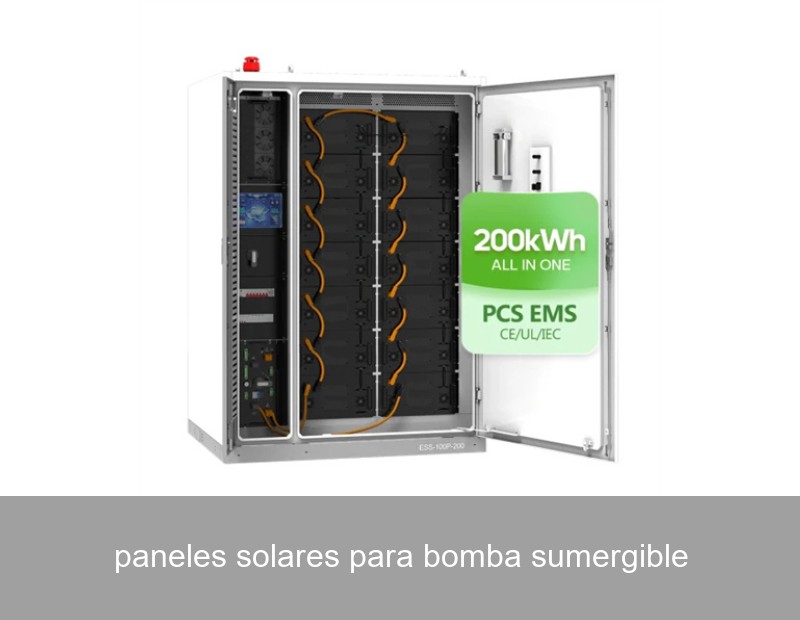
While a basic system runs the pump directly from sunlight, what if you need water pressure on demand or want to run the pump during non-sunny hours? This is where advanced energy management comes in. Integrating a battery storage system and a smart energy management system, like those developed by Highjoule, can transform a simple solar pump into a fully intelligent water solution. Our Highjoule HES Series Hybrid Energy Storage systems can store excess solar energy to run the pump in the early morning, evening, or during brief cloudy periods, ensuring unparalleled reliability without needing a generator.
A Real-World Case Study: Vineyard in California, USA
Let's move from theory to practice with a concrete case from Sonoma County, California. A 50-acre vineyard faced escalating electricity costs and wanted to increase its irrigation resilience amid recurring drought conditions and Public Safety Power Shutoffs (PSPS).
The Project: Installation of a 15kW solar array directly coupled to a 10HP submersible pump for drip irrigation, supported by a Highjoule HES-20 battery storage unit and smart controller.
| Metric | Before Solar | After Solar + Highjoule System |
|---|---|---|
| Monthly Energy Cost for Pumping | $1,200 - $1,800 | $0 (direct solar) / ~$40 (min. grid connection fee) |
| Irrigation Reliability during Grid Outages | Zero (Pump offline) | Full (48+ hours on battery, indefinite with sun) |
| Daily Water Pumping Capacity | Limited to 6 hours (cost) | 8-10 hours (sunlight + stored energy) |
| Estimated Payback Period | N/A | 4.2 years |
This insight is powerful: pairing paneles solares para bomba sumergible
Why Choose Solar for Your Water Pumping Needs?
The benefits are compelling:
- Zero Fuel Cost & Low Operating Expenses: Sunlight is free. After the initial investment, your running costs are minimal.
- Energy Independence: Free yourself from the grid and volatile utility prices.
- Low Maintenance & High Reliability: With no moving parts except the pump, solar arrays require very little upkeep.
- Environmentally Sustainable: A clean, renewable solution that reduces your carbon footprint.
- Scalability: Systems can be designed to meet exact needs and expanded later if required.
The Highjoule Advantage: Beyond Just Panels
While the solar panels are the visible component, the system's heart is in the power conversion and management. This is where Highjoule, as a global leader in advanced energy storage systems, adds transformative value. We don't just sell components; we provide integrated, intelligent power solutions.
For a solar pumping application, our Highjoule HES Series can be configured to:
- Prioritize direct solar power for the pump, maximizing efficiency.
- Store surplus energy in integrated lithium batteries for pumping on demand or powering other critical farm loads.
- Provide seamless backup power, ensuring the pump operates even during grid instability.
- Offer remote monitoring and control via our platform, so you can manage your water assets from anywhere.
Think of it as giving your solar pumping system a brain and a backup heart, ensuring it performs optimally every single day. For larger commercial or agricultural applications, our Highjoule C&I (Commercial & Industrial) Energy Storage Solutions can manage multiple loads, integrating the pump into the entire property's energy ecosystem.

Image Source: Unsplash - Solar panels supporting large-scale irrigation.
Making It Work for You: Key Considerations
So, is a solar submersible pump system right for you? Ask yourself and your provider these key questions:
- Water Needs: What is your daily water requirement (in gallons or liters)? This determines pump size and solar array size.
- Solar Resource: What is the solar insolation at your location? (Tools like Global Solar Atlas provide excellent data).
- Well Characteristics: What is the static water level, pumping water level, and well yield? This defines the pump's lift and flow rate.
- Storage Strategy: Will you store water, energy, or both? A water tank is standard, but adding a Highjoule battery system future-proofs your operation.
- Future Expansion: Might you add more pumps or other electrical loads? An expandable system from the start is wise.
For authoritative information on solar potential and water resource management, you can refer to resources like the U.S. Department of Energy's Solar Energy Technologies Office and the FAO's resources on solar pumping.
Your Next Step
The journey to water independence starts with a detailed assessment. What specific water challenge on your property could be solved by harnessing the sun's power with a system designed for intelligence and resilience?
 Inquiry
 Online Chat