


Understanding the Panneau Solaire avec Onduleur Intégré: A Simpler Path to Solar Power
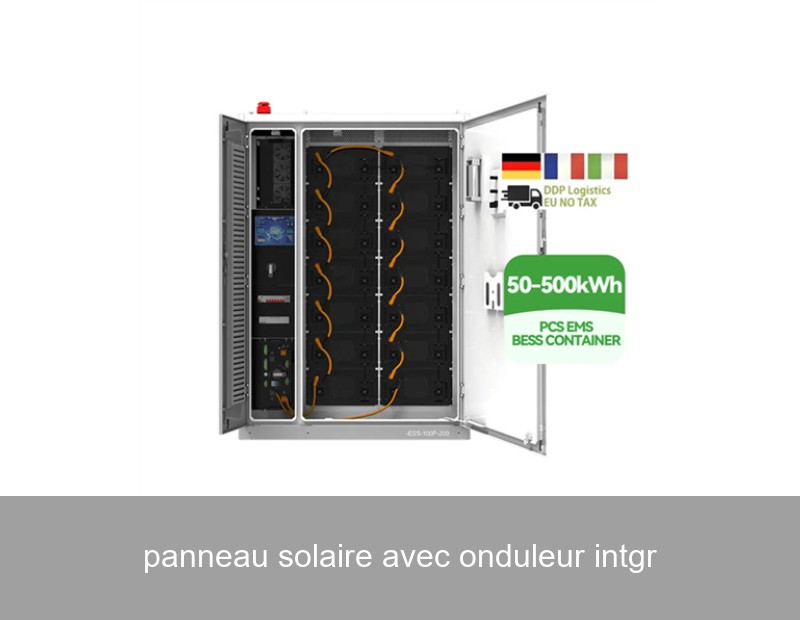
If you're exploring solar energy for your home, you've likely encountered a sea of technical terms. One innovation that's genuinely changing the game, especially for homeowners in Europe and the US, is the panneau solaire avec onduleur intégré – the solar panel with a built-in inverter. This all-in-one solution promises a cleaner, more efficient installation. But is it the right choice for your energy needs? Let's demystify this technology, examine its real-world performance, and see how it fits into the broader, smarter energy systems of today.
Table of Contents
- What is an Integrated Solar Panel?
- Key Benefits and Practical Challenges
- The Data That Matters: Efficiency and Performance
- Real-World Case Study: A German Household's Experience
- Thinking Beyond the Panel: The Role of Smart Storage
What Exactly is a Panneau Solaire avec Onduleur Intégré?
Traditionally, a solar power system involves multiple components: the panels on your roof, a string inverter mounted on a wall (usually in your garage or basement), and a web of DC cabling connecting them. The inverter's job is crucial—it converts the direct current (DC) electricity produced by the panels into the alternating current (AC) that powers your home.
A panneau solaire avec onduleur intégré flips this design. Here, a small, powerful micro-inverter is attached directly to the back of each individual solar panel. This means each panel becomes its own independent power station, converting DC to AC right on the roof.
Image Source: Unsplash - A modern rooftop solar array where integrated inverter technology can optimize each panel's output.
Key Benefits and Practical Challenges
So, why the shift towards integration? The advantages are compelling:
- Enhanced Energy Harvest: With a traditional system, if one panel is shaded or dirty, the output of the entire string can drop. With integrated micro-inverters, each panel operates independently. Shade on one panel doesn't drag down the performance of the others, leading to higher overall energy production, especially on roofs with complex angles or partial shading.
- Simplified Design & Safety: The system uses standard AC wiring from the roof, which is often simpler to install and can be safer, as there's no high-voltage DC running through your home.
- Granular Monitoring: You can track the performance of every single panel via an app, instantly identifying if a specific module has an issue.
However, it's not without considerations. The initial cost per panel can be higher. Also, because the electronics are on the roof exposed to the elements, long-term durability is a key factor—choosing a reputable manufacturer with a strong warranty is essential.
The Data That Matters: Efficiency and Real-World Performance
Independent studies back up the performance claims. Research from the National Renewable Energy Laboratory (NREL) has shown that systems using module-level power electronics (like integrated micro-inverters) can outperform traditional string inverter systems by 5% to 25% in scenarios with shading or panel mismatch. For an average 6kW home system, that could mean hundreds of extra kilowatt-hours of electricity per year—enough to power your refrigerator for months.
| System Type | Advantage in Shaded Conditions | Typical Monitoring Level | Best For Roofs With... |
|---|---|---|---|
| Traditional String Inverter | Low | System Total | Uniform sun exposure, no obstructions |
| Panels with Integrated Micro-Inverter | High | Per-Panel | Chimneys, vents, multiple angles, partial shading |
Real-World Case Study: The Müller Family Home in Bavaria
Let's look at a concrete example. The Müller family in Munich, Germany, installed a 8.2 kW solar array on their south-west facing roof in 2021. Their roof has two dormer windows that cast shadows in the late afternoon. Their installer recommended a system using high-efficiency panels with integrated micro-inverters.
- System Size: 8.2 kW (20 panels)
- Technology: Panneaux solaires avec onduleur intégré
- Key Challenge: Partial shading from dormers after 3 PM.
- Result: System monitoring showed that while the four shaded panels saw a ~40% drop in output during peak shade, the other 16 panels continued operating at 98-100% capacity. The estimated annual energy loss was only 8%. With a traditional string inverter, simulations indicated losses could have been as high as 35% during those shaded hours, reducing their annual production by nearly 15%. The integrated system ensured they maximized their self-consumption and ROI.

Image Source: Unsplash - Homeowners can monitor per-panel performance through intuitive apps, a key benefit of modern systems.
Thinking Beyond the Panel: The Crucial Role of Smart Storage
Choosing the right panel technology is a brilliant first step, but true energy independence comes from storing the power you generate. This is where the story evolves. Your panneau solaire avec onduleur intégré produces power during the day, but what about at night or during a grid outage? This is the domain of advanced battery storage systems.
As a global leader in advanced energy storage since 2005, Highjoule understands this synergy intimately. Our smart battery systems, like the Highjoule HomePower Stack, are designed to seamlessly integrate with modern solar arrays, whether they use string inverters or integrated micro-inverters. Our systems don't just store energy; they intelligently manage it. Using AI-driven software, the Highjoule system learns your household's consumption patterns, automatically deciding when to store solar energy, power your home, or even provide backup power during an outage—all while optimizing for time-of-use electricity rates common in many European and US markets.
Think of it this way: your integrated solar panels are a highly efficient team of producers. A Highjoule battery storage system is the savvy manager that ensures none of that valuable production goes to waste, maximizing your self-consumption and protecting your home.
Making the Right Choice for Your Energy Future
So, is a panneau solaire avec onduleur intégré your best option? If your primary goal is to maximize production on a challenging roof and you value detailed monitoring, it is an excellent, future-proof choice. The higher initial investment is often justified by greater long-term yield and resilience.
However, the most powerful solution combines optimized production with intelligent storage. It's about creating a holistic, resilient energy ecosystem for your home. This integrated approach—high-performance generation paired with smart storage—is at the core of what Highjoule provides for residential, commercial, and microgrid applications worldwide.
Your Home's Energy Personality
Every home has a unique "energy personality" shaped by its roof, location, consumption habits, and goals. The technology, from panel to inverter to battery, must be tailored to match. What step will you take today to better understand your home's energy potential and move towards a more sustainable, independent power supply?
 Inquiry
 Online Chat