


Solar Panel Price in Sweden 1000 Watt: Your Guide to Smart Investment and Long-Term Savings
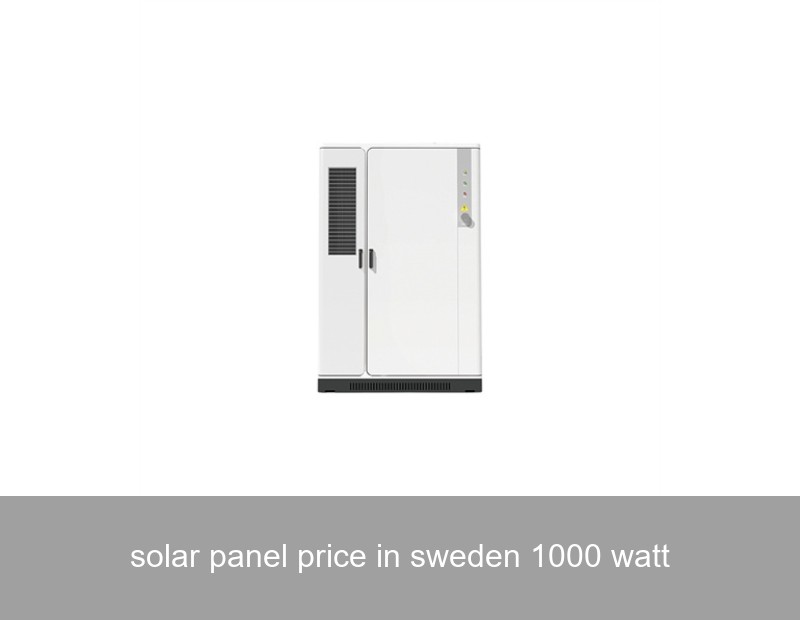
If you're researching the solar panel price in Sweden for a 1000 watt system, you're asking the right first question. But here's a crucial insight from the field: focusing solely on the per-watt cost of the panels is like buying a car based only on the tire price. The true value—and the real return on investment—lies in the complete, intelligent system that captures, stores, and manages that solar energy. In Sweden's unique energy landscape, with its seasonal variations and attractive electricity prices, how you use your solar power is just as important as how you generate it.

Understanding the "Solar Panel Price in Sweden 1000 Watt"
Let's decode the baseline. A 1 kW (1000-watt) photovoltaic (PV) system is a common entry point for residential installations. As of 2024, the hardware cost for the panels themselves for such a system in Sweden can range from SEK 2,000 to SEK 4,000 before VAT, depending on panel efficiency and brand. However, this is just a fragment of the total project cost.
The total installed price per kWp (kilowatt-peak) in Sweden typically falls between SEK 15,000 and SEK 25,000 for a standard grid-tied system. This "turnkey" price includes:
- High-efficiency solar panels (monocrystalline is the dominant choice for Swedish conditions).
- Inverters (which convert DC solar power to usable AC).
- Mounting systems, cabling, and safety components.
- Professional installation, grid connection paperwork, and certification.
Why the significant jump from panel-only to installed price? It's the value of a certified, safe, and optimized system. A poorly installed 1 kW system will never deliver its full financial or energetic potential, making the initial panel savings a false economy.
The Swedish Context: It's Not Just About Sunshine Hours
Sweden's solar potential is surprisingly strong, with annual insolation comparable to parts of Germany, a global solar leader. The economics are driven less by blistering sun and more by high and volatile electricity prices. According to the Swedish Energy Agency, average household electricity prices have seen significant fluctuations, making self-consumption and independence increasingly attractive. The government support, like the tax deduction for green technology (grön teknik), further improves the payback period.
The Real Cost Breakdown: More Than Just Panels
To make an informed decision, you must look at the system lifecycle. Let's break down the value chain of a typical 1 kW installation:
| Cost Component | Approximate Share of Total Cost | What It Delivers |
|---|---|---|
| PV Modules (Panels) | 15-25% | Energy generation; efficiency & durability are key. |
| Inverter & Power Electronics | 10-15% | System heart; converts and manages power flow. |
| Mounting, Cabling, Hardware | 10-15% | Safety, longevity, and roof integration. |
| Installation & Soft Costs | 50-60% | Expertise, warranty, permits, and peace of mind. |
The table reveals a critical point: the majority of your investment goes towards expertise and integration. This is where choosing a partner like Highjoule becomes pivotal. We don't just sell components; we provide integrated PowerStack™ solutions that combine high-performance generation with intelligent battery storage and energy management software. This transforms a simple PV system into a resilient personal microgrid.
A Real-World Case: The Västerås Warehouse Project
Let's move from theory to practice. In 2023, a medium-sized logistics warehouse in Västerås faced rising operational costs and sought to lock in long-term energy stability. Their goal wasn't just to offset costs but to ensure critical cooling systems remained online during grid fluctuations.
- System Size: A 40 kWp solar array (significantly larger than a residential 1 kW, but the principles scale).
- Key Challenge: High daytime generation, but significant energy use in early morning and evening when solar production was low.
- Solution: A Highjoule integrated system featuring our PowerStack™ HS Series commercial battery storage (50 kWh capacity) and the EnergyOS management platform.
- Result: The system now stores excess midday solar energy. It discharges during peak price hours (17-20) and maintains cooling for 4+ hours during a simulated grid outage. The project increased the facility's self-consumption of solar power from 35% to over 80%, reducing grid dependence and shortening the payback period by an estimated 2 years compared to a solar-only setup.
This case illustrates the paradigm shift: the most critical metric is no longer just the cost per watt of panels, but the levelized cost of stored energy you actually use.

The Highjoule Advantage: Intelligent Storage Maximizes Your Investment
So, you've researched the solar panel price in Sweden for 1000 watt. Now, consider what happens after installation. Without storage, you might export surplus power to the grid at a lower price and buy it back at night at a higher price. This dynamic is why Highjoule's core expertise is essential.
Our PowerStack™ residential and commercial battery systems are engineered for Nordic conditions and are seamlessly integrated with solar inverters. When you pair your solar panels with a Highjoule system, you:
- Maximize Self-Consumption: Store your cheap, clean solar energy for use anytime, drastically reducing grid imports.
- Gain Energy Security: Provide backup power during outages, a value beyond price.
- Enable Smart Energy Management: Our EnergyOS software can intelligently charge from the grid when prices are low (if you choose) and discharge when they are high, optimizing against the spot market. You can monitor and control everything via an intuitive app.
For a homeowner, this means the effective "value" of each kilowatt-hour your 1 kW system produces is significantly higher, making the entire investment more robust and future-proof. We encourage you to think of solar and storage as a single, synergistic investment.
Navigating Incentives and Total ROI
Sweden's tax deduction (RUT-avdrag) for solar cell installation can cover up to 15% of labor costs. When you invest in a combined solar-plus-storage system from Highjoule, the eligible labor portion often increases, as the installation of our integrated storage units is included. A comprehensive financial analysis from our experts will model your specific payback time, factoring in your consumption pattern, local grid fees, and current electricity contracts.
The Future of Solar Economics in Sweden
The trend is clear: panel hardware costs have fallen steadily and will likely continue a gradual decline. However, the soft costs (installation, design) and the value of grid services are becoming more prominent. Furthermore, as electricity grids modernize, dynamic tariffs and time-of-use pricing will become standard. A system that is "storage-ready" or includes storage from day one, like Highjoule's offerings, positions you perfectly for this future.
Innovations in battery chemistry, like the LFP (Lithium Iron Phosphate) cells we use in many PowerStack™ models, offer longer lifetimes, enhanced safety, and better performance in a wider temperature range—crucial for Swedish winters.

Is Your Roof Ready for a Smarter Energy Future?
The question of solar panel price in Sweden for a 1000 watt system is your starting line, not the finish. The ultimate goal is to achieve energy independence, cost predictability, and sustainability. With Highjoule's 18+ years of global experience in advanced energy storage, we help you navigate from initial curiosity to a fully optimized, intelligent power solution for your home or business.
What does your current electricity consumption profile look like, and how could shifting just 70% of that to self-generated, stored solar power change your financial and environmental footprint over the next decade?
 Inquiry
 Online Chat