


Building a Resilient Power System and Renewable Energy Future
Imagine a world where the lights stay on, factories hum steadily, and our homes are comfortably powered—all by the clean, abundant energy of the sun and wind. This is the promise of the modern power system and renewable energy integration. Yet, for many grid operators and energy managers, the current reality is a complex balancing act. The very nature of solar and wind—their glorious intermittency—poses a fundamental challenge to the century-old model of the power grid. How do we keep the system stable when the sun sets or the wind stops? The answer lies not in building more fossil-fuel peaker plants, but in intelligent, large-scale energy storage. As a global leader in advanced energy storage solutions since 2005, Highjoule is at the forefront of this transformation, providing the technological keystone that bridges renewable potential with grid reliability.
The Modern Power Dilemma
Our traditional power system was designed for one-way flow: from large, centralized, and dispatchable power plants (like coal, gas, or nuclear) to consumers. Generation was adjusted to meet predictable demand. Enter renewables. Solar farms and wind turbines generate power when nature allows, not necessarily when we need it most. This creates a mismatch. On a brilliantly sunny afternoon, solar generation can soar, potentially overloading the grid, while demand peaks in the early evening when solar output plummets. This instability forces grid operators to curtail (waste) clean energy or rely on fast-responding, often carbon-intensive, gas plants to fill the sudden gaps. This is the core dilemma of our energy transition.
The Renewables Reliability Gap: A Data-Driven Phenomenon
The data paints a clear picture. In 2023, the U.S. generated 238 million MWh of utility-scale solar power, a staggering increase of 155% over five years. In Europe, wind and solar occasionally supplied over 70% of daily electricity demand in countries like Germany and Spain. However, the International Energy Agency (IEA) consistently highlights grid integration and flexibility as the critical bottlenecks for further renewable deployment. The variability isn't just a daily issue; it's seasonal and weather-dependent. A prolonged calm, cloudy period—a "dunkelflaute" as Germans call it—can drastically reduce renewable output for days. The grid needs a shock absorber, and that's precisely what advanced battery storage provides.

Credit: Photo by American Public Power Association on Unsplash. Utility-scale solar is a cornerstone of renewable energy, but its intermittent nature challenges grid stability.
Case Study: California's Duck Curve & The Storage Solution
No discussion of power system and renewable energy challenges is complete without the iconic "Duck Curve." Coined by the California Independent System Operator (CAISO), it visually represents the steep net load drop in midday (solar abundance) and the sharp ramp-up required in the evening (solar decline + peak demand). In 2022, CAISO reported that over 2.4 million MWh of solar and wind energy was curtailed—enough to power over 200,000 homes for a year—primarily because the grid lacked sufficient capacity to store and shift it.
The state's response has been a massive build-out of energy storage. In one notable project, a 250 MW / 1,000 MWh battery energy storage system (BESS) was deployed in Monterey County. This facility, using technology analogous to Highjoule's grid-scale solutions, is designed to absorb excess solar during the day and discharge it over four hours during the evening peak. In its first year of operation, it helped reduce renewable curtailment in the region by an estimated 15% and provided critical grid services like frequency regulation. This real-world example demonstrates that storage is not a theoretical concept but an operational necessity smoothing the duck curve's belly and neck.
| Time of Day | Solar Generation | Grid Demand | Without BESS | With Highjoule-Style BESS |
|---|---|---|---|---|
| 12:00 - 3:00 PM | Very High | Moderate | Potential Curtailment | Storage Charging: Capturing excess energy |
| 6:00 - 9:00 PM | Low/None | Peak | Gas Peaker Plants Activated | Storage Discharging: Powering the peak cleanly |
| Overnight | None | Low | Baseload & Wind | Grid Services: Providing stability & reserves |
The Critical Role of Advanced Battery Energy Storage Systems (BESS)
A modern BESS is far more than just a big battery. It's an intelligent, grid-forming asset. Key capabilities include:
- Energy Time-Shifting (Arbitrage): Buying/store cheap renewable energy, selling/dispatching it during expensive peak periods.
- Frequency Regulation: Responding in milliseconds to tiny fluctuations in grid frequency, a service vital for stability that traditional plants struggle to provide efficiently.
- Black Start Capability: The ability to restart a portion of the grid after a total blackout, a function once exclusive to fossil-fuel plants.
- Voltage Support: Maintaining proper voltage levels, especially important in areas with high rooftop solar penetration.
This is where Highjoule's expertise becomes critical. Our systems are engineered with these grid-support functions as core design principles, not as afterthoughts.
Highjoule's Integrated Solutions for a Resilient Power System
At Highjoule, we understand that a successful power system and renewable energy integration requires tailored solutions. Our product suite is designed to address challenges at every level:
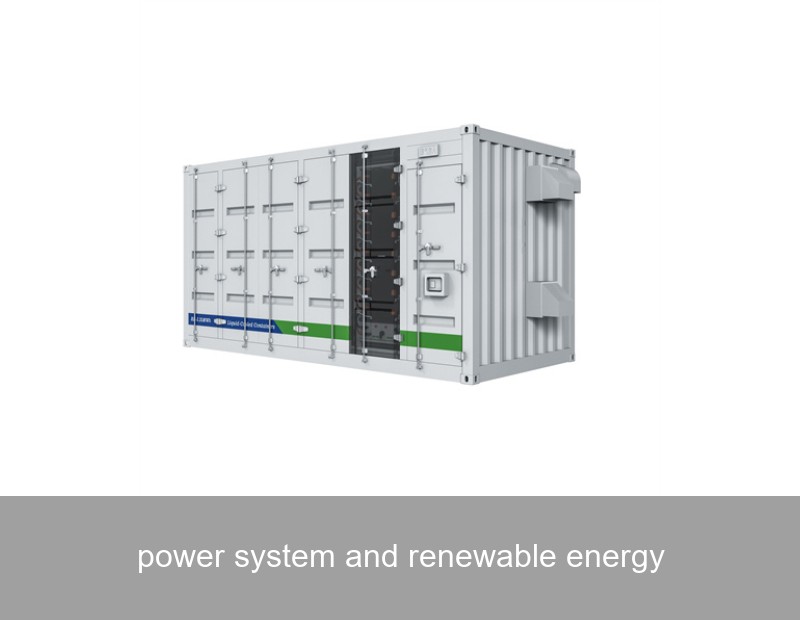
- For Utilities & Large-Scale Developers (Highjoule GridMax): Our flagship containerized BESS solution, scalable from 1 MW to hundreds of MW. It features advanced thermal management for longevity, grid-forming inverter technology for superior stability, and our proprietary JouleMind AI platform for optimizing dispatch across multiple revenue streams (energy arbitrage, frequency services, capacity markets).
- For Commercial & Industrial (C&I) Sites (Highjoule BusinessHub): Behind-the-meter systems that reduce demand charges, provide backup power during outages, and enable participation in demand response programs. A European manufacturing plant using our BusinessHub reduced its annual energy costs by 22% and secured its critical processes against grid instability.
- For Community Microgrids & Remote Areas: We design integrated systems combining solar PV, wind, and storage to create self-sufficient, resilient energy islands. This is particularly transformative for remote industrial sites or communities vulnerable to grid outages.
Our services extend beyond hardware, encompassing feasibility studies, system design, financing support, and long-term performance monitoring. We partner with our clients to ensure their investment delivers both economic and resilience returns.

Credit: Photo by Kindel Media on Pexels. Advanced, containerized battery storage systems like Highjoule's GridMax are the building blocks of a modern grid.
Envisioning the Future Grid Architecture
The end goal is a decentralized, flexible, and self-healing grid. Imagine thousands of distributed assets—rooftop solar, community batteries, EV fleets, and industrial storage like Highjoule's BusinessHub—all coordinated through intelligent software. This virtual power plant (VPP) can aggregate these resources to respond to grid needs as reliably as a traditional power plant, but with far greater agility and sustainability. This architecture flattens the duck curve, mitigates the need for new transmission lines, and democratizes energy security.
The journey to a 100% renewable-powered future is not a question of if, but how. The linchpin is our ability to store energy at scale and with intelligence. The technology is here, proven, and evolving rapidly.
 Inquiry
 Online Chat