


Beyond the Grid: Energiespeicher Kraftwerk as the Cornerstone of a Renewable Future
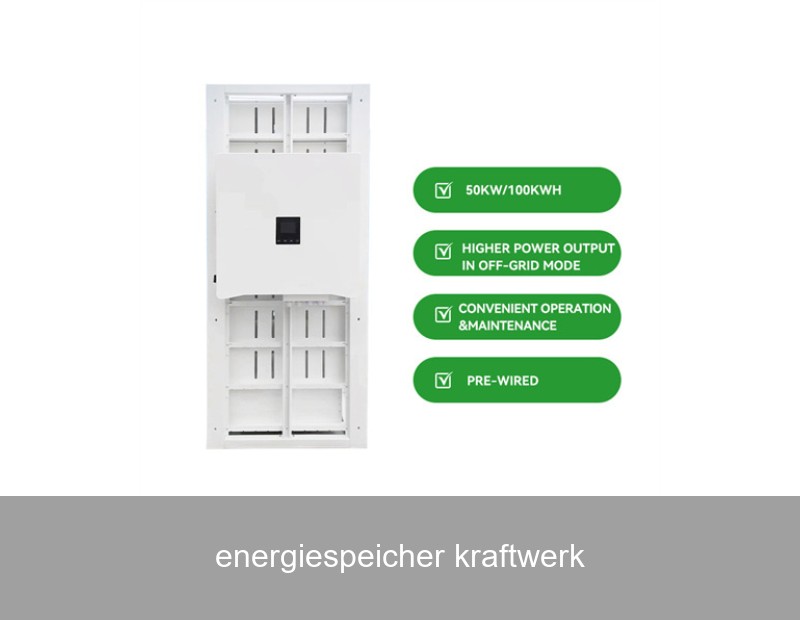
Imagine a world where a power plant doesn't burn fuel, but stores sunshine and wind. This isn't science fiction; it's the reality being built today with energiespeicher kraftwerk – energy storage power plants. As Europe and the U.S. aggressively pursue decarbonization, the intermittent nature of solar and wind power presents a critical challenge. The solution lies not just in generating clean energy, but in intelligently managing it. This is where large-scale battery energy storage systems (BESS) step in, transforming from passive units into active, grid-forming assets that stabilize networks and maximize renewable use.
Table of Contents
- The Challenge: Renewable Intermittency and Grid Strain
- The Solution: Energiespeicher Kraftwerk Explained
- The Data: Why Storage is Now Non-Negotiable
- Case Study: Grid Stability in Texas, USA
- Highjoule's Role: Intelligent Storage for Every Scale
- The Future: From Storage to Virtual Power Plants
The Challenge: Renewable Intermittency and Grid Strain
Let's be honest, we've all heard the concern: "What happens when the sun doesn't shine or the wind doesn't blow?" This question lies at the heart of the energy transition. In Germany, for instance, renewable sources frequently supply over 50% of daily electricity demand, but these peaks are followed by troughs that require rapid compensation. Similarly, in California or Texas, solar generation curves create the famous "duck curve," where net demand plummets during the day and ramps up steeply in the evening. This volatility strains conventional power plants, can lead to curtailment (wasting) of excess renewable energy, and threatens grid frequency stability.

Image: The 'Duck Curve' illustrates grid management challenges with high solar penetration. Source: U.S. Department of Energy
The Solution: Energiespeicher Kraftwerk Explained
An energiespeicher kraftwerk is a centralized facility that uses vast arrays of battery modules, sophisticated power conversion systems (PCS), and advanced energy management software (EMS) to perform multiple critical grid services. Think of it as a massive "shock absorber" and "time-shift" device for the electricity grid. Unlike a traditional peaker plant that takes minutes to hours to fire up, a storage power plant can respond in milliseconds.
Its core functions include:
- Frequency Regulation: Instantly injecting or absorbing power to keep the grid's frequency at 50 Hz (Europe) or 60 Hz (U.S.).
- Renewable Energy Time-Shift (Arbitrage): Storing cheap, excess solar/wind energy during the day and discharging it during expensive peak evening hours.
- Voltage Support: Providing reactive power to maintain voltage levels within safe limits on local distribution lines.
- Black Start Capability: Helping to restart the grid after a widespread outage, a function traditionally reserved for fossil-fuel plants.
The Data: Why Storage is Now Non-Negotiable
The growth trajectory speaks for itself. According to BloombergNEF, global energy storage installations are set to multiply exponentially, reaching terawatt-hour scale by 2030. In the U.S., the Inflation Reduction Act (IRA) has turbocharged the market, while the EU's Green Deal and RepowerEU plan set ambitious storage targets. The economics have flipped: the levelized cost of storage (LCOS) for lithium-ion batteries has fallen dramatically, making energiespeicher kraftwerk projects not just a technical necessity, but a commercially savvy investment. They are becoming the most cost-effective tool for grid operators to defer costly infrastructure upgrades and manage congestion.
| Region | Key Driver | Projected BESS Growth (2023-2030) |
|---|---|---|
| United States | Inflation Reduction Act (IRA), FERC Order 841 | Over 100 GW |
| European Union | REPowerEU Plan, Grid Modernization | Over 60 GW |
| Germany | Energiewende, Phase-out of Nuclear & Coal | Significant portion of EU capacity |
Case Study: Grid Stability in Texas, USA
Let's look at a real-world application. The ERCOT grid in Texas is known for its high wind penetration and isolated nature, making it vulnerable to frequency events. In 2021, a major freeze caused widespread blackouts, highlighting the need for more resilient assets. In response, one of the world's largest battery storage projects came online: the 300 MW / 450 MWh "Cunningham" energy storage power plant.
This facility acts as a giant shock absorber for the ERCOT grid. During a period of unexpectedly low wind generation in the summer of 2023, this and similar storage plants discharged over 1,500 MWh of electricity during peak demand hours, preventing potential rolling blackouts and stabilizing wholesale prices. It provided fast frequency response that traditional thermal plants simply could not match, showcasing the energiespeicher kraftwerk as an essential reliability tool. You can read more about ERCOT's storage integration in this report by the U.S. Department of Energy.
Highjoule's Role: Intelligent Storage for Every Scale
At Highjoule, we've been at the forefront of this transformation since 2005. We understand that a true energiespeicher kraftwerk is more than just hardware; it's an intelligent system. Our flagship product, the GridMax BESS, is engineered for utility-scale applications. It features our proprietary Adaptive Cell Management (ACM) technology, which extends battery cycle life by up to 20% by individually monitoring and balancing thousands of cells. Coupled with our NeuralGrid EMS platform, it can autonomously optimize dispatch across multiple revenue streams—frequency regulation, arbitrage, and capacity services—maximizing ROI for our clients.

Image: Modern large-scale BESS installations require precision engineering. Source: Unsplash (Representative Image)
But our expertise scales across the energy ecosystem. For commercial and industrial (C&I) clients, our PowerHub C&I systems reduce demand charges and provide backup power. For microgrids and communities, our integrated solutions enable energy independence. From initial consultancy and system design to long-term performance monitoring, Highjoule provides a full turnkey service, ensuring every storage asset operates as a reliable and profitable kraftwerk in its own right.
The Future: From Storage to Virtual Power Plants
The evolution of the energiespeicher kraftwerk is leading us to the concept of the Virtual Power Plant (VPP). A VPP aggregates thousands of distributed assets—home batteries, EV chargers, C&I storage systems, and even large-scale BESS—into a single, coordinated network controlled by cloud-based software. This aggregated "virtual" plant can bid into energy markets and provide grid services with even greater flexibility and resilience. Highjoule's NeuralGrid EMS is already enabling this future, allowing diverse storage assets to communicate and act as one. Research from institutions like NREL confirms the massive potential of VPPs to enhance grid reliability at a lower cost.
So, as we look at our energy grids, the question is no longer just about how much renewable energy we can generate. The pivotal question for grid operators, policymakers, and energy investors is: How will you design the intelligence layer that orchestrates these millions of distributed energy resources, and what role will your storage strategy play in building the resilient, clean grid of tomorrow?
 Inquiry
 Online Chat