


Quelle Panneau Solaire Choisir pour une Maison: The Complete Homeowner's Guide
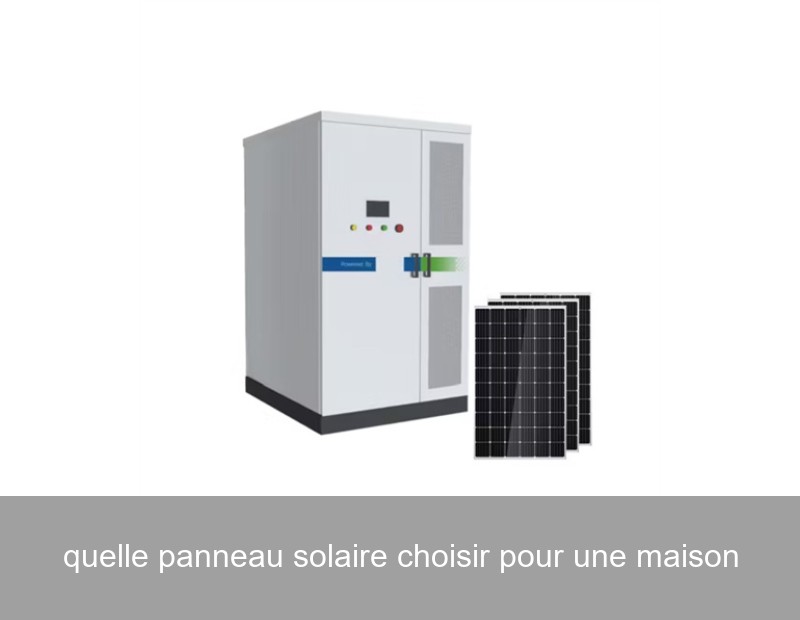
So, you've decided to join the energy revolution and power your home with the sun. That's fantastic! But now you're faced with the million-dollar question: Quelle panneau solaire choisir pour une maison? With so many brands, technologies, and technical specs, it's easy to feel overwhelmed. This guide will cut through the noise. We'll walk you through the key considerations—from panel types and efficiency to system design and the crucial role of energy storage—helping you make an informed decision that maximizes your energy independence and return on investment for years to come.
Table of Contents
- The Solar Dilemma: More Than Just Panels on Your Roof
- Understanding the Core Technologies: Monocrystalline vs. Polycrystalline
- Key Metrics: Decoding Efficiency, Wattage, and Degradation
- Beyond the Panel: The System That Makes It All Work
- The Storage Imperative: Why Your Solar Choice is Incomplete Without a Battery
- A Real-World Case: The Bordeaux Family Home
- Making Your Final Decision: A Practical Checklist
The Solar Dilemma: More Than Just Panels on Your Roof
Choosing solar panels for your home is rarely just about picking the shiniest module. It's a holistic decision about your home's entire energy ecosystem. Think of it like building a team: the solar panels are your star scorers, but they need a strong support system—a quality inverter, durable racking, and most importantly, a reliable "defender" to save that extra energy for later. That defender is a home battery storage system. The goal isn't just to generate power when the sun shines; it's to ensure you can use that clean, free energy on a cloudy Tuesday evening or during a power outage. This integrated approach is where true energy independence lies.
Understanding the Core Technologies: Monocrystalline vs. Polycrystalline
For most homeowners today, the choice narrows down to two dominant silicon-based technologies.
- Monocrystalline Solar Panels: Made from single-crystal silicon, these panels are easily identifiable by their uniform dark color and rounded cell edges. They are the efficiency champions, typically converting 20-23% of sunlight into electricity. This higher efficiency means you need less roof space to achieve your desired power output. They also generally perform slightly better in low-light conditions and have a longer lifespan, but this comes at a higher cost per panel.
- Polycrystalline Solar Panels: Constructed from melted fragments of silicon, these have a blue, speckled appearance. Their efficiency range is usually between 15-18%. While they require more roof space for the same output, they are more budget-friendly upfront. The technology has improved significantly, making them a solid, cost-effective choice for roofs with ample space.
For residential installations where roof space is often at a premium, monocrystalline panels are frequently the recommended choice in Europe and the US, offering more power per square meter and a sleeker aesthetic.

Image Source: Unsplash - Visual difference between panel types
Key Metrics: Decoding Efficiency, Wattage, and Degradation
When comparing spec sheets, focus on these critical numbers:
| Metric | What It Means | What to Look For |
|---|---|---|
| Panel Efficiency (%) | How well the panel converts sunlight into electricity. | Higher is better. Monocrystalline: 20%+. Polycrystalline: 17%+. |
| Power Rating (W) | The electrical output under standard test conditions. | Typical residential panels range from 350W to 450W. Higher wattage means fewer panels. |
| Temperature Coefficient | How much power output drops as the panel heats up. | A percentage per °C (e.g., -0.35%/°C). Closer to zero is better. |
| Degradation Rate | How much output decreases each year. | Industry standard is ~0.5%/year. Premium brands offer warranties as low as 0.25%/year. |
Always check the manufacturer's product and performance warranty. A 25-year linear performance warranty is now standard for tier-one brands, guaranteeing your panels will still produce at 80-87% of their original output after a quarter-century.
Beyond the Panel: The System That Makes It All Work
Your panels are just one part of the puzzle. A complete solar power system includes:
- Inverters: These convert the DC electricity from your panels into AC electricity for your home. You'll choose between string inverters (cost-effective for simple roofs) or microinverters/optimizers (better for shaded roofs, offering panel-level monitoring and optimization).
- Mounting & Racking: The hardware that secures panels to your roof. Quality here is non-negotiable for long-term durability and weather resistance.
- Monitoring System: Allows you to track your system's production and home's consumption in real-time, often via a smartphone app.
The Storage Imperative: Why Your Solar Choice is Incomplete Without a Battery
This is the game-changer. Without storage, excess solar energy you produce at midday is sent back to the grid, often for minimal compensation (through mechanisms like net metering, which is becoming less lucrative). A home battery system, like those developed by Highjoule, captures that surplus energy for you to use at night or during peak tariff periods.
When evaluating quelle panneau solaire choisir pour une maison, you must simultaneously consider storage. Why? Because the battery's capabilities will influence how you size and optimize your solar array. Highjoule's Residential Energy Storage Systems are designed for this synergy. Our systems use advanced lithium iron phosphate (LFP) battery chemistry, renowned for its safety, longevity (typically over 6,000 cycles), and stable performance. Paired with our intelligent energy management system, a Highjoule battery ensures you maximize self-consumption of your solar power, shield yourself from rising electricity costs, and gain peace of mind with backup power during outages.
Choosing a panel that generates abundant daytime power is wise; pairing it with a storage system that lets you control 100% of that power is brilliant.

Image Source: Unsplash - Example of a home battery installation
A Real-World Case: The Bordeaux Family Home
Let's look at a concrete example from our European operations. The Lambert family in Bordeaux, France, faced high electricity bills and an unreliable grid in their rural setting. Their primary goal was self-sufficiency.
- System Installed (2022): 9.8 kWp solar array using high-efficiency monocrystalline panels (22% efficiency).
- Storage Solution: A Highjoule H2-ESS battery system with 13.5 kWh usable capacity.
- Results After One Year: Their grid electricity consumption dropped by 92%. The system provided seamless backup during three grid outages, totaling 11 hours. Their calculated return on investment period is under 8 years, thanks to maximizing self-consumption to over 85% (far above the typical 30-50% for solar-only systems).
"The panels produce, but the Highjoule battery gives us control," notes Mr. Lambert. "We don't worry about time-of-use rates or blackouts anymore. Our home is truly powered by our sun." This case underscores that the value of your solar panels is dramatically amplified by the right storage partner.
Making Your Final Decision: A Practical Checklist
As you navigate the final choice, use this checklist:
- Audit Your Energy Needs: Review your past year's electricity bills to understand your consumption pattern (kWh used).
- Assess Your Roof: Note available space, orientation (south-facing is ideal in the Northern Hemisphere), and potential shading.
- Set Clear Goals: Is it bill reduction, full energy independence, backup power, or all three?
- Choose Panel Technology: For limited space/higher output, prioritize monocrystalline. For larger roofs on a budget, polycrystalline is viable.
- Demand a Holistic Quote: Insist on a design that includes solar and storage options. Ask installers to model scenarios with and without a Highjoule battery system.
- Verify Credentials: Ensure your installer is certified (e.g., NABCEP in the US or equivalent in Europe) and uses tier-one equipment.
For authoritative information on solar technology basics, you can refer to resources from the U.S. Department of Energy or the European Commission's PVGIS tool for production estimates.
Your Home's Energy Future
The journey to answer quelle panneau solaire choisir pour une maison leads you beyond a simple product selection. It's about designing a resilient, intelligent energy system for your home. The most forward-thinking homeowners are now asking not just about panel brands, but about how the entire system—panels, inverter, and especially the brain of the operation, the storage system—will work together for decades. With partners like Highjoule providing the critical storage piece, your solar investment becomes a comprehensive energy solution.
What will your first step be towards not just generating solar energy, but truly owning it?
 Inquiry
 Online Chat