


Understanding Your Quotation for Solar Installation: A Guide to Value, Not Just Price
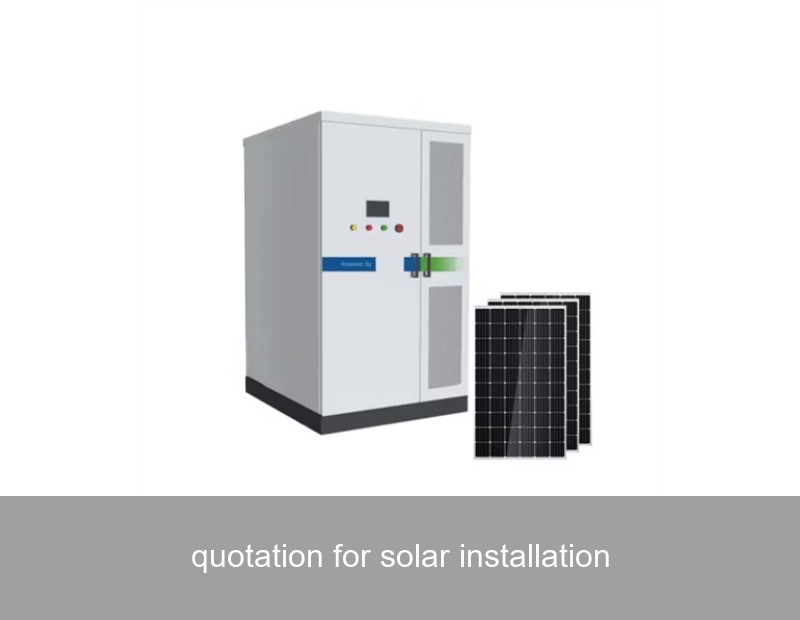
So, you've decided to explore solar power. You've contacted a few installers, and now you have a handful of documents labeled "quotation for solar installation" in your inbox. As you look through them, a wave of confusion might hit. The prices vary, the components are listed with unfamiliar names, and the long-term savings projections seem almost too good to be true. How do you, as a homeowner or business owner, cut through the noise and understand what you're truly paying for? This guide will help you decode your solar quote, transforming it from a confusing price tag into a transparent blueprint for your energy future.
Table of Contents
- Beyond the Bottom Line: What a Truly Comprehensive Quote Reveals
- The Anatomy of a Solar Installation Quotation
- The Silent Star: Why Your Battery Storage Quote Deserves Scrutiny
- Case Study: From Quote to Reality - A German Bakery's Journey
- Highjoule's Approach: Intelligent Solutions for Predictable Outcomes
- Asking the Right Questions: Your Path to Clarity
Beyond the Bottom Line: What a Truly Comprehensive Quote Reveals
A competitive quotation for solar installation should be an educational document, not just a financial one. The cheapest upfront cost can often lead to the highest long-term expense due to inferior equipment, underestimated energy needs, or a lack of system scalability. The phenomenon we see across Europe and the U.S. is a market flooded with options, where price competition sometimes overshadows quality and long-term value engineering.
Consider this data: The National Renewable Energy Laboratory (NREL) consistently finds that system performance and component quality account for over 60% of the lifetime value of a solar PV system. This means the specifics buried in your quote—panel efficiency ratings, inverter warranties, and battery chemistry—are far more critical than the total figure on the last page. A robust quote transparently breaks down these elements, allowing you to compare not just cost, but capability and durability.
The Anatomy of a Solar Installation Quotation
Let's dissect the key sections you should find in every professional quotation.
System Design & Energy Production Forecast
This section should include a detailed roof layout or site plan, panel placement, and a month-by-month energy production estimate. Be wary of quotes that only provide an annual total; seasonal variation matters. Reputable installers use software like PVsyst that models shading and local weather patterns.
- Key Detail to Check: The "derate factor" or system losses. A realistic quote accounts for dirt, wiring losses, and inverter efficiency (typically 75-85% of the panel's rated output). An overly optimistic factor inflates your savings forecast.
Equipment Breakdown: The Heart of Your Investment
This is where quotes truly diverge. A simple list of "Solar Panel, 400W" is insufficient.
| Component | What to Look For in the Quote | Why It Matters |
|---|---|---|
| Solar Panels | Manufacturer, model, efficiency rating (e.g., 21.5%), power temperature coefficient, and product warranty length (often 25+ years). | Higher efficiency means more power per square meter. A better temperature coefficient means less performance drop on hot days. |
| Inverters | Type (string, micro, or hybrid), manufacturer, peak efficiency, and warranty (often 10-12 years, extendable). | The inverter is the brain of your solar system. Its quality dictates how much solar energy is actually converted to usable AC power. |
| Mounting & Racking | Material (aluminum), corrosion resistance, and wind/snow load certification for your region. | This is the skeleton holding your investment to the roof. Quality here ensures structural integrity for decades. |
The Silent Star: Why Your Battery Storage Quote Deserves Scrutiny
For many, a quotation for solar installation now includes a critical addendum: battery storage. This transforms your system from a daylight-only supplier to a true 24/7 energy asset. The specifications here are even more crucial, as battery technology varies widely.
Image: A modern home battery storage unit, a key component in a comprehensive solar and storage quote. Source: Unsplash

When reviewing the battery section, focus on:
- Usable Capacity (kWh): Not just the total capacity. Some batteries have a "depth of discharge" limit. The usable capacity tells you how much energy you can actually access.
- Round-Trip Efficiency: The percentage of energy put in that you can get back out. A 90% efficiency means for every 10 kWh you store, you get 9 kWh back.
- Power Rating (kW): How much power the battery can deliver at once. A high capacity with a low power rating might run your lights all night but not start your well pump.
- Cycles & Warranty: The warranty often guarantees a certain capacity (e.g., 70%) after a specified number of cycles (e.g., 10,000) or years (e.g., 10).
Case Study: From Quote to Reality - A German Bakery's Journey
Let's look at a real example from Bavaria, Germany. "Bäckerei Schmidt," a family-run bakery with high pre-dawn energy loads for ovens and refrigeration, received three starkly different quotes for a solar-plus-storage system.
The Challenge: Reduce peak grid demand charges and ensure backup power for critical cold storage, without overspending on an oversized system.
Quote Analysis:
- Quote A: The lowest upfront cost. Used generic panels and a basic lead-acid battery system with a 5-year warranty and low cycle life.
- Quote B: A mid-range price. Featured good-quality panels but paired with a lithium-ion battery that had a low power rating, insufficient for the simultaneous startup of multiple oven fans.
- Quote C: The highest initial investment. Included high-efficiency panels and a Highjoule EverSafe 15 commercial battery storage system. This quote detailed a 15 kWh usable capacity, a 10kW continuous power output, and a 10-year warranty guaranteeing 80% capacity retention.
The Outcome: Bäckerei Schmidt chose Quote C. The detailed quotation for solar installation included a precise load analysis and simulation showing how the Highjoule system's high power rating would handle their morning demand surge. Two years post-installation, data shows a 92% reduction in peak demand charges and complete energy security during two grid outages. The bakery's owner noted, "The clarity of the quote showed us exactly how the system would perform for our unique needs. The higher initial cost was justified by the robust battery specs and long-term warranty, giving us a predictable ROI."
Highjoule's Approach: Intelligent Solutions for Predictable Outcomes
At Highjoule, we believe your quotation for solar installation should be a promise of performance, not a puzzle. Our quotes are built on a foundation of intelligent design and premium components. For our residential and commercial clients across Europe and North America, we integrate our proprietary Highjoule Energy Router and EverSafe battery series.
Our systems are designed for sustainability and resilience. The Highjoule Energy Router is a hybrid inverter that intelligently manages energy flow between solar panels, battery storage, the grid, and your home's circuits. In a quote, you'll see this translated into:
- Adaptive Learning: The system studies your consumption patterns to optimize self-consumption and grid interaction.
- Seamless Backup: A dedicated "protected loads" panel is always included in our design, ensuring critical appliances stay on during an outage.
- Grid Services Ready: For markets that allow it, our systems can be configured for future participation in virtual power plants (VPPs), creating a potential revenue stream.
Image: A residential solar installation, the first step toward energy independence. Source: Unsplash

By specifying Highjoule technology, your quote moves beyond commodity hardware to a smart, integrated energy ecosystem. We provide detailed performance simulations and transparent warranty terms because we believe an informed customer is our best partner.
Asking the Right Questions: Your Path to Clarity
Armed with this knowledge, your next step is to engage in a dialogue with your potential installer. A reputable company will welcome these questions about your quotation for solar installation:
- "Can you walk me through the derate factors and assumptions in the production estimate?"
- "For the battery, what is the usable capacity, and what is the guaranteed end-of-warranty capacity?"
- "How does the system design and component choice account for my future needs, like adding an electric vehicle charger?"
- "Can you provide a reference case study or monitoring data from a similar installation you've completed?"
Remember, you are not just buying panels and a battery box; you are investing in a decades-long energy partnership. The quote is the first draft of that partnership agreement. Does it inspire confidence in the technology, the installer's expertise, and the long-term health of your system?
What single question about your solar quote feels most urgent to have answered before you make a decision?
 Inquiry
 Online Chat