


Monocrystalline Solar Panels: The High-Efficiency Choice for Modern Energy Independence
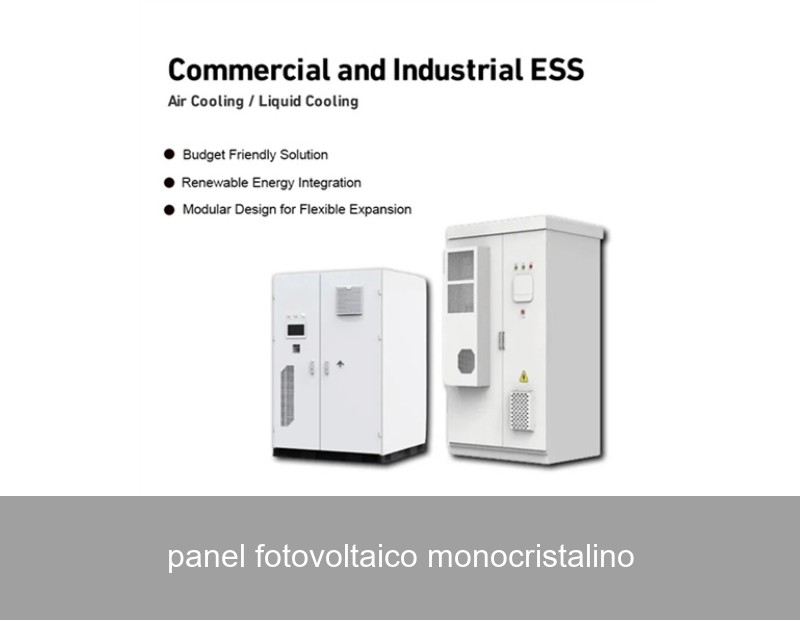
Table of Contents
- What Are Monocrystalline Solar Panels?
- Efficiency & Performance: The Data That Matters
- Beyond the Price Tag: Understanding Long-Term Value
- A Real-World Case: Maximizing Limited Rooftop Space
- Is a Monocrystalline Panel the Perfect Choice for Your Project?
- The Future is Integrated: Pairing Panels with Smart Storage
If you're researching solar options for your home or business, you've likely encountered the term "monocrystalline solar panel" or panel fotovoltaico monocristalino. These sleek, black panels are increasingly dominating rooftops across Europe and the United States. But what sets them apart? The answer lies in a combination of superior efficiency, space-saving design, and long-term reliability—factors that are critical as energy prices fluctuate and the demand for clean power grows. Choosing the right panel technology is the first, and perhaps most crucial, step in a journey toward true energy resilience.
What Are Monocrystalline Solar Panels?
Let's break down the name. "Mono" means single, and "crystalline" refers to the structure of the silicon used. A monocrystalline solar panel is made from silicon that has been carefully grown into a single, pure crystal structure. This intricate manufacturing process, known as the Czochralski method, results in silicon ingots with perfectly aligned atoms. These ingots are then sliced into ultra-thin wafers that form the heart of the panel.
The uniform crystal structure is the key to its performance. With no grain boundaries (imperfections where crystals meet), electrons can flow more freely. This translates directly into the highest efficiency rates commercially available—typically converting 20% or more of captured sunlight into usable electricity. The pure silicon also gives these panels their characteristic dark black color and uniform appearance, a aesthetic preferred by many homeowners and architects.

Image Source: Wikimedia Commons (Creative Commons). A visual comparison highlighting the uniform texture of monocrystalline cells.
Efficiency & Performance: The Data That Matters
Efficiency isn't just a marketing buzzword; it's the engine of your solar investment. In practical terms, higher efficiency means you generate more power from the same amount of roof space. This is particularly vital in urban settings or on properties with limited, shaded, or complex roof areas.
Consider this comparative data:
| Panel Type | Typical Efficiency Range | Key Advantage | Best Suited For |
|---|---|---|---|
| Monocrystalline (Mono-Si) | 20% - 23%+ | Highest power output per sq. meter | Limited space, high energy needs, aesthetic priority |
| Polycrystalline (Poly-Si) | 15% - 18% | Lower cost per panel | Large, unconstrained spaces with a tight initial budget |
| Thin-Film | 10% - 13% | Flexible, lightweight, performs better in heat | Commercial roofs with low weight tolerance, specialized applications |
Furthermore, monocrystalline panels generally exhibit better performance in low-light conditions (like cloudy days or early mornings) and have a lower temperature coefficient than polycrystalline panels. This means their output degrades slightly less as the temperature rises—an important factor during hot summer peaks. According to the National Renewable Energy Laboratory (NREL), ongoing research continues to push the efficiency boundaries of monocrystalline-based cell designs.
Beyond the Price Tag: Understanding Long-Term Value
It's true: a monocrystalline system often comes with a higher initial cost per panel. However, the total cost of a solar energy system must be evaluated over its 25-30+ year lifespan. The higher energy yield from day one means you offset more grid electricity immediately, accelerating your payback period. You're essentially buying a more powerful "engine" that delivers greater financial returns over decades.
Durability is another cornerstone of value. High-quality monocrystalline panels from reputable manufacturers typically come with robust warranties, often guaranteeing 90% performance after 10 years and 80-85% after 25 years. This long-term reliability, combined with higher efficiency, makes them a preferred choice for investors and homeowners looking for a dependable, set-and-forget asset.
A Real-World Case: Maximizing Limited Rooftop Space
Let's look at a concrete example from Southern California, a market with similar solar incentives and goals to many European regions. A craft brewery in San Diego wanted to achieve 80% energy independence to stabilize operational costs and meet sustainability targets. Their main challenge? A historic building with a relatively small, partially shaded rooftop area.
- Problem: Limited viable roof space of only 1,200 sq. ft. Polycrystalline panels would require all available space to meet ~70% of their goal, leaving no room for future expansion.
- Solution: Installation of 42 high-efficiency monocrystalline panels (each 400W).
- Result: The system achieved the target 80% energy offset within the constrained space. The higher per-panel output allowed for a smaller, more aesthetically integrated array. The brewery now saves approximately $8,400 annually on electricity bills, with a projected payback period under 7 years.
This case underscores a critical insight: Your roof area is a finite resource. Maximizing its power-generating capacity with monocrystalline technology can be the difference between meeting your energy goals or falling short.
Is a Monocrystalline Panel the Perfect Choice for Your Project?
While monocrystalline panels are an excellent technology, the "best" panel is the one that optimally aligns with your specific project constraints and goals. Ask yourself these questions:
- Is your roof space limited or expensive? If yes, monocrystalline's space efficiency is likely a top priority.
- Is the visual appearance important? The uniform black look of mono panels is often considered more discreet and modern.
- Are you focused on the highest lifetime return on investment (ROI)? The combination of high output and long lifespan typically offers superior lifetime value.
- Do you have a very large, simple roof with a strict upfront budget? In this scenario, polycrystalline might be a viable contender to consider.
Ultimately, a professional site assessment using advanced modeling software is indispensable. This analysis will weigh factors like local irradiance, shading, roof orientation, and your consumption patterns to model the precise output and financial return of different panel technologies for your property.
The Future is Integrated: Pairing Panels with Smart Storage
Generating abundant solar energy is only half the equation. The true leap towards energy independence comes from storing that power for use when the sun isn't shining—during evening demand peaks, power outages, or periods of low generation. This is where the choice of solar panel intersects with the broader energy system.
An efficient monocrystalline array produces a high, predictable DC output. To harness this fully, you need an energy storage system (ESS) with sophisticated power conversion and intelligent energy management. This ensures every kilowatt-hour you generate is used optimally, either powering your home in real-time, charging your battery, or being fed back to the grid intelligently.
This is the core of what companies like Highjoule provide. As a leader in advanced energy storage since 2005, Highjoule doesn't just supply batteries; we deliver integrated smart energy solutions. Our HES (Highjoule Energy Stack) platform seamlessly connects with high-efficiency solar arrays, including monocrystalline installations. The system's AI-driven software learns your consumption patterns, weather forecasts, and utility rate structures to autonomously decide the most economical and resilient way to dispatch your stored solar energy.
For instance, a homeowner with premium monocrystalline panels paired with a Highjoule HES can program the system to power essential loads during a grid outage automatically, use stored solar energy to avoid expensive evening tariff rates, or even participate in grid services programs where available. We provide solutions for residential, commercial, and microgrid applications, ensuring that the high-quality DC power from your panels is matched by equally intelligent AC power management and storage.

Image Source: Unsplash. A modern home energy setup featuring rooftop solar and an integrated wall-mounted battery storage unit.
So, as you contemplate investing in a panel fotovoltaico monocristalino, consider the complete picture. How will you capture, store, and manage the premium energy it produces to achieve true resilience and savings? What does your ideal day of energy independence look like, from sunrise to sunset and through the night?
 Inquiry
 Online Chat