


Smart Energies: How Much Can They Truly Save and Transform Your Power?
As energy prices remain volatile and climate concerns grow, businesses and homeowners across Europe and the US are asking a crucial question: smart energies, how much can they actually deliver? It's not just about generating kilowatt-hours; it's about intelligent management, storage, and optimization of every unit of power. This article delves beyond the hype, using real data and case studies to quantify the impact of smart energy systems, with a focus on the pivotal role of advanced battery storage.
Table of Contents
- The Phenomenon: From Passive Consumer to Active Prosumer
- The Data: Quantifying the "How Much" of Smart Storage
- The Case Study: A German Bakery's Recipe for Energy Resilience
- The Insight: It's About Intelligence, Not Just Capacity
- Highjoule's Role: Delivering Tailored Smart Energy Solutions
- The Future Question for You
The Phenomenon: From Passive Consumer to Active Prosumer
For decades, the energy grid was a one-way street. You consumed, you paid the bill. The rise of rooftop solar changed the game, but it introduced a new challenge: intermittency. The sun doesn't shine on demand, and this mismatch between generation and consumption is where the true "smart" energy revolution begins. Smart energy systems integrate generation (like solar), storage (primarily batteries), and sophisticated software to create a self-optimizing power ecosystem for your home or business. The core question shifts from "how much power can I make?" to "how much value can I extract, save, and control?"

Image Source: Unsplash - A modern home energy system featuring solar and storage.
The Data: Quantifying the "How Much" of Smart Storage
Let's break down the "how much" into tangible metrics. The savings and ROI depend on your location, energy rates, consumption patterns, and the specific technology deployed.
| Benefit Category | Typical Range of Impact | Key Driver |
|---|---|---|
| Electricity Bill Savings | 50% - 90%+ of grid consumption | Maximizing self-consumption of solar, avoiding peak tariffs. |
| Peak Demand Charge Reduction (Commercial) | 20% - 40% reduction | Battery discharging during short periods of highest grid use. |
| Increased Solar Self-Consumption | Increase from ~30% to 70%+ | Storing excess daytime solar for use at night. |
| Backup Power Duration | Hours to multiple days | Battery capacity (kWh) and managed critical loads. |
| Grid Services Revenue (VPP) | Varies significantly by market | Aggregated batteries providing grid stability services. |
According to a U.S. Department of Energy study, pairing storage with solar can enhance the value of solar by managing its timing, making it a more reliable grid resource. In markets like California or Germany with high penetration of renewables, this time-shifting capability is where a significant portion of the value lies.
The Case Study: A German Bakery's Recipe for Energy Resilience
Let's make this concrete. Consider "Bäckerei Schmidt," a mid-sized artisan bakery in Bavaria, Germany. Their challenge: high energy costs from overnight refrigeration and early morning production peaks, coupled with a desire to be more sustainable.
- Phenomenon: Spiking demand charges at 6 AM when ovens fired up, and volatile wholesale electricity prices.
- Action: They installed a 100 kW solar canopy and a 250 kWh Highjoule Industrial Battery System (HI-Series), integrated with smart energy management software.
- Data & Results (12-month period):
- Grid Energy Consumption Reduced by 78%: Solar + storage covered most daytime and critical nighttime loads.
- Peak Demand Charges Cut by 32%: The battery seamlessly powered up ovens at dawn, flattening the demand spike.
- Self-Consumption of Solar: Increased from an estimated 35% to 92%, drastically reducing feed-in reliance.
- ROI Period: Achieved in under 5 years, factoring in German energy price trends and available incentives.
For Bäckerei Schmidt, the question "smart energies, how much" was answered in euros, carbon savings, and operational peace of mind. Their system, powered by Highjoule's technology, now acts as a virtual power plant, participating in local grid balancing programs for additional revenue.
The Insight: It's About Intelligence, Not Just Capacity
The bakery's story highlights a critical insight: the core of a smart energy system isn't just the physical hardware; it's the intelligence layer. A battery without smart software is like a computer without an operating system. The true value is unlocked by algorithms that:
- Predict solar generation and load patterns using weather and historical data.
- Optimize charge/discharge cycles based on real-time electricity prices (time-of-use rates).
- Seamlessly manage grid interaction, including backup transition during outages.
- Aggregate with other systems to provide grid services (Virtual Power Plant - VPP).
This is where the expertise of the system provider becomes paramount. It's the difference between simply having storage and truly harnessing smart energy.
Highjoule's Role: Delivering Tailored Smart Energy Solutions
Since 2005, Highjoule has been at the forefront of this intelligent energy transition. We understand that the question "smart energies, how much" has a unique answer for every client. Our approach is not one-size-fits-all.
For Residential clients, our HOMEsafe series integrates seamlessly with existing solar or acts as a turnkey solar-plus-storage solution. Its AI-driven manager learns your household's patterns, maximizing self-consumption and ensuring critical loads are protected during outages. You gain clarity and control over your energy destiny.
For Commercial & Industrial (C&I) applications, like the German bakery, our HI-Series modular battery systems are engineered for durability and high-cycle performance. Coupled with our GridMAX energy management platform, they deliver precise peak shaving, demand response, and energy arbitrage. We help businesses turn a cost center into a strategic, resilient asset.
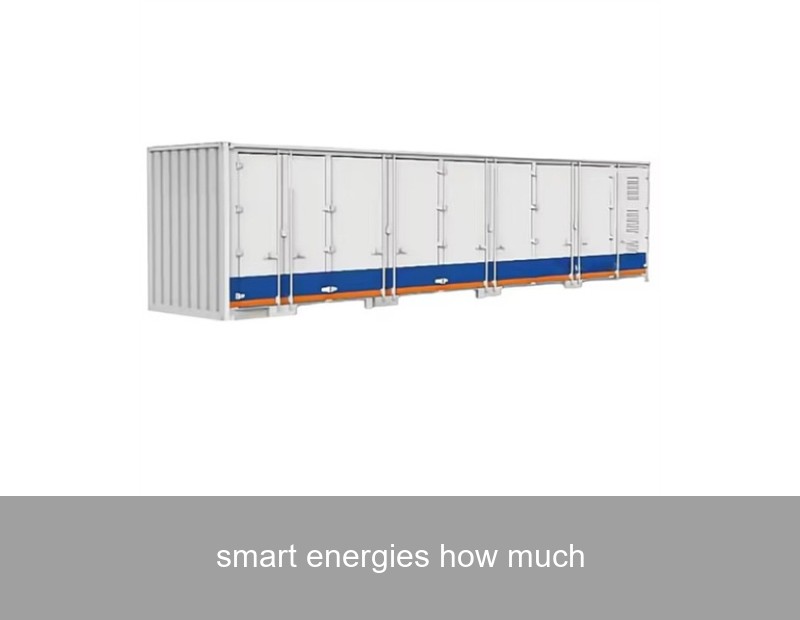
For Microgrids and utility-scale projects, Highjoule provides robust, containerized MEGA storage solutions that stabilize grids, integrate renewable farms, and empower communities toward energy independence.

Image Source: Unsplash - Technician monitoring a commercial-scale battery energy storage system.
The Future Question for You
The data is compelling, the technology is proven, and the need for energy resilience is clearer than ever. The journey begins with a detailed assessment of your unique energy profile. So, as you consider your own path toward a smarter, more sustainable energy future, what is the first specific energy challenge—be it a stubborn peak demand charge, a reliability concern, or a sustainability goal—that you would want a smart energy system to solve for you?
 Inquiry
 Online Chat