


Demystifying Solar Cell Energy Storage Cabinet Price: A Smart Investment Guide
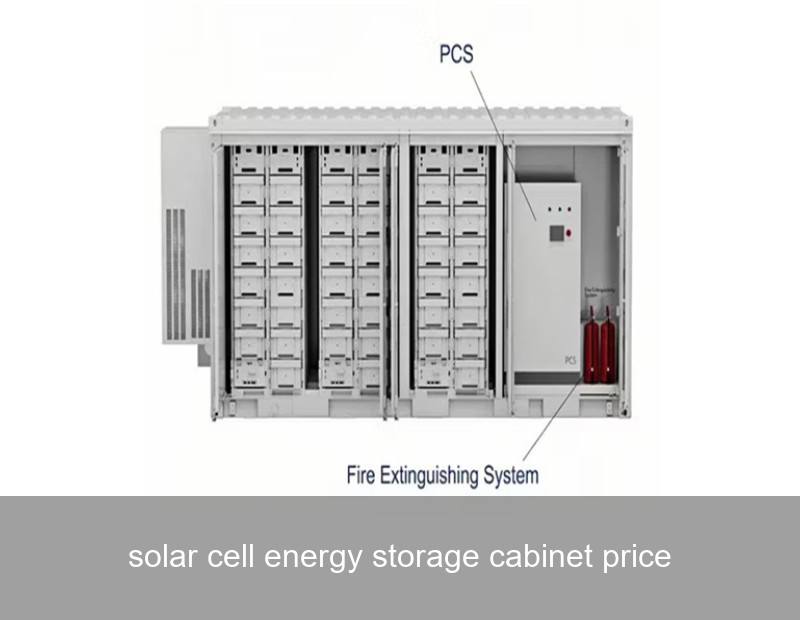
If you're exploring solar energy for your home or business, you've likely encountered a crucial question: what's the real cost of a solar cell energy storage cabinet? The price tag you see is more than just a number; it's the gateway to energy independence, resilience, and long-term savings. In markets like Europe and the U.S., where electricity prices can be volatile and grid reliability a growing concern, understanding this investment is key. This guide will break down the factors influencing solar energy storage cabinet prices, provide real-world data, and help you see the value beyond the initial cost.
Table of Contents
- The Price Breakdown: What You're Really Paying For
- Key Factors Driving Solar Battery Cabinet Costs
- Looking Beyond Price: The Highjoule Value Proposition
- How to Choose the Right System for Your Budget
The Price Breakdown: What You're Really Paying For
Let's be clear: the solar cell energy storage cabinet price isn't just for a metal box. It represents a sophisticated, integrated energy system. Typically, for a residential installation in the U.S. or Europe, you're looking at a cost range of $7,000 to $15,000+ for the storage cabinet and its components, before installation and incentives. This includes:
- The Battery Cells & Chemistry: The heart of the system. Lithium Iron Phosphate (LFP) is now the dominant, safe, and long-lasting chemistry, making up a significant portion of the cost.
- The Power Conversion System (PCS): This includes the inverter and charger, which manage the flow of electricity between solar panels, the battery, and your home.
- Battery Management System (BMS): The brain that ensures safety, performance, and longevity by monitoring each cell.
- Thermal Management & Enclosure: Crucial for safety and efficiency, this system keeps batteries at optimal temperature year-round.
- Software & Intelligence: Modern systems like those from Highjoule include advanced energy management software that learns your usage patterns and optimizes for self-consumption or grid services.

Image Source: Unsplash - A modern, integrated home energy storage unit.
Key Factors Driving Solar Battery Cabinet Costs
Why such a wide price range? Several concrete factors determine your final quote.
| Factor | Impact on Price | Consideration for Buyers |
|---|---|---|
| Capacity (kWh) | Direct, linear relationship. More kWh = higher price. | Size based on your daily "load shifting" needs, not just backup. A 10-13 kWh system often covers critical loads for a day. |
| Power Rating (kW) | Higher continuous/peak power output requires more robust components. | Can you run multiple high-power appliances (AC, oven) simultaneously during an outage? This dictates power needs. |
| Chemistry & Brand | LFP batteries have a different cost structure than older NMC. Premium brands invest more in BMS and safety. | Prioritize lifecycle (number of cycles) and warranty terms over just upfront cost. A 10-year, 10,000-cycle warranty indicates confidence. |
| Integration Level | All-in-one (hybrid) systems can be more cost-effective than component-based setups. | An integrated system like Highjoule's HES Series simplifies installation, reduces points of failure, and offers seamless control. |
| Installation Complexity | Electrical upgrades, mounting location, and local permitting can vary widely. | Get multiple detailed quotes. A certified installer familiar with the product line is worth the premium for safety and performance. |
A Real-World Case: California's TOU Rates & Storage Payback
The price makes more sense when viewed through the lens of savings. Consider a typical homeowner in Southern California under a Time-Of-Use (TOU) rate plan like PG&E's EV2-A. Here, electricity can cost over $0.50/kWh during peak evening hours (4-9 pm) but only $0.30/kWh off-peak.
Scenario: A homeowner installs a Highjoule HES-13 system (13 kWh usable capacity, 7 kW power). The system stores cheap solar or off-peak grid power and discharges during the expensive peak period.
- Daily Avoided Cost: Shifting 10 kWh from peak to off-peak saves ~$2.00/day (10 kWh * $0.20 price difference).
- Annual Savings: ~$730 from load shifting alone.
- Adding Value: With the U.S. Federal ITC (covering 30% of installed cost for storage paired with solar) and California's SGIP incentive for backup power, the net system cost can drop significantly. In this case, the simple payback period can move into the 6-8 year range, well within the system's warranty.
This isn't theoretical. Highjoule's monitoring software for our commercial and residential systems shows customers consistently achieving 70-90% self-consumption of their solar generation, dramatically reducing their reliance on the grid during high-rate periods.
Looking Beyond Price: The Highjoule Value Proposition
At Highjoule, we believe the conversation should shift from "solar cell energy storage cabinet price" to "total cost of ownership and value." Since 2005, we've engineered our systems for intelligence, durability, and seamless integration.
Our HES Series Residential Storage Cabinets and Commercial C&I Solutions are built with:
- Ultra-Safe LFP Chemistry: Non-toxic, stable, with a lifespan exceeding 6,000 cycles.
- AI-Powered Energy Management: Our platform doesn't just store energy; it learns and automatically optimizes for electricity rates, weather, and your habits.
- Scalable Design: Start with what you need and add more capacity modules later, protecting your initial investment.
- Grid Services Ready: In some markets, systems can participate in virtual power plants (VPPs) to earn additional revenue by supporting grid stability.

Image Source: Unsplash - A professional monitoring a large-scale battery storage system.
This engineering focus translates to a lower lifetime cost. When you factor in a longer warranty (typically 10 years), higher efficiency (less energy lost in conversion), and robust software updates, the slightly higher initial investment in a quality system like Highjoule's often yields a much better return.
How to Choose the Right System for Your Budget
So, how do you navigate this decision?
- Audit Your Energy Use: Look at your utility bill. Identify your baseline consumption and peak demand. An installer can do a detailed load audit to size your system correctly.
- Define Your Primary Goal: Is it bill savings (load shifting), backup power (resilience), or both? This prioritizes capacity vs. power.
- Get Detailed, Comparable Quotes: Ensure quotes include all hardware, software, installation, permitting, and warranty details. Compare the cost per kWh of usable capacity over the warranty period.
- Research Incentives: Use resources like the DSIRE database for the U.S. or local energy agencies in Europe to find tax credits, rebates, and grants.
- Ask About the Future: Can the system expand? Is the software updated? Will it work with future smart home tech or VPP programs?
Where Highjoule Fits In
We offer tailored solutions across the spectrum. For the homeowner seeking resilience, our HES-10 cabinet is a perfect start. For a business looking to cap demand charges and ensure operational continuity, our Commercial C&I Stack offers modular, scalable power. In every case, we provide transparent pricing that reflects a system built to last and backed by a global support team.
The journey to energy independence starts with an informed question about cost. But the destination is defined by the value, control, and sustainability you gain. What energy challenge—be it a rising utility bill or an unreliable grid—is motivating you to look at storage today?
 Inquiry
 Online Chat