


Navigating the Booming Solar Central ESS Market: A Guide to Intelligent Energy Storage
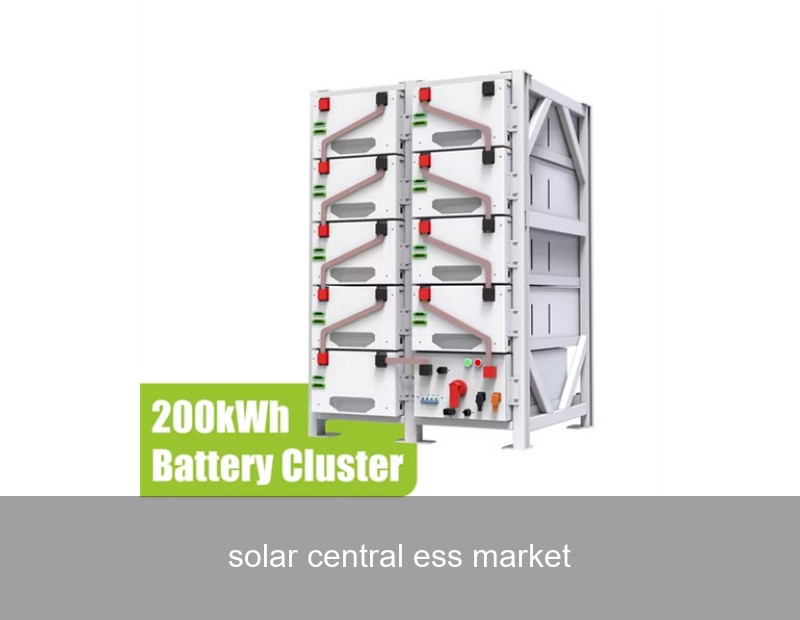
Have you noticed the landscape of energy generation shifting? Across Europe and the US, fields and rooftops are increasingly adorned with solar panels. Yet, a critical question emerges as sunset approaches: where does all that clean energy go? The answer is reshaping the power sector and lies at the heart of the rapidly expanding solar central ESS market. Central Energy Storage Systems (ESS) are no longer a futuristic concept but a present-day necessity for grid stability and maximizing renewable investment. This article demystifies the solar central ESS market, exploring its drivers, real-world impact, and how to choose the right solution for large-scale solar success.
Table of Contents
- The Phenomenon: From Intermittent to Indispensable
- The Data: Why the Solar Central ESS Market is Exploding
- Case Study: A European Utility's Success Story
- The Essentials: What Makes a Great Central ESS?
- Highjoule's Role: Engineered for Grid-Scale Performance
- The Future Horizon: What's Next for Central ESS?
The Phenomenon: From Intermittent to Indispensable
Solar power has a well-known characteristic: it's variable. The sun doesn't shine 24/7, but our homes, factories, and cities demand constant power. This mismatch creates a significant challenge for grid operators. On extremely sunny days, an oversupply of solar can even force grids to curtail (waste) clean energy. Conversely, in the evening when demand peaks, traditional fossil-fuel plants often ramp up. This is where the solar central ESS market comes in. Think of these systems as massive, intelligent power banks for the grid. They store excess solar energy during the day and dispatch it precisely when needed, turning solar from an intermittent source into a reliable, dispatchable one.

For utilities, independent power producers, and large commercial entities, integrating a central ESS with a solar farm is no longer just about sustainability—it's a strategic business decision for revenue optimization and grid service provision.
The Data: Why the Solar Central ESS Market is Exploding
The numbers tell a compelling story. According to the U.S. Energy Information Administration (EIA), battery storage capacity in the United States is projected to nearly double in 2024 alone (source: EIA). In Europe, driven by ambitious REPowerEU goals and the need for energy security, the market is experiencing similar growth. What's fueling this expansion?
- Falling Costs: The levelized cost of battery storage has plummeted over 80% in the last decade, making large-scale projects economically viable.
- Supportive Policy: Incentives like the IRA in the US and various capacity mechanisms in Europe directly encourage storage deployment.
- Grid Decarbonization Mandates: Regulations are pushing utilities to integrate higher shares of renewables, necessitating storage for balance.
- Revenue Stacking: A modern central ESS can generate value from multiple streams: energy arbitrage (buy low, sell high), frequency regulation, capacity payments, and deferring costly grid upgrades.
This confluence of factors has created a perfect storm of opportunity in the solar central ESS market. The system is no longer a mere "add-on" but the brain of a modern, resilient power plant.
Case Study: A European Utility's Success Story
Let's move from theory to practice. A major utility in Southern Spain was facing two issues: frequent curtailment of its 50 MW solar PV plant during midday peaks and an inability to meet local evening demand spikes without purchasing expensive peak power.
The Solution: They deployed a 10 MW / 40 MWh central energy storage system co-located with the solar farm. The system was designed for multiple applications: solar energy time-shift, frequency control, and peak shaving.
The Results (18-Month Operational Data):
| Metric | Result | Impact |
|---|---|---|
| Solar Curtailment Reduction | 98% | Virtually all generated solar energy was utilized. |
| Peak Power Cost Savings | €320,000 annually | Reduced reliance on expensive grid power during peaks. |
| Ancillary Service Revenue | €180,000 annually | Additional income from providing grid frequency services. |
| Levelized Cost of Storage (LCOS) | < €0.05/kWh | Well below the peak energy prices, ensuring strong ROI. |
This case exemplifies the tangible financial and operational benefits driving the solar central ESS market. The project paid for itself in under 7 years and is now a profitable, grid-stabilizing asset.
The Essentials: What Makes a Great Central ESS?
Not all storage systems are created equal. For the demanding environment of utility-scale solar integration, key differentiators matter:
- Longevity & Cycle Life: The battery must withstand daily charge/discharge cycles for 15-20 years. Lithium Iron Phosphate (LFP) chemistry is now the industry standard for its safety and long life.
- Intelligent Energy Management System (EMS): This is the true "brain." A superior EMS can forecast solar generation and grid prices, optimizing dispatch across multiple revenue streams autonomously.
- Safety by Design: At this scale, safety is non-negotiable. This includes advanced thermal management, fault detection, and compartmentalization.
- Grid-Forming Capabilities: The next-generation feature. Advanced inverters can allow the ESS to "form" the grid, providing stability in areas with high renewable penetration, a topic actively researched by institutions like the National Renewable Energy Laboratory (NREL).
- Total Cost of Ownership (TCO): Look beyond upfront price. Consider efficiency losses, degradation rates, and maintenance costs over the system's entire life.
Highjoule's Role: Engineered for Grid-Scale Performance
This is where Highjoule's nearly two decades of expertise become critical. Since 2005, we have focused on developing advanced storage solutions that meet the rigorous demands of the global solar central ESS market. Our products are engineered not just as battery containers, but as fully integrated, intelligent power plants.
Our flagship solution for this market, the Highjoule GridMax Utility ESS, is designed from the ground up for large-scale solar integration:
- Proprietary LFP+ Cells: Offering an industry-leading cycle life with less than 10% degradation over 10,000 cycles, ensuring long-term ROI.
- Athena AI EMS Platform: Our cloud-native platform uses machine learning to perform 96-hour-ahead forecasting, automatically optimizing dispatch for maximum revenue. It can seamlessly switch between applications like energy arbitrage and frequency response in milliseconds.
- Containerized & Scalable Design: Each 3.5 MWh GridMax unit is a pre-tested, plug-and-play building block. Systems can be scaled from 10 MWh to over 1 GWh with consistent performance and simplified maintenance.
- Uncompromising Safety: Featuring a multi-layer protection system with active gas detection, passive fire suppression, and cell-level fusing, our design philosophy prioritizes safety above all.
For a developer in Texas or a utility in Germany, this translates to a bankable, high-performance asset that reliably turns their solar investment into a 24/7 revenue generator and a cornerstone of grid resilience.
Beyond Hardware: Highjoule's Full-Service Partnership
We understand that deploying a central ESS is a major undertaking. Highjoule supports clients with comprehensive services, including detailed feasibility studies, financial modeling for revenue stacking, turnkey EPC support, and long-term performance guarantees with remote monitoring. Our goal is to be a true partner in your energy transition journey.
The Future Horizon: What's Next for Central ESS?
The solar central ESS market is dynamic. We are moving towards even longer duration storage (8-12 hours) to cover multi-day weather events. Innovations like second-life batteries and hybrid systems coupling lithium-ion with flow batteries are being piloted. Furthermore, the role of storage in providing virtual inertia and black-start capabilities is becoming crucial as coal and gas plants retire. The International Energy Agency (IEA) consistently highlights storage as a key pillar for net-zero grids (source: IEA).
The trajectory is clear: the future grid will be built around renewable generation buffered and managed by intelligent storage. The central ESS is the enabling technology making a 100% renewable future not just possible, but stable and economical.
As you evaluate your next solar or storage project, what specific grid challenge or revenue opportunity is driving your interest in the solar central ESS market?
 Inquiry
 Online Chat