


Why Your Solar Company's Website Needs to Be More Than Just a Digital Brochure
Let's be honest. For many solar companies, the website is often an afterthought—a static online business card listing services and a phone number. But in today's hyper-competitive renewable energy market, that approach is costing you leads, credibility, and revenue. Your website is your primary touchpoint for homeowners and businesses actively seeking energy independence. It's not just a brochure; it's your most powerful sales engineer, educator, and trust-builder. This article explores the critical evolution of solar companies websites from simple informational pages to dynamic hubs of customer education and sophisticated system visualization, directly impacting your bottom line.
The Digital Shift: From Passive to Persuasive
Gone are the days when a potential customer would simply call three local installers from a directory. The modern journey begins with extensive online research. A prospective homeowner might spend 20+ hours researching solar online before ever speaking to a sales representative. They're not just looking for "solar panel installers near me." They're asking complex questions: "What is the ROI for a 10kW system in my area?", "How do batteries work with time-of-use rates?", and "What happens to my system during a grid outage?" If your website doesn't provide clear, authoritative answers to these questions, you've lost the customer before the race even began.
Data, Trust, and the Educated Consumer
Trust in the solar industry is built on transparency and expertise. Your website must establish both immediately. Consider this: websites with detailed educational content (blogs, guides, explainer videos) see up to 55% more traffic and significantly higher engagement than those without. Furthermore, showcasing real-world data is no longer optional. Consumers expect to see simulations, potential savings estimates, and environmental impact metrics tailored to their location.
This is where generic content fails. A page that simply says "solar saves you money" is less effective than an interactive tool that allows a visitor in California to input their average PG&E bill and see a personalized projection. This level of detail demonstrates technical proficiency and builds the confidence needed for a high-consideration purchase.
Case Study: A German Installer's 40% Lead Increase
Let's look at a real example from Europe. A mid-sized solar installer in Bavaria, Germany, revamped its website in 2023. The old site had the standard service pages and a gallery. The new site integrated:
- A high-precision solar yield calculator using local weather data and satellite imagery.
- Detailed, downloadable guides on the KfW subsidy programs and feed-in-tariffs.
- Interactive 3D visualizations of how different battery storage systems integrate with solar arrays.
- Clear explanations of self-consumption optimization—a key concern for German homeowners.
Within six months, the company reported a 40% increase in qualified leads from their website. More importantly, the average sales cycle shortened because customers arrived at consultations already well-informed. The website had done the heavy lifting of initial education, allowing sales conversations to focus on customization and closing.

Image: A modern German home with a solar installation. Today's consumers expect to understand and monitor such systems in detail via digital platforms.
Visualizing Power: Beyond Basic Calculators
The most advanced solar companies websites are moving beyond simple savings calculators. They are incorporating full system design simulators. Imagine a homeowner being able to adjust the roof pitch, panel type, and battery capacity in a visual model and instantly see the impact on annual energy production, backup duration, and cost. This level of interactivity not only engages the user but also positions your company as a technological leader.
It also addresses a major pain point: the fear of the unknown. Solar and storage are significant investments. By visualizing the system's performance and financial benefits in real-time, you make the abstract concrete, reducing perceived risk and accelerating decision-making.
The Storage Imperative on Your Website
Solar is increasingly just one part of the equation. For markets like California, Texas, or across Europe where energy prices are volatile and grid resilience is a concern, battery storage is the critical add-on. Your website must comprehensively address storage. This isn't just adding a "Battery" tab. It requires explaining:
- Resilience: How does the system keep the lights on during an outage?
- Economics: How does arbitrage (charging from solar/grid when cheap, discharging when expensive) work?
- Technology: What are the differences between AC-coupled and DC-coupled systems? (Hint: This is where your expertise shines).
Failing to demystify storage on your website means missing out on the higher-value, more profitable projects that define the future of the industry.
How Highjoule Empowers Solar Company Websites
This is where a partnership with a technology leader like Highjoule becomes a strategic asset for forward-thinking solar companies. Since 2005, Highjoule has been at the forefront of intelligent energy storage, providing systems that are not just hardware, but software-driven energy platforms.
For our installer partners, we provide the deep technical resources and visualization tools needed to elevate their solar companies websites from basic to brilliant:
- White-Label Simulation Tools: Integrate Highjoule's advanced performance modeling engines into your site. Show customers accurate simulations of energy independence levels, backup times, and savings with our HPS (Highjoule PowerStack) residential and HCS (Highjoule Commercial Suite) systems.
- Comprehensive Technical Content: Access detailed, easy-to-understand explainers on system architecture, battery longevity, and smart energy management that you can adapt for your blog and resource center.
- Real-World Data & Case Studies: Leverage anonymized, real performance data from Highjoule systems installed in similar climates to build compelling, localized case studies. For instance, showcase how a bakery in Spain uses an HCS system to avoid peak demand charges, with clear before/after cost graphs.

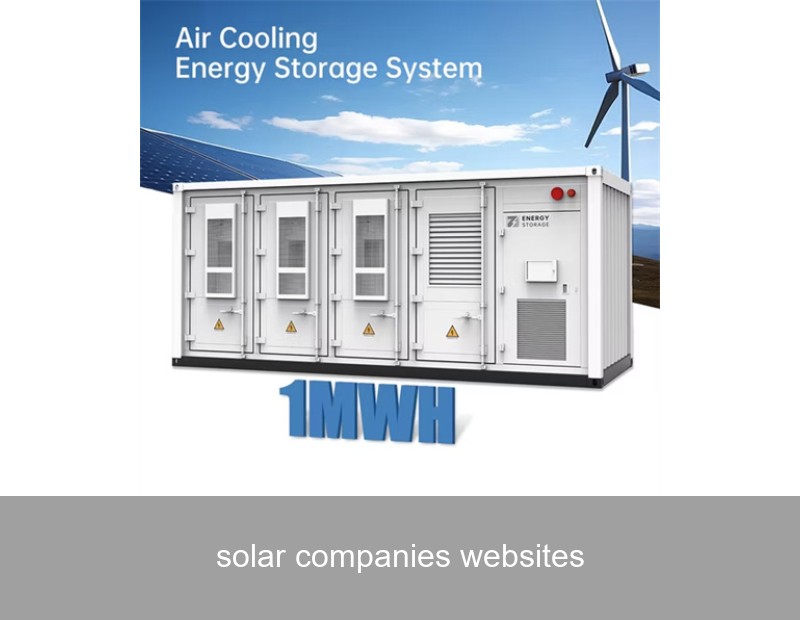
Image: A clean, modern battery storage installation. Highjoule's systems are designed for seamless integration, a key selling point for premium solar websites.
By embedding Highjoule's expertise into your digital presence, you're not just selling components; you're selling a proven, intelligent energy ecosystem. This partnership allows your sales team to focus on relationship-building, while your website handles complex technical education with authority.
Integrating the Complete Solution Narrative
A superior website tells a complete story: Sunlight to Security. It visually guides the visitor from solar generation, through intelligent conversion, to storage and consumption. Highjoule's Energy Management System (EMS) is the brain behind this narrative. On your website, use diagrams and short videos to explain how our EMS optimizes every kilowatt-hour—whether it's maximizing self-consumption, participating in virtual power plants (where available), or providing seamless backup. This positions your company as a full-service solutions provider, not just an installer.
What's the First Step to Transform Your Digital Front Door?
The gap between a standard solar website and a high-converting educational platform is significant, but the path forward is clear. It begins with an audit of your current content. Does it answer the nuanced questions of today's energy-conscious consumer? Does it visually demonstrate the value of a fully integrated solar-plus-storage system?
Consider this: If a competitor's website can clearly show a homeowner how to achieve 95% energy independence with a visualized system design, while yours only talks about "quality panels," who wins the trust—and the contract? The future belongs to solar companies that use their website not as a static billboard, but as an interactive proving ground for their technical mastery and customer-centric solutions.
Is your website currently equipped to close the deal on a complex solar-plus-storage project, or is it inadvertently sending your most valuable leads to competitors who tell the full story better?
 Inquiry
 Online Chat