


Building a Profitable Solar Energy Farm Business Plan: A Modern Developer's Guide
So, you're considering entering the solar energy farm business. The vision is clear: vast fields of photovoltaic panels harnessing the sun's power, contributing to a greener grid, and generating reliable revenue. But between that vision and reality lies the critical document that will determine your success—a robust, bankable, and forward-thinking solar energy farm business plan. In today's market, it's no longer just about panels and land; it's about intelligent system design, financial resilience, and integrating storage to maximize value. This guide walks you through the essential modern components, blending proven strategy with the latest technological imperatives.
Table of Contents
- The New Reality: Solar Farms Need More Than Sunshine
- Core Components of a Winning Solar Farm Business Plan
- The Financial Model: From LCOE to Revenue Stacking
- Case Study: Navigating Grid Constraints in Spain
- The Pivotal Role of Energy Storage Systems (ESS)
- How Highjoule's Solutions Integrate Into Your Plan
- Your Next Step: From Plan to Action
The New Reality: Solar Farms Need More Than Sunshine
Gone are the days when a solar farm's business case was solely based on a high Feed-in-Tariff (FiT) and a sunny location. The phenomenon across markets like the U.S. and Europe is clear: grid congestion, increasing curtailment, and volatile energy prices are squeezing margins. The data is telling. According to the International Energy Agency (IEA), global renewable capacity grew by 50% in 2023, with solar PV accounting for three-quarters of additions. This rapid growth is leading to new challenges. For instance, in parts of California and Germany, solar farms sometimes have to shut down during peak production hours because the grid cannot absorb the power—a process called curtailment, which directly erodes revenue.
This means your solar energy farm business plan must address not just generation, but also deliverability and flexibility. Investors and financiers are now scrutinizing plans for how a project will mitigate these risks and create multiple revenue streams. The simple "build and forget" model is evolving into a "build, store, and optimize" imperative.
Core Components of a Winning Solar Farm Business Plan
Your business plan is your project's blueprint. Here are the non-negotiable sections that require deep detail:
1. Executive Summary & Project Overview
Clearly state the project's location, capacity (MW), technology choice (e.g., bifacial panels, single-axis tracking), and overarching mission. Highlight what makes it unique and resilient.
2. Market & Regulatory Analysis
Detail the specific regional market (e.g., ERCOT in Texas, or the German EEG scheme). Analyze power purchase agreement (PPA) trends, wholesale electricity price forecasts, and local/state incentives for solar and storage.
3. Technical Design & Site Specifications
Move beyond basic layouts. Discuss:
- Technology Selection: Justify panel and inverter choices for durability and efficiency.
- Grid Interconnection Study: Cite the queue status and any required upgrade costs.
- Energy Yield Assessment: Provide a detailed production forecast using tools like PVsyst, accounting for degradation.

Image: A modern solar farm's technical design is foundational to its financial model.
4. Operational & Maintenance (O&M) Strategy
Outline proactive vs. reactive maintenance schedules, performance monitoring platforms, and security protocols. This section assures long-term asset health.
The Financial Model: From LCOE to Revenue Stacking
The financial heart of your solar energy farm business plan is a dynamic model. Key metrics include:
| Metric | Description | Why It Matters |
|---|---|---|
| Levelized Cost of Energy (LCOE) | The net present cost of electricity generation over the plant's lifetime. | Benchmarks your project's cost-competitiveness against other energy sources. |
| Net Present Value (NPV) & IRR | Measures project profitability and return rate. | The primary indicators for investor attractiveness. |
| Debt Service Coverage Ratio (DSCR) | Annual net operating income divided by annual debt payments. | Critical for securing project financing; lenders typically require a minimum DSCR (e.g., 1.3x). |
The modern differentiator is revenue stacking. Beyond a base PPA, can your farm earn money from grid services (frequency regulation, capacity markets), or by arbitraging energy prices? This is where integrating a Battery Energy Storage System (BESS) transforms the economics.
Case Study: Navigating Grid Constraints in Spain
Let's look at a real-world example from southern Spain, a region with superb solar resources but growing grid saturation. A 50 MWp solar farm developed in 2022 faced a projected 15% annual curtailment rate from the grid operator, threatening its PPA viability.
The Solution: The developers revised their solar energy farm business plan to include a co-located 20 MW / 40 MWh battery storage system. The BESS was designed to:
- Capture excess generation during peak solar hours that would otherwise be curtailed.
- Store it and discharge during high-price evening peaks.
- Provide primary frequency response services to the Spanish grid for additional revenue.
The Data-Driven Outcome: The retrofit, while adding ~15% to the CAPEX, increased the project's net revenue by an estimated 32% annually. The payback period for the BESS addition was calculated at under 5 years, primarily from energy arbitrage and ancillary services. This case underscores that a plan considering storage from the outset is now a competitive necessity in many markets.
The Pivotal Role of Energy Storage Systems (ESS)
As the case shows, storage is the linchpin of modern solar farm economics. It directly de-risks your business plan by:
- Mitigating Curtailment: Store "clipped" energy for later sale.
- Enabling Firm, Dispatchable Power: Offer a more reliable product to offtakers, potentially commanding a higher PPA price.
- Unlocking Ancillary Services: Generate revenue from grid stability services—a market detailed by sources like the Energy Storage News.
- Smoothing Output: Reduce interconnection challenges by ensuring a more predictable feed-in to the grid.

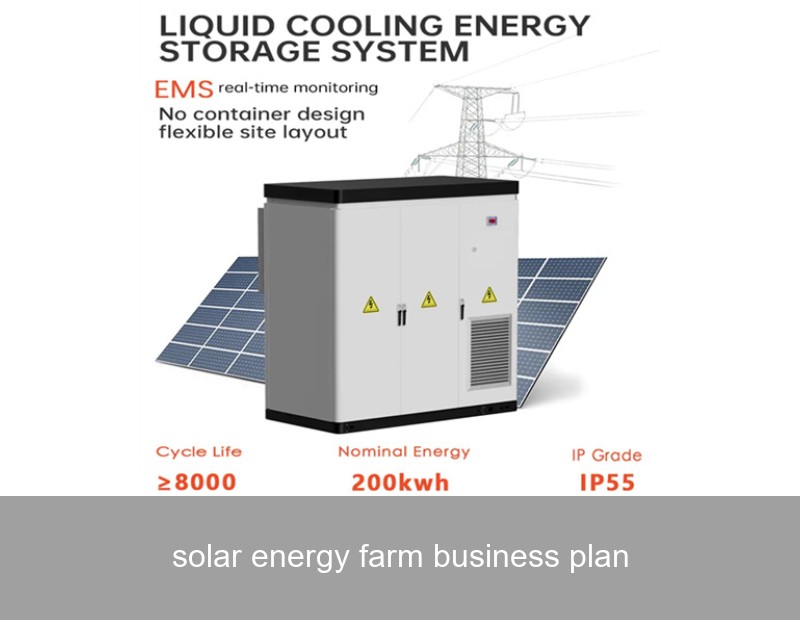
Image: A containerized BESS unit co-located with a solar array, enabling energy time-shifting.
How Highjoule's Solutions Integrate Into Your Plan
This is where partnering with an experienced technology provider becomes a strategic advantage. At Highjoule, with nearly two decades of expertise, we don't just sell battery containers; we provide integrated, intelligent storage solutions that directly address the challenges outlined in your business plan.
For the Technical Design section, specifying Highjoule's HPC Series of utility-scale battery storage systems provides confidence. These systems feature industry-leading safety protocols, high cycle life, and superior energy density, directly impacting your long-term yield and O&M cost assumptions.
For the Financial Model, our Energy Management System (EMS) is the brain that maximizes revenue stacking. It uses AI-driven forecasting to autonomously decide when to store, when to sell, and when to provide grid services, optimizing your asset's return. Mentioning a partnership with Highjoule signals to investors that you have a credible plan for operational excellence and revenue optimization.
For the O&M Strategy, Highjoule's 24/7 cloud-based monitoring and predictive maintenance platform reduces operational risk and ensures system availability, a key factor for meeting performance guarantees.
Highjoule's Value Proposition for Solar Farm Developers:
- Proven Technology: Deployed in over 15 countries across commercial, industrial, and utility-scale projects.
- Full-Scope Support: From initial feasibility and system design to commissioning and long-term service.
- Financial Modeling Partnership: Our technical sales team can provide performance simulations and revenue optimization scenarios to strengthen your plan's financial chapter.
Your Next Step: From Plan to Action
Crafting a compelling solar energy farm business plan is complex, but the opportunity has never been greater. The integration of solar with smart storage is no longer a futuristic concept—it's the baseline for bankability in 2024 and beyond. As you refine your technical appendices and financial projections, consider this: What single revenue stream (e.g., a fixed PPA) could you augment with storage to future-proof your project against market volatility and grid constraints?
We invite you to examine the specific interconnection challenges and market rules of your target region. How might a tailored storage solution transform your project's risk profile and investor appeal?
 Inquiry
 Online Chat