


Unlocking Solar Energy for Apartment Buildings: A Practical Guide for Residents and Owners
Imagine this: you live in an apartment building, you're passionate about sustainability, and you see houses with rooftop solar panels all around. You wonder, "Why can't we have that too?" You're not alone. The potential of solar energy for apartment buildings is immense, yet it often feels locked behind a tangle of logistical, financial, and technical hurdles. For multi-unit dwellings across Europe and the US, the transition to clean energy isn't just a trend; it's becoming an economic and environmental necessity. This article cuts through the complexity, showing how modern technology and smart solutions are making shared solar power not only possible but highly advantageous.
Table of Contents
The Challenge: Why Apartments Are Different
Deploying solar for a single-family home is relatively straightforward. For an apartment building, the dynamics shift dramatically. The primary obstacles are:
- Shared Roof Space: Who owns it? Who gets to use the generated power? How are costs and benefits shared?
- Complex Metering: Traditional net metering credits a single meter. An apartment building has dozens.
- Upfront Investment: A larger system requires significant capital, and reaching a consensus among all owners or tenants can be difficult.
- Grid Interaction: Feeding excess solar energy back to the grid at scale requires careful management to avoid overloading local transformers.
These aren't minor details; they're the core reasons many buildings have hesitated. But the landscape is changing fast.
The Solutions: Models for Multi-Tenant Solar
Innovative business and technological models have emerged to address these very issues. Here are the most common and effective approaches:
| Model | How It Works | Best For |
|---|---|---|
| Behind-the-Meter (BTM) with Virtual Allocation | A single solar array powers the building's common areas and supplies residents. Smart software (virtual net metering) allocates solar credits to individual apartments based on agreed-upon shares. | Condominium associations or building owners looking to directly reduce tenant electricity bills. |
| Solar for Common Areas | A simpler approach where solar panels power shared loads like hallway lighting, elevators, gyms, and laundry rooms, reducing the building's operational costs. | Any multi-family building as a first, low-complexity step towards sustainability. |
| Community Solar Gardens | Residents subscribe to a share of a larger, off-site solar farm. The energy credits appear on their utility bill, bypassing rooftop constraints entirely. | Buildings with unsuitable roofs or renters who want renewable energy without installation. |
The Data: Why It Makes Financial Sense
Let's talk numbers. According to the National Renewable Energy Laboratory (NREL), multi-family solar represents a massive, under-tapped market in the US. In the EU, the European Commission's Heating and Cooling Strategy explicitly encourages renewable integration in buildings to enhance security and reduce costs.
- Cost Reduction: A well-designed system can offset 30-60% of a building's common area electricity and a significant portion of individual unit usage, leading to substantial savings on escalating energy bills.
- Property Value Increase: Studies show buildings with solar and sustainable features command higher rents and sale prices, as they offer protection against future energy price volatility.
- Carbon Footprint: A typical 50kW system on an apartment block can avoid 25-40 metric tons of CO2 annually—equivalent to planting over 1,000 trees.

Image: Solar integration in modern architecture. Source: Unsplash (Photographer: Andreas Gücklhorn)
Case Study: A Berlin Apartment Complex Success Story
Let's look at a real-world example. The "GreenVista" residential complex in Berlin, built in the 1970s, underwent a major energy retrofit in 2022. The owners' association wanted to reduce both carbon emissions and rising operational costs.
The Problem: An old, inefficient heating system and high electricity costs for common areas. The roof was suitable for solar, but the grid connection was weak.
The Solution: A hybrid system was installed:
- A 120kW rooftop solar PV array.
- A centralized Highjoule H2-Stack Commercial Battery Energy Storage System (BESS) with 250 kWh capacity.
- An intelligent energy management system (EMS) to optimize flow.
The Results (after 12 months):
- 75% of common area electricity now comes from solar + storage.
- Peak demand charges from the grid were reduced by 40%.
- The BESS provides backup power for emergency lighting and elevators, enhancing resilience.
- Annual CO2 emissions for building operations were cut by 28 metric tons.
- Tenants reported high satisfaction due to stabilized service charges and the building's green credentials.
This case highlights a critical insight: for many apartment buildings, solar paired with intelligent storage is the key to maximizing value. It solves the grid constraint issue, maximizes self-consumption of solar power, and turns the building into a self-reliant energy community.
The Technology Enabler: Smart Storage Systems
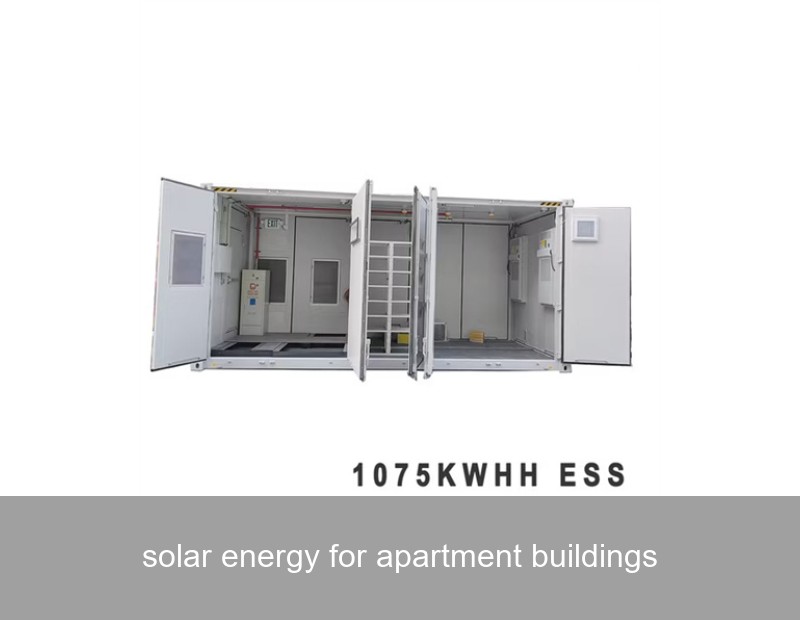
This is where companies like Highjoule change the game. Solar panels alone often export excess power at midday when prices are low. A battery storage system captures that excess and discharges it when residents need it most—in the evening when everyone is home, cooking, and charging devices. Highjoule's systems, like the H2-Stack for commercial/multi-family and the HomeVault for smaller buildings or individual floor applications, are designed for this exact purpose.
Their integrated EMS doesn't just store and release energy; it intelligently decides the most economical moment based on time-of-use tariffs, weather forecasts, and building consumption patterns. For property managers, this means automated savings and a future-proof asset. For residents, it means cleaner, more reliable, and ultimately cheaper power.

Image: A modern Battery Energy Storage System (BESS) installation. Source: Unsplash (Photographer: American Public Power Association)
Getting Started: Your Roadmap to Solar Power
Feeling inspired? Here’s a practical roadmap for your apartment building:
- Form a "Green Committee": Gather interested owners/tenants. Passion is contagious.
- Conduct a Feasibility Study: Engage a specialist (like Highjoule's project consultancy team) to assess your roof, energy consumption, local regulations, and financial incentives (e.g., tax credits in the US, EU funding programs).
- Explore Financing: Options include building reserve funds, green loans, or third-party ownership models where a developer owns the system and sells you the power.
- Design with Storage in Mind: Even if you start with solar only, ensure your design is "storage-ready." This will save significant cost and complexity later.
- Choose a Partner with Expertise: Look for providers with proven experience in multi-family projects, not just single homes. They will navigate the regulatory and technical complexities for you.
Highjoule, with nearly two decades of experience, specializes in end-to-end solutions for exactly these scenarios—from initial consultancy and system design using components like the H2-Stack BESS, to installation support and long-term performance monitoring.
An Open Question to Ponder
As electricity prices continue to fluctuate and climate action becomes ever more urgent, can your apartment building afford to leave its roof—a potential power plant—empty? What would be the first question you'd ask at your next building association meeting to start this conversation?
 Inquiry
 Online Chat