


Unlocking the Potential of Your Solar Array: A Deep Dive into the Solar Energy Storage Cabinet PCB Kit
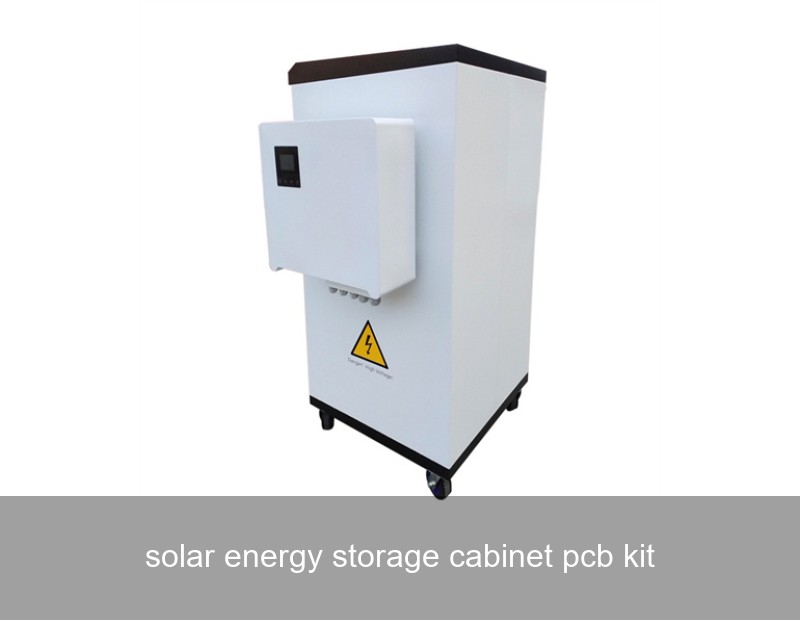
You've made the smart investment in solar panels. They're gleaming on your roof, silently converting sunlight into clean electricity. Yet, if you're like many homeowners and businesses across Europe and the US, you might be facing a familiar puzzle: your system produces a surplus at noon, but you're still drawing expensive power from the grid in the evening. The missing piece isn't just a battery; it's the intelligent brain that controls it. This is where the solar energy storage cabinet PCB kit comes into play – the unsung hero that transforms raw storage into a reliable, efficient, and smart energy asset.
Table of Contents
- The Core Challenge: From Intermittent to Intelligent Power
- What Exactly is a Solar Energy Storage Cabinet PCB Kit?
- Key Components and Their Roles
- A Real-World Case: The German Bakery Project
- The Highjoule Approach: Integrated Intelligence
- Choosing the Right Kit: A Practical Guide
- The Future is Modular and Smart
The Core Challenge: From Intermittent to Intelligent Power
Solar energy is inherently variable. Grids in California (CAISO) and Germany (Energy-Charts) frequently see the "duck curve" – a steep ramp in demand just as solar production plummets. This mismatch isn't just a grid operator's headache; it hits your wallet. Without storage, you export excess solar at low rates and import at peak, high rates. A battery cabinet solves half the problem. The PCB (Printed Circuit Board) kit solves the other half: it's the command center that decides when to store, when to discharge, and how to protect the entire system, ensuring every kilowatt-hour is used optimally.
What Exactly is a Solar Energy Storage Cabinet PCB Kit?
Think of your solar storage cabinet as a body. The battery cells are the heart, storing energy. The metal enclosure is the skeleton, providing structure. The solar energy storage cabinet PCB kit is the central nervous system and brain combined. It's a suite of interconnected circuit boards that manage power conversion, battery management, system monitoring, and safety protocols. For integrators and technically-inclined homeowners, these kits offer a flexible, often more cost-effective path to building a robust storage system compared to off-the-shelf, all-in-one units.

Image source: Unsplash (User: @lukechesser)
Key Components and Their Roles
A high-quality kit typically includes several critical PCBs, each with a dedicated function:
- Battery Management System (BMS) Master Board: The guardian of your battery. It monitors every cell's voltage, temperature, and state of charge, ensuring balance and preventing dangerous conditions like overcharge or deep discharge.
- Power Conversion System (PCS) Controller: This board governs the bi-directional inverter/charger. It converts DC from the batteries to AC for your home, and AC from the grid/solar to DC for charging, all with high efficiency.
- System Control & Communication Board: The system's logic center. It runs the energy management algorithms, decides on charge/discharge schedules based on tariffs or consumption patterns, and communicates with external networks (solar inverter, grid, home energy management system).
- Safety and Protection Module: A dedicated board for real-time monitoring of ground faults, arc faults, short circuits, and temperature extremes, triggering immediate shutdowns if needed.
A Real-World Case: The German Bakery Project
Let's look at a concrete example from Bavaria, Germany. A family-run bakery with a 50 kWp rooftop solar system faced high grid fees and wanted to ensure uninterrupted power for its refrigeration units. They opted for a custom 40 kWh lithium-ion storage cabinet built using a professional-grade PCB kit.
- Problem: High energy costs, reliance on grid during early morning baking hours, vulnerability to outages.
- Agitation: Data showed 60% of solar generation was being exported to the grid at a feed-in tariff of €0.08/kWh, while purchasing power at €0.32/kWh during operation hours.
- Solution: Installation of the custom storage cabinet with an advanced PCB kit featuring intelligent load-shifting logic. The kit was programmed to prioritize charging from excess solar, then discharge during peak morning and evening hours, with a grid-backup mode for outages.
| Metric | Before | After |
|---|---|---|
| Grid Energy Consumption | 85% of total usage | 35% of total usage |
| Self-Consumption of Solar | ~40% | ~92% |
| Annual Energy Cost Savings | Baseline | €8,400 |
| Backup Power Coverage | 0 hours | Critical loads for 10+ hours |
This case highlights how the intelligence embedded in the PCB kit directly translates to financial resilience and operational security.
The Highjoule Approach: Integrated Intelligence
At Highjoule, with nearly two decades of experience since 2005, we understand that the hardware is only as good as the software that commands it. While we offer complete, pre-engineered storage solutions for plug-and-play simplicity, our expertise also informs our support for advanced integrators.
Our H-IQ Core platform, which powers our commercial and residential systems, is the culmination of learning from thousands of installations. For projects requiring custom cabinet builds, the principles embedded in our H-IQ Core – predictive algorithms, seamless integration with major inverter brands, and robust safety protocols – serve as the benchmark for what a superior solar energy storage cabinet PCB kit should achieve. We advocate for kits that offer not just connectivity, but true interoperability and grid-service readiness, preparing systems for future capabilities like virtual power plant (VPP) participation.

Image source: Unsplash (User: @thisisengineering)
Choosing the Right Kit: A Practical Guide
Selecting a PCB kit is a critical decision. Here’s what to prioritize:
- Certification & Safety: Ensure the kit design complies with regional standards (UL 9540 in the US, IEC 62619 in Europe). Look for functional safety certifications in the BMS.
- Software & Updates: The best hardware is crippled by poor software. Choose a kit from a provider that offers a clear, updatable firmware roadmap and a user-friendly interface for configuration.
- Scalability: Can the kit manage a parallel stack of multiple battery cabinets if your needs grow? Modular design is a future-proof advantage.
- Support & Documentation: Comprehensive technical manuals, wiring diagrams, and accessible technical support are non-negotiable for a smooth installation.
The Future is Modular and Smart
The evolution of the solar energy storage cabinet PCB kit is headed towards greater decentralization and intelligence. We're moving into an era of modular "plug-and-play" battery packs each with their own onboard BMS, communicating via a central controller. This simplifies maintenance and expansion. Furthermore, AI-driven energy forecasting will become standard, allowing your system to make decisions based on weather predictions, historical usage, and real-time grid signals.
This shift turns every storage cabinet from a passive asset into an active grid participant. Imagine your system automatically earning revenue by providing grid stability services during times of high stress—all coordinated by that unassuming set of circuit boards.
So, as you contemplate maximizing your solar investment, the question isn't just "how much storage?" but rather, "how intelligent is the control system at the heart of that storage?" What energy management goal—maximizing self-consumption, achieving backup resilience, or future grid participation—will drive the specification of your PCB kit?
 Inquiry
 Online Chat