


What is a Solar Grade Supplier and Why Does It Matter for Your Energy Independence?
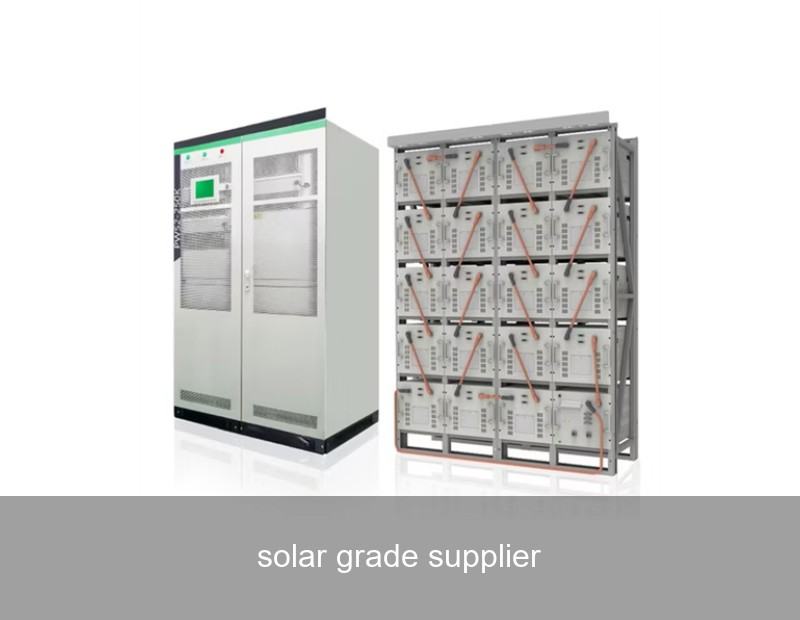
You've decided to go solar. You've compared panels, calculated potential savings, and dreamt of energy independence. But there's a crucial link in the chain you might not have considered yet: the solar grade supplier. This isn't just about who sells you equipment; it's about partnering with a provider whose components are engineered, integrated, and supported to deliver the reliable, high-performance system your investment deserves. In today's energy landscape, where solar is often paired with storage, the role of your supplier becomes even more critical. They are the architects of your power resilience.
Table of Contents
Defining "Solar Grade": More Than Just a Label
Let's break down the term. A true solar grade supplier provides a holistic ecosystem of hardware, software, and services specifically designed for the demands of photovoltaic (PV) systems. Think of it this way: you can power a lightbulb with a standard battery, but to run your entire home, you need a designed, managed battery system. The same principle applies to solar.
The key differentiators of a solar grade supplier include:
- Component Compatibility & System Integration: Ensuring inverters, optimizers, and mounting systems communicate flawlessly with the panels and, vitally, with any storage addition.
- Performance Warranty & Longevity Assurance: Backing their products with robust, long-term warranties that guarantee energy output and product durability, often for 25 years or more.
- Grid Service Capabilities: Providing equipment that doesn't just generate power but can also support grid stability through features like frequency regulation and voltage control—a growing requirement in markets like the EU and parts of the US.
- Technical Support & Certification: Offering accredited installer training and accessible expert support for the entire system lifecycle, not just the sale.
The Storage Imperative: Where Your Supplier's Expertise Is Key
Here's the pivotal shift: modern solar is rarely just solar. The sun doesn't shine at night, and grid prices are volatile. Adding battery energy storage system (BESS) transforms your setup from a one-trick generator into a 24/7 personal power plant. This is where the distinction of your solar grade supplier becomes non-negotiable.
Integrating storage adds layers of complexity: battery chemistry (like Lithium Iron Phosphate for safety and longevity), advanced energy management software, and complex system controls. A supplier offering a piecemeal solution—panels from one brand, batteries from another, and a third-party inverter—often leads to integration headaches, suboptimal performance, and fragmented support.
According to the International Energy Agency (IEA), global grid-scale storage capacity is set to multiply exponentially, with distributed storage in homes and businesses leading the charge. Your supplier needs to be a master of this integrated equation.

Image: A modern solar-plus-storage installation. The seamless integration of panels and battery unit is a hallmark of a true solar grade supplier. (Source: Unsplash)
Case Study: A European Logistics Hub's Journey to Resilience
Consider the challenge faced by a mid-sized logistics warehouse in Northern Germany. Their goals: reduce peak grid demand charges, ensure refrigeration security, and generate a return on investment.
- Phenomenon: High operational costs from grid consumption, especially during expensive peak hours, and anxiety over potential grid outages spoiling cold-stored goods.
- Data & Solution: The facility worked with a solar grade supplier to deploy a 450 kWp rooftop PV array coupled with a 500 kWh DC-coupled battery storage system. The system was designed to prioritize self-consumption, shift peak loads, and provide backup power to critical cooling circuits.
- Outcome: Within the first year:
Metric Result Grid Energy Consumption Reduced by 68% Peak Demand Charges Cut by 42% Self-Consumption of Solar Increased from ~30% to over 85% - Insight: The success hinged not on individual components, but on the supplier's ability to deliver a system with intelligent, weather-aware energy management software that predicted solar yield and optimized battery charge/discharge cycles against real-time electricity prices.
Choosing Your Solar Grade Supplier: A Practical Framework
So, how do you identify a partner that meets this high standard? Ask these questions:
- Do you offer an integrated, AC or DC-coupled, solar-plus-storage solution? A single-source provider for the core system minimizes compatibility risk.
- What is the depth of your performance guarantee? Look for linear power warranties on panels and throughput/cycle warranties on batteries.
- Can your system provide grid services or operate in an off-grid/microgrid mode? This future-proofs your investment against evolving grid policies and needs.
- What does your monitoring and energy management platform offer? You should have clear, actionable insights into generation, consumption, and storage status.
The Highjoule Approach: Integrated Intelligence from Panel to Plug
This is precisely the philosophy behind Highjoule. Since 2005, we have evolved from a component supplier to a global solar grade supplier and advanced储能系统提供商. We understand that energy independence is built on harmony between generation, storage, and consumption.
For our commercial and industrial clients across Europe and North America, Highjoule delivers this through our Unison Energy Platform. It's not a collection of parts; it's a pre-engineered ecosystem:
- High-Efficiency PV Modules & Inverters: Selected and configured for optimal yield in local conditions.
- Highjoule H-Cube Battery Systems: Scalable, containerized BESS solutions built with Lithium Iron Phosphate (LFP) cells for unparalleled safety and lifecycle performance. For residential and smaller commercial applications, our H-Flex battery products offer the same core intelligence in a modular format.
- Brain: The Aegis Energy Management System (EMS): This proprietary software is the true differentiator. It doesn't just monitor; it autonomously optimizes every kilowatt-hour based on weather forecasts, usage patterns, tariff structures, and grid signals, maximizing your financial return and energy resilience.
Our role as a solar grade supplier is to assume the technical burden of integration, providing a single point of accountability, training for certified installers, and 24/7 system performance monitoring. This allows business owners, facility managers, and homeowners to focus on the outcome—reliable, low-cost, clean power—rather than the engineering complexities.

Image: Utility-scale solar projects demand the highest grade of supply and integration. (Source: Unsplash)
The energy transition is accelerating. With policies like the EU's Green Deal and the U.S. Inflation Reduction Act creating strong incentives, the question is no longer if you should adopt solar and storage, but with whom. Choosing a partner that embodies the full definition of a solar grade supplier is the most critical decision you'll make on that journey.
Is your current energy setup merely generating power, or is it intelligently managing it to create true economic and operational resilience for your future?
 Inquiry
 Online Chat