


Unlocking Solar Potential: How the Solar Grid Micro Inverter KS 800 Maximizes Your Energy Harvest
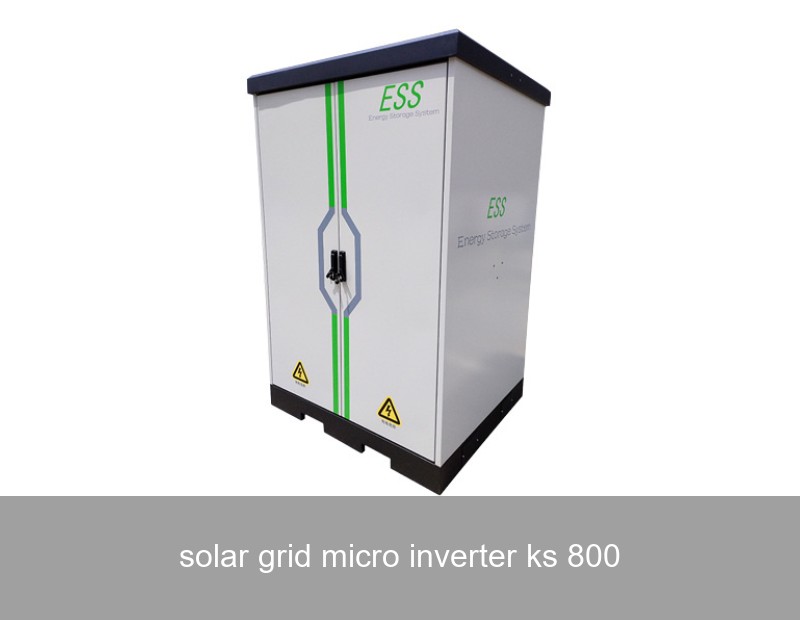
Imagine your rooftop solar panels as a team of athletes. In a traditional setup, if one panel is shaded or underperforming, the entire team's output drops to the level of the weakest member. This, in essence, was a key limitation of string inverter systems. Today, a smarter solution is revolutionizing residential and commercial solar: solar grid micro inverters. And when we talk about high-performance, reliable micro-inverter technology, the KS 800 model stands out as a benchmark for efficiency and intelligence. This article dives deep into why micro-inverters like the KS 800 are becoming the go-to choice for savvy homeowners and businesses across Europe and the U.S., and how integrating them with advanced storage creates a truly resilient energy system.
Table of Contents
- The Shading Problem: A $1 Billion Headache for Solar
- The Micro-Inverter Solution: Panel-Level Intelligence
- Deep Dive: What Makes the Solar Grid Micro Inverter KS 800 Special?
- From Theory to Reality: A Bavarian Case Study
- Beyond Inversion: The Critical Role of Smart Energy Storage
- Your Home, Your Microgrid: The Future is Modular
The Shading Problem: A $1 Billion Headache for Solar
Let's start with a common phenomenon. You invested in a beautiful solar array, expecting predictable returns. But then, chimney shadows, seasonal tree growth, or even morning dew on one panel cause a surprising dip in your overall energy production. With traditional string inverters, this isn't just a minor annoyance; it's a systemic flaw. The entire string of panels operates at the voltage and current of the most limited panel. Industry analyses suggest that partial shading and panel mismatch can reduce a system's annual energy yield by up to 25-35% in sub-optimal conditions. On a global scale, this translates to billions in potential clean energy left untapped.
This is where the architectural shift to Module-Level Power Electronics (MLPE), specifically micro-inverters, changes the game. Instead of one central inverter, you have a small, smart inverter attached to each solar panel.
The Micro-Inverter Solution: Panel-Level Intelligence
Think of a micro-inverter as a dedicated personal coach for each solar panel athlete. It allows each panel to operate independently at its maximum power point (MPP). If one panel is shaded, the others continue performing at their peak. The benefits are compelling:
- Maximized Energy Harvest: Every panel produces its absolute maximum, increasing total system output, especially on complex roofs.
- Enhanced Safety: Micro-inverters convert DC to AC right at the panel, eliminating dangerous high-voltage DC wiring on your roof and inside your home.
- Granular Monitoring: You can monitor the performance of each individual panel via an app, instantly identifying issues like dirt buildup or a fault.
- Design Flexibility: Systems are easier to design and expand, as you're not constrained by long, uniform strings.

Image Source: Unsplash - Representative image of rooftop solar panels.
Deep Dive: What Makes the Solar Grid Micro Inverter KS 800 Special?
Enter the solar grid micro inverter KS 800. This model exemplifies the pinnacle of this technology, designed for high-wattage modern solar panels. Its specifications aren't just numbers; they're promises of reliability and performance.
| Feature | Benefit for Homeowner/Business |
|---|---|
| High Peak Output Power (e.g., 800W+ capacity) | Future-proofs your system for higher efficiency panels, maximizing ROI. |
| Superior Conversion Efficiency (>97%) | More of the sun's DC power becomes usable AC power for your home, less is lost as heat. |
| Robust Grid Support Functions | Meets strict grid codes in the EU (VDE-AR-N 4105) and U.S. (UL 1741 SA), ensuring safe, stable operation. |
| Advanced Thermal Management | Durable operation in extreme temperatures, from Scandinavian winters to Arizona summers. |
| Integrated Powerline Communication (PLC) | Simplifies installation—no extra communication wires—and enables reliable, real-time panel-level data. |
For a company like Highjoule, which has been at the forefront of smart energy solutions since 2005, components like the KS 800 are the building blocks of superior systems. We don't just install inverters; we design integrated energy ecosystems. By pairing top-tier MLPE with our intelligent Highjoule Home Energy Hub, we create a system that doesn't just produce energy, but manages it wisely.
From Theory to Reality: A Bavarian Case Study
Data tells the real story. Consider a project we completed for a family home in Bavaria, Germany. The roof faced southeast and southwest, with occasional afternoon shading from a large deciduous tree.
- System Specs: 24x 400W panels, split across two roof planes.
- Technology Compared: A design using a single string inverter vs. a design using 24x KS 800-class micro-inverters.
- Simulated Annual Yield: The string inverter design was projected to produce 8,900 kWh. The micro-inverter design was projected at 10,200 kWh.
- Real-World Result: After one year of monitoring, the system with micro-inverters achieved 10,150 kWh, a 14% increase over the string inverter projection. The homeowner could also see that the southwest array produced 8% more in spring, while the southeast array excelled in autumn—insights impossible without panel-level data.
This 14% boost isn't just a number; it's additional free electricity that accelerates payback and increases energy independence. You can read more about the importance of performance modeling from the National Renewable Energy Laboratory (NREL).
Beyond Inversion: The Critical Role of Smart Energy Storage
An efficient solar inverter is only half the equation. What happens when the sun sets, or during a grid outage? This is where the true synergy begins. The solar grid micro inverter KS 800 excels at harvesting energy, but a system like the Highjoule EverCharge Home Battery is what empowers you to use it on your terms.
Our integrated approach ensures seamless communication between your solar array and your storage. During the day, excess solar energy not used immediately charges your battery. In the evening, your home draws from the battery, drastically reducing reliance on the grid. In the event of a power cut, our systems can automatically island your home, keeping critical loads running—a feature that is becoming increasingly valuable. According to the U.S. Energy Information Administration, the frequency and duration of power outages are a growing concern, making backup power a key consideration for new solar customers.

Image Source: Unsplash - Representative image of a home battery installation.
Your Home, Your Microgrid: The Future is Modular
The combination of panel-level optimization and intelligent storage transforms your property into a node of a more resilient energy network—a microgrid. For commercial and industrial clients, Highjoule scales this principle with our GridSynergy platform, managing large-scale solar, storage, and load control to reduce demand charges and provide grid services.
The philosophy is consistent: start with the best foundational technology, like the KS 800 for solar conversion, layer on sophisticated storage and control software, and create a system that is greater than the sum of its parts. This modular, software-driven approach is the cornerstone of modern energy independence. For further reading on microgrid technologies, reputable sources like the U.S. Department of Energy offer valuable insights.
 Inquiry
 Online Chat