


How Much Does an SDI ESS Battery Really Cost? A Comprehensive Breakdown
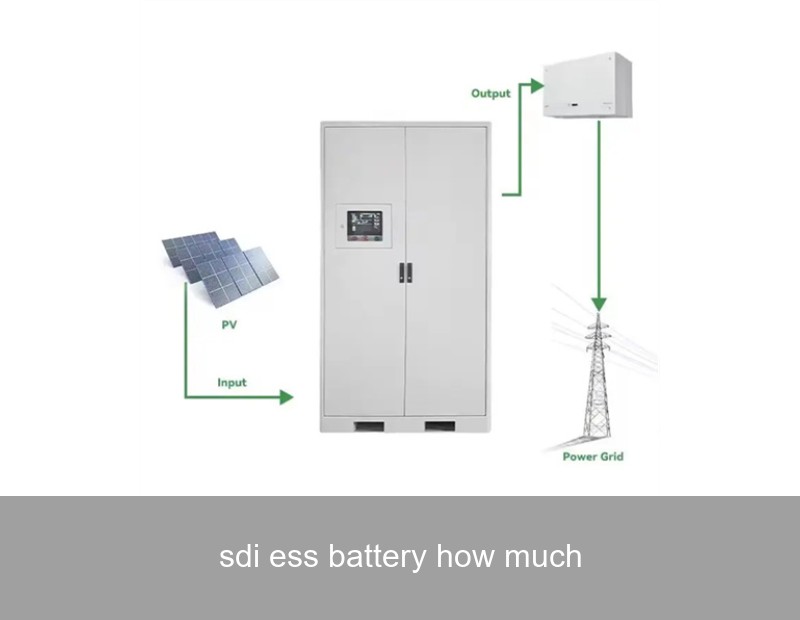
If you're researching energy storage for your home or business, you've likely encountered the term "SDI ESS battery" and the inevitable next question: how much? It's a common starting point, but the answer is rarely a simple number on a price tag. As a product and technical expert at Highjoule, a global leader in advanced energy storage since 2005, I spend my days helping customers from Europe to the US navigate this very question. The cost of a Samsung SDI (Samsung SDI Energy Storage System) battery solution is a blend of hardware, intelligence, and long-term value. Let's demystify the pricing and explore what you're truly investing in for a resilient and sustainable energy future.
Table of Contents
- Breaking Down the "Sticker Price": More Than Just Batteries
- Key Factors That Influence Your SDI ESS Battery System Cost
- The Total Value Proposition: Savings, Security, and Sustainability
- A Real-World Case Study: Quantifying the Investment
- The Highjoule Approach: Smart Integration for Optimized Cost
- Your Energy Future: What Should You Calculate First?
Breaking Down the "Sticker Price": More Than Just Batteries
Asking "how much for an SDI ESS battery?" is like asking "how much for a house?" Location, size, and features matter immensely. A complete, installable system involves several core components:
- Battery Modules (SDI cells): This is the core energy bank, often using Samsung SDI's proven lithium-ion technology. Cost scales with capacity (kWh).
- Battery Management System (BMS): The brain of the operation. A high-quality BMS, like those integrated into Highjoule systems, is critical for safety, longevity, and performance.
- Power Conversion System (PCS/Inverter): This converts DC battery power to AC for your home or business. It needs to be correctly sized and compatible.
- System Integration & Engineering: This includes the enclosure, thermal management, safety systems, and the crucial software that ties everything together.
- Installation & Permitting: Labor, electrical work, and navigating local building and grid connection codes vary widely by region in both the US and Europe.
Therefore, a quoted price for a complete SDI ESS solution typically ranges from $8,000 to $25,000+ for residential systems (10-30kWh), and from $50,000 to several hundred thousand dollars for commercial/industrial setups, before incentives. The wide range is why understanding the factors is key.
Key Factors That Influence Your SDI ESS Battery System Cost
Let's look at the primary levers that affect your final investment.
| Factor | Impact on Cost | Highjoule's Perspective |
|---|---|---|
| System Capacity (kWh) | The largest cost driver. More kWh = more battery cells = higher upfront cost. | We conduct detailed energy audits to right-size your system, preventing over- or under-spending. |
| Power Rating (kW) | Determines how much power you can draw at once. High-power needs (e.g., heavy machinery) require a more robust inverter, increasing cost. | Our systems are designed to handle peak loads efficiently, ensuring your critical operations never lag. |
| Installation Complexity | Retrofit vs. new build, distance from main panel, and local labor rates can cause significant variation. | Our certified installer network across Europe and the US ensures standardized, efficient installations. |
| Grid Services & Software Intelligence | Basic backup vs. smart grid-interactive systems with revenue-generating potential (like frequency regulation). | Highjoule's Adaptive Grid OS software unlocks value streams, turning your storage into a potential income asset. |
| Incentives & Rebates | Can reduce net cost by 30% or more. Examples: US Federal ITC (source), various EU national grants. | We provide guidance on available incentives in your region to maximize your return. |
The Total Value Proposition: Savings, Security, and Sustainability
Focusing solely on upfront cost misses the forest for the trees. An SDI ESS battery is a capital investment with a measurable return. Here’s the value equation:
- Energy Bill Savings: By storing solar energy or cheap off-peak grid power, you avoid buying expensive peak-time electricity. Over 10-15 years, these savings can offset a major portion of the system cost.
- Backup Power Security: For businesses, power outages mean lost revenue. For homes, they're a major inconvenience. The value of continuous power during a grid failure is significant and often a primary driver.
- Grid Independence & Sustainability: Increasing your self-consumption of renewable energy reduces your carbon footprint and buffers you from volatile energy markets.
At Highjoule, we build this value into every system. Our IntelliBESS series for commercial & industrial applications and HomeGuard series for residences are not just battery containers; they are integrated, intelligent energy platforms designed to maximize each of these value streams over a 20+ year lifecycle.
A Real-World Case Study: Quantifying the Investment
Let's move from theory to data. Consider a mid-sized dairy processing facility in Bavaria, Germany, facing high demand charges and seeking backup for critical refrigeration.
- Challenge: High peak power demand charges and vulnerability to grid interruptions.
- Solution: A Highjoule IntelliBESS C&I system with 250 kWh SDI battery capacity and 100 kW inverter power.
- Cost Breakdown (Approx.): System & Integration: ~€120,000; Installation & Grid Connection: ~€20,000. Gross Investment: ~€140,000.
- Incentives: German federal funding for commercial storage (KfW) covered ~30%. Net Cost: ~€98,000.
- Value Generated (Annual): Demand charge savings: €15,000. Optimized solar self-consumption savings: €8,000. Avoided spoilage from brief outages: Priceless, but quantifiably tens of thousands.
- Payback Period: With ~€23,000 in annual direct savings, the simple payback period is just over 4 years. For more on commercial storage economics, see this NREL report on storage value.

Image: A modern industrial battery storage installation, similar to Highjoule's C&I solutions. Source: Unsplash (representative image).
The Highjoule Approach: Smart Integration for Optimized Cost
Why choose a full Highjoule system over just buying components? Integration is the answer. We don't just source high-quality SDI battery cells; we engineer the entire ecosystem. Our proprietary Adaptive Grid OS acts as the system's nervous system, constantly learning energy patterns, forecasting weather, and optimizing charge/discharge cycles not just for today, but for the lifetime of the battery. This extends longevity, maximizes financial returns, and ensures safety—factors that a cheap, poorly integrated system can't match.
For our residential customers, the HomeGuard system offers this same intelligence in a sleek, quiet package. It seamlessly integrates with new or existing solar, provides whole-home or critical-load backup, and can be managed intuitively via a smartphone app. You're paying for peace of mind and decades of optimized performance.

Image: Solar panels paired with a home battery storage system, enabling energy independence. Source: Unsplash (representative image).
Your Energy Future: What Should You Calculate First?
So, "how much for an SDI ESS battery?" The most honest reply is another question: What is the cost of *not* having reliable, controllable, and sustainable power for your home or business? Start your journey not with a search for the lowest price per kWh of battery, but with an assessment of your needs:
- What are your peak electricity bills, and what are the demand charges?
- Which appliances or operations are critical during an outage?
- What are your sustainability goals and solar production (if any)?
With this information, a specialist from a company like Highjoule can provide a tailored proposal that shows the true cost and, more importantly, the long-term value. The right SDI ESS battery system isn't an expense; it's an investment in resilience and independence.
What's the first energy challenge you'd like your storage system to solve—cutting your peak bill, ensuring backup for your home office, or finally maximizing your solar investment?
 Inquiry
 Online Chat