


Solar Material: How Much Do We Really Need for a Sustainable Future?
You're ready to make the switch to solar. You've seen the potential savings, you're excited about clean energy, but a practical question nags at you: solar material, how much is actually involved? It's not just about the sleek panels on the roof. Understanding the material footprint—from the silicon in cells to the aluminum in frames and, crucially, the components that store that energy—is key to a truly efficient and sustainable system. Let's unpack the material reality behind your solar power.
Key Solar Panel Materials: A Breakdown
A standard photovoltaic (PV) panel is a sophisticated sandwich of various materials, each playing a critical role. The exact quantities vary by technology, but for a typical 400-watt residential panel (approximately 2m x 1m), the composition is telling.
| Material | Primary Function | Approx. Weight per Panel | Key Notes |
|---|---|---|---|
| Glass | Front protection, light transmission | 12-15 kg | Low-iron, tempered glass for durability. |
| Aluminum Frame | Structural rigidity | 3-4 kg | Recyclable, protects edges. |
| Silicon Solar Cells | Convert sunlight to electricity | ~0.7-1 kg | The "active" material; polycrystalline or monocrystalline. |
| Encapsulant (EVA) | Seals and protects cells | ~1 kg | Ethylene-vinyl acetate, a transparent plastic layer. |
| Backsheet | Insulation and humidity barrier | ~0.5 kg | Polymer-based composite. |
| Copper | Wiring, busbars | ~0.2 kg | Critical for conducting generated electricity. |
| Junction Box | Connects panel to system | ~0.2 kg | Holds diodes and cable connections. |
So, for a single panel, you're looking at roughly 18-22 kg of total mass. But here's the crucial point: the panel is only part of the story. To maximize the value of every gram of silicon and every watt generated, you need to intelligently manage the energy. That's where balance of system (BOS) components, especially advanced battery storage, become material-efficient force multipliers.
The Material Efficiency Evolution: Doing More with Less
The solar industry's history is a masterclass in material optimization. In the early 2000s, silicon wafers were over 300 microns thick. Today, they are approaching 150 microns—almost as thin as a human hair. This means less raw silicon per watt, reducing cost and material intensity. According to the National Renewable Energy Laboratory (NREL), average module efficiencies have climbed from around 15% to over 22% for commercial panels in the last decade. Higher efficiency directly translates to needing fewer panels, and thus less material, for the same power output.
Image: Modern solar cells use thinner silicon and advanced designs to maximize efficiency. Credit: Unsplash.

This drive for efficiency mirrors our philosophy at Highjoule. Just as PV technology squeezes more power from sunlight, our battery energy storage systems (BESS) are engineered to extract maximum utility from every kilowatt-hour stored. Our proprietary battery management and system integration software ensures minimal energy waste, meaning you need a smaller, more material-efficient battery bank to achieve the same energy resilience and savings.
Beyond the Panel: The Full System Material Footprint
When we ask "solar material, how much," we must consider the entire installation:
- Mounting & Racking: Steel or aluminum structures add significant weight (5-10 kg per panel).
- Inverters: Contain copper, silicon semiconductors, and aluminum heat sinks.
- Cabling: Hundreds of feet of copper wiring are needed for most systems.
- Energy Storage (The Game-Changer): This is where material investment pays the highest dividends. A lithium-ion battery system adds weight and materials (lithium, nickel, cobalt, graphite, steel), but it radically increases the utility of your entire solar material investment.
Think of it this way: Without storage, excess solar energy generated at midday is often exported to the grid at low value. With a Highjoule BESS, that surplus energy is captured. It's then available to power your home or business during expensive peak hours or at night. This effectively increases the utilization rate of your solar panels from maybe 30-40% self-consumption to over 80%. You're getting far more value out of the same initial material input.
Case Study: Material Efficiency in Action at a German Industrial Plant
Let's look at real data. A medium-sized automotive parts manufacturer in Bavaria installed a 500 kW rooftop solar array in 2020. Initially, without storage, they were consuming only 35% of their solar generation on-site, exporting the rest.
In 2022, they integrated a Highjoule H2 Commercial Series battery system (rated at 750 kWh / 375 kW). The results over the first year were transformative:
- On-site solar consumption jumped from 35% to 92%.
- Peak grid demand charges were reduced by 68%.
- The effective "value yield" per installed solar watt increased by an estimated 40%.
This case demonstrates the synergy. The solar panels are the source, but the Highjoule storage system is the intelligent hub that maximizes the return on every material resource used in the PV system—and itself. Our batteries use a lithium iron phosphate (LFP) chemistry, which prioritizes longevity and safety, using abundant iron and phosphate instead of scarcer cobalt.
The Highjoule Advantage: Material-Smart Energy Storage
Since 2005, Highjoule has focused on creating intelligent storage that complements and amplifies solar investments. Our products are designed with a holistic view of the material cycle:
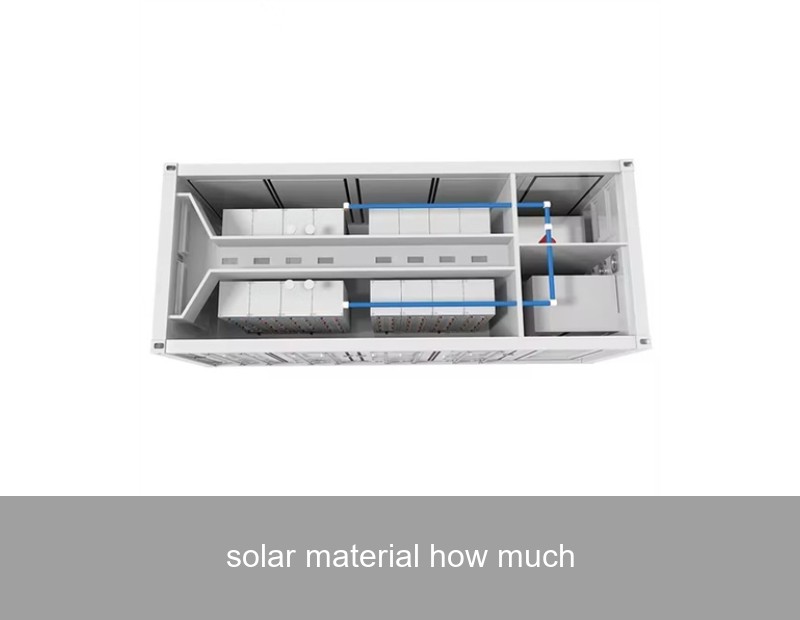
- High-Density Systems: Our containerized H3 Microgrid Series packs massive storage capacity into a compact footprint, minimizing land and structural material use for large-scale deployments.
- Longevity & Durability: With a design life exceeding 15 years and cycle life of 6000+, our systems outlast many competitors. A longer lifespan means fewer raw materials consumed per decade of service—a core tenet of sustainability.
- Smart Integration: Our AI-driven energy management platform doesn't just store power; it optimizes its flow in real-time based on weather, usage patterns, and grid signals, ensuring no watt is wasted.
Image: A compact, integrated battery storage system maximizing energy use. Credit: Unsplash (Representative).

Sustainability and The Recycling Horizon
The end-of-life question is vital. The International Renewable Energy Agency (IRENA) estimates that by 2050, up to 78 million tonnes of solar panel waste could be generated globally, but also notes this represents a huge "urban mine" of recoverable materials. Leading recyclers can now recover over 95% of the glass and 85% of the metals.
At Highjoule, we are actively engaged in circular economy partnerships. Our battery systems are designed for disassembly, and we participate in take-back programs to ensure critical materials like lithium, copper, and nickel are recovered and fed back into the manufacturing chain. Choosing a storage provider with a clear end-of-life strategy is as important as choosing one with high efficiency.
So, when you contemplate "solar material, how much," shift the perspective. It's not just about the physical quantity. It's about the value per kilogram. By pairing high-efficiency solar with intelligent, durable storage from Highjoule, you ensure that every ounce of material in your energy system works harder, lasts longer, and delivers a greater return—both for your wallet and for the planet. What material efficiency questions are most pressing for your specific energy project?
 Inquiry
 Online Chat