


Solar Panel for 1kVA ESS: Your Guide to a Perfectly Balanced Energy System
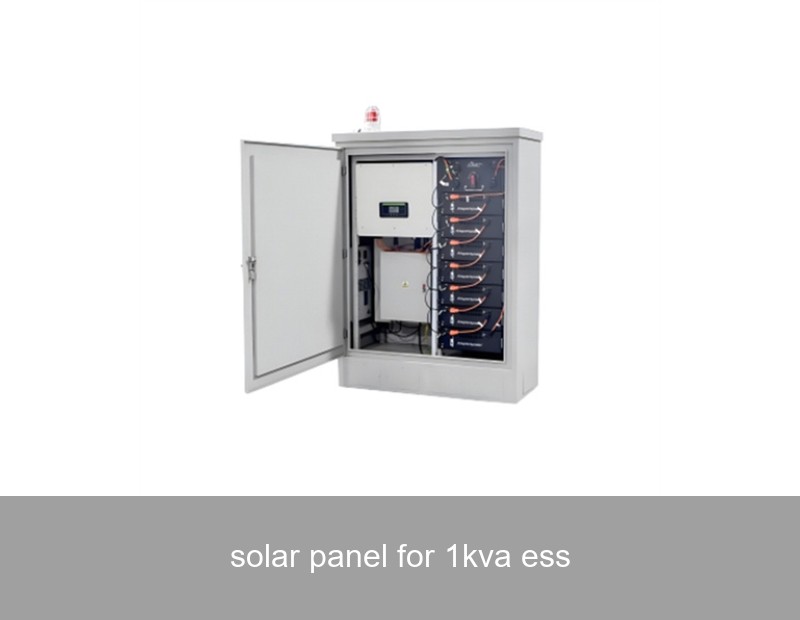
Have you ever felt the frustration of investing in a solar and battery system, only to find it doesn't quite meet your daily needs? Perhaps your battery drains too quickly on cloudy days, or your solar panels seem to be underperforming. You're not alone. A common challenge for homeowners and small business owners is achieving harmony between solar generation and storage capacity. This is where understanding the precise pairing of a solar panel for 1kVA ESS becomes critical. A 1kVA (kilovolt-ampere) Energy Storage System, roughly equivalent to 1kW (kilowatt) in many cases with a usable capacity often between 1-3kWh, is a popular choice for essential loads, backup power, or maximizing self-consumption. But its true potential is only unlocked when paired with correctly sized solar panels. Let's demystify this pairing and explore how to build a resilient, efficient, and intelligent power solution.
The Art of Right-Sizing: Solar Panel for 1kVA ESS
The goal isn't just to connect panels to a battery; it's to create a symbiotic relationship. An undersized solar array will struggle to recharge your battery, especially in winter or during poor weather. An oversized array might waste potential energy if the battery is full and the local grid has unfavorable feed-in tariffs. So, what's the sweet spot?
It starts with understanding your energy flow. A 1kVA ESS with, say, 2.4kWh of usable storage is ideal for powering critical circuits—lighting, refrigeration, internet, and a few outlets. To keep it charged and power your home during the day, you need consistent solar input.
- Daily Recharge Needs: If your battery cycles from 30% to 100% daily, you need to replenish roughly 1.7kWh.
- Solar Insolation: This is where location matters immensely. In Southern California, you might get 5.5 peak sun hours. In Germany, it could average 2.5-3.5. You need to generate your daily recharge need within those hours.
- The Calculation: For a home in Bavaria, Germany (approx. 3 peak sun hours), to generate 1.7kWh, you'd need about 570W of solar panels (1.7kWh / 3h = 0.57kW). However, this only covers battery recharge, not simultaneous daytime household load!
Therefore, for a balanced solar panel for 1kVA ESS system, a typical recommendation is 1.2kW to 2kW of solar panels. This provides enough power to charge the battery and offset daytime consumption, creating genuine energy independence. This is the principle behind Highjoule's design philosophy for residential systems: intelligent sizing that matches real-world consumption patterns, not just theoretical maximums.

Image Source: Unsplash - A well-sized residential solar installation.
Beyond the Basics: Key Components for a Reliable System
Panels and a battery are just the start. The brain and the nervous system of your setup are what make it safe, efficient, and smart.
- The Inverter/Charger: This is the heart. For a 1kVA system, you need a hybrid inverter that can manage DC power from the panels, convert it to AC for your home, convert excess AC to DC to charge the battery, and invert battery DC to AC during an outage. Highjoule's HelioCore Hybrid series excels here, with high conversion efficiencies exceeding 97.5%, ensuring minimal energy is lost in the process.
- Battery Chemistry: Most modern ESS units, including Highjoule's VoltStack residential line, use Lithium Iron Phosphate (LFP) chemistry. It's safer, has a longer lifespan (typically 6000+ cycles), and performs better across a wider temperature range than older lithium-ion types.
- Energy Management System (EMS): This software is the genius. A smart EMS, like the one embedded in every Highjoule system, learns your habits, weather patterns, and electricity rates. It can decide to store solar energy for evening use, sell excess to the grid during peak price hours, or provide backup power seamlessly during a blackout—all without you lifting a finger.
A Real-World Case Study: The Berlin Bakery
Let's move from theory to practice. Consider a small artisanal bakery in Berlin. Their challenge: refrigerators and proofing cabinets causing significant energy draw, and brief grid outages risking spoilage. Their goal was to ensure uninterrupted operation for critical cooling and essential lighting (a ~1.5kW continuous load).
They installed a system comprising:
- 1.8kW of solar panels on their flat roof.
- A Highjoule VoltStack 1kVA/2.4kWh ESS with integrated HelioCore inverter.
- Smart load management to prioritize refrigeration circuits during backup.
| Metric | Before Installation | After 12 Months |
|---|---|---|
| Grid Energy Consumption | 100% (Baseline) | Reduced by 68% |
| Self-Consumption of Solar | N/A | Increased from ~40% to 92%* |
| Outage Protection | Zero | Critical loads protected for 8+ hours |
| ROI Timeline | N/A | Projected under 6 years |
*The high self-consumption rate was achieved by the intelligent EMS charging the battery with midday solar excess for use during the bakery's late afternoon/evening operational peak.
This case, documented in a Fraunhofer ISE study on bakery decarbonization, illustrates the tangible impact of a correctly sized solar panel for 1kVA ESS solution in a commercial setting. The system's reliability was tested during a planned grid maintenance blackout, where the bakery continued operations uninterrupted, saving hundreds of euros in potential lost inventory.
The Highjoule Solution: Intelligent Integration for Peak Performance
At Highjoule, we understand that an energy system is more than the sum of its parts. Our approach to a solar panel for 1kVA ESS configuration is holistic. We provide pre-engineered, compatible systems where the inverter, battery, and EMS are designed to communicate perfectly. This eliminates the compatibility guesswork and ensures safety and performance are guaranteed.
For the DIY enthusiast or professional installer, our HelioCore Hybrid Inverter is a versatile centerpiece. For those seeking a complete "plug-and-play" solution, the Highjoule HomePower Bundle offers a 1kVA ESS, recommended solar capacity guidance, and all balance-of-system components in one package, with remote monitoring and control via our user-friendly app.
Our systems are built with the European and North American markets in mind, complying with strict standards like VDE-AR-N 4105 in Germany and UL 9540 in the USA. This global expertise, honed since 2005, means you get a product that is not only powerful but also certified safe for your home and grid.

Image Source: Unsplash - A sleek, wall-mounted home battery energy storage system.
Is Your Energy System Future-Ready?
The energy landscape is shifting. Electricity prices are volatile, and climate events are making grid reliability a growing concern. A well-designed solar panel for 1kVA ESS system is a step toward resilience. But the next question is: how can this system adapt? With Highjoule's modular design, you can often start with a 1kVA/2.4kWh battery and later add more battery modules if your needs grow—a concept supported by the U.S. Department of Energy's focus on scalable DERs.
So, as you consider taking control of your power, think beyond the simple hardware specs. What daily energy rhythm are you trying to create? What are your non-negotiable loads during an outage? The perfect system listens to these needs and responds intelligently.
What's the first critical load you would ensure stays on during a power outage, and how would that shape the design of your personal energy ecosystem?
 Inquiry
 Online Chat