


Solar Panel for 200 Ah Battery: Your Complete Sizing and Compatibility Guide
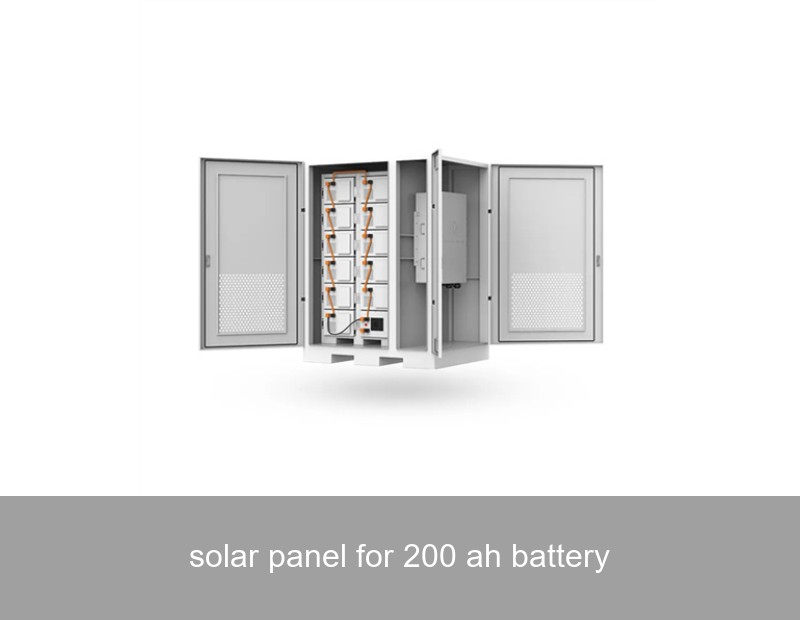
So, you've got a 200 Ah battery, or you're planning to get one. It's a popular choice for reliable backup power, cabins, RVs, and off-grid setups. But here's the question we hear all the time at Highjoule: "What size solar panel do I actually need to charge it effectively?" The answer isn't a single number. Pairing the right solar panel for a 200 Ah battery is a delicate dance between energy capture, storage chemistry, and your daily power needs. Getting it wrong means either a perpetually undercharged battery (reducing its lifespan) or an oversized, costly solar array. Let's demystify the process and ensure your energy system works in perfect harmony.
Table of Contents
- The Basics: It's About Watts and Amp-Hours
- The Critical Factor: Your Battery's Voltage
- Practical Sizing Calculations
- Beyond the Panels: The Essential System Ecosystem
- A Real-World Case Study: The German Dairy Farm
- Highjoule's Integrated Solutions for Reliable Power
- Your Next Step Towards Energy Independence
The Basics: It's About Watts and Amp-Hours, Not Just Panels
First, let's clear up a common confusion. A 200 Amp-hour (Ah) battery tells you its capacity—like the size of a fuel tank. It means it can, in theory, deliver 200 amps for 1 hour, 10 amps for 20 hours, and so on. But to refill this "tank" with solar, we need to talk about power input, measured in Watts (W).
The solar panel's job is to generate Watts. The relationship is governed by a simple formula: Watts = Volts x Amps. This becomes crucial when determining recharge rates. For a healthy lead-acid battery, a good rule of thumb is to provide a solar charge current between 10% and 20% of its Ah rating. For a 200 Ah battery, that's 20 to 40 Amps of charging current.
The Critical Factor: Your Battery's Voltage
You cannot choose a panel without knowing your battery bank voltage. A "200 Ah battery" could be 12V, 24V, or 48V. The voltage dramatically changes the energy (Watt-hours) stored and the solar power required.
| Battery Voltage | Total Energy Storage (Watt-hours)* | Equivalent "Tank Size" |
|---|---|---|
| 12V | 2,400 Wh (12V x 200Ah) | Small to Medium System (RV, Boat, Small Cabin) |
| 24V | 4,800 Wh | Larger Off-Grid Home, Workshop |
| 48V | 9,600 Wh | Full Residential or Commercial Backup |
*Assuming 200 Ah capacity at the specified voltage.
Practical Sizing Calculations: From Theory to Your Roof
Let's make this practical. Assume you have a common 12V, 200 Ah lead-acid battery for a weekend cabin.
- Step 1: Desired Charge Current: Aim for the 10-20% rule (20-40A). Let's choose 30A for a balanced charge.
- Step 2: Calculate Solar Wattage Needed: Power (Watts) = Battery Voltage (12V) x Charge Current (30A) = 360 Watts.
- Step 3: Account for Real-World Losses: Solar panels rarely produce their rated power due to heat, dust, and imperfect angle. A 20-30% loss is standard. So, 360W / 0.75 = ~480 Watts of solar panel rating.
Therefore, for a single 12V 200Ah battery, you'd typically need a 450W to 500W solar array. This could be one large panel or two 250W panels in parallel. For a 24V system using two 12V 200Ah batteries in series, the required panel wattage would double, but the charge current in amps would stay similar, affecting wire sizing.

Image Source: Unsplash (Photographer: Andreas Gücklhorn)
Solar Array Types & Configurations
Not all solar setups are the same. Your choice depends on your energy goals:
- Off-Grid Systems: Require the most precise sizing. Your solar array must fully recharge the battery and power daily loads, even on short winter days. Oversizing by 20-50% is often recommended.
- Backup Power Systems: The focus is less on daily full cycles and more on having enough solar to periodically "float" charge the battery and offset grid usage. A moderately sized array works well.
- RV & Marine Systems: Space is limited. Here, high-efficiency monocrystalline panels are king, and the array size is often maximized to whatever fits on the roof.
Beyond the Panels: The Essential System Ecosystem
Thinking only about the panel and battery is like buying a car engine without a transmission. Two components are non-negotiable:
- Solar Charge Controller (MPPT vs. PWM): An MPPT (Maximum Power Point Tracking) controller is highly recommended, especially for larger systems. It can be up to 30% more efficient than older PWM types, extracting more power from your panels and correctly managing the charge stages (bulk, absorption, float) for your 200 Ah battery. This is critical for battery longevity.
- The Inverter: This converts stored DC battery power (12V/24V/48V) to usable AC power for your appliances. Its size (in Watts) must exceed the total wattage of the appliances you'll run simultaneously.
A Real-World Case Study: The German Dairy Farm
Let's look at a concrete example from our European operations. A dairy farm in Bavaria, Germany, wanted to secure power for its automated milking systems and cooling tanks during increasingly frequent grid fluctuations. They had an existing 48V battery bank with a capacity of roughly 400 Ah (equivalent to two 200 Ah 48V blocks).
The Challenge: Recharge this substantial storage daily using solar, while also supporting daytime farm loads.
Highjoule's Solution & Data: Our team designed a 15 kW ground-mounted solar array (using 36 high-efficiency 415W panels). This system was connected via our Highjoule HMPPT-100 charge controller to the battery bank. In the first year of operation:
- The system generated an average of 52 kWh per day (peaking at 82 kWh in summer).
- It achieved a full recharge of the battery bank by early afternoon, even in spring/fall.
- Grid consumption for the farm's main operations was reduced by over 70%.
The key takeaway? For their large 48V system, the "solar panel for 200 Ah battery" equivalent was part of a much larger, custom-designed array. The project's success hinged on precise MPPT technology and system-level integration, not just panel count. You can read more about the importance of charge controllers in off-grid systems from the U.S. Department of Energy.
Highjoule's Integrated Solutions for Reliable Power
At Highjoule, we understand that questions like "what solar panel for my 200 Ah battery?" are the starting point for a broader conversation about energy resilience. Since 2005, we've moved beyond component sales to deliver intelligent, integrated systems.
For residential and commercial clients in Europe and the U.S., our Highjoule HES (Home Energy System) and CES (Commercial Energy System) product lines take the guesswork out of the equation. These are all-in-one units that seamlessly integrate a high-voltage battery (with capacities scalable to your needs), a hybrid inverter, and an advanced MPPT solar charger. They are pre-configured for compatibility and safety. You simply connect your solar panels—whether it's a 4 kW array for a home or a 100 kW array for a business—and the system intelligently manages the optimal charge profile for the batteries, maximizes self-consumption of solar energy, and provides uninterrupted power during outages.
Our systems are agnostic to solar panel brands, but our design software ensures the total array voltage and current are perfectly matched to the internal charge controllers, eliminating the risk of under or overcharging your valuable battery investment. Learn more about battery technologies from a trusted source like ScienceDirect.

Image Source: Unsplash (Photographer: American Public Power Association)
Your Next Step Towards Energy Independence
The journey to pairing the perfect solar panel with your 200 Ah battery is a blend of basic math, understanding your energy habits, and choosing the right supporting technology. Whether you're a DIY enthusiast piecing together a cabin system or a business owner evaluating commercial backup, the principles of voltage matching, accounting for losses, and prioritizing charge control remain the same.
We've seen how the right system can transform a dairy farm's operations. What specific energy challenge—be it unpredictable utility bills, frequent power outages, or a desire for true off-grid freedom—is motivating you to explore solar and battery storage today?
 Inquiry
 Online Chat