


Powering Your 3-Phase Motor Directly with Solar Panels: A Practical Guide
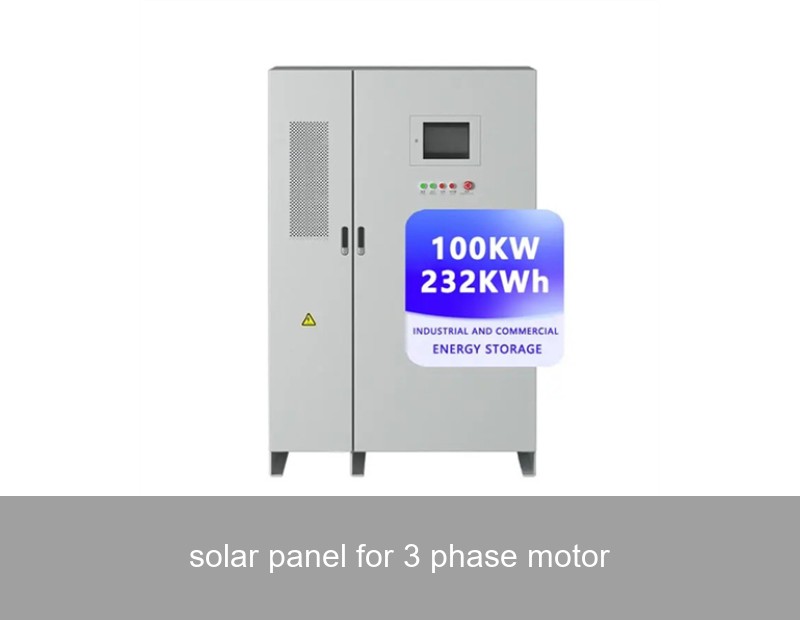
If you're an industrial facility manager, a farm owner, or operate any business relying on heavy-duty machinery, you've likely felt the pinch of rising electricity costs. The hum of a 3-phase motor is the sound of productivity, but also a significant line item on your energy bill. What if you could harness the sun to fuel that power directly? The concept of using a solar panel for 3 phase motor applications is not just a green dream—it's a viable, cost-saving reality for operations across Europe and the US. This guide cuts through the complexity to show you how modern solar and storage solutions make it possible to run your most demanding equipment sustainably and intelligently.
Table of Contents
- The Challenge: 3-Phase Power Demands and Grid Dependency
- The Solution: More Than Just Solar Panels
- Key Components for a Solar-Powered 3-Phase System
- A Real-World Case Study: Farming in California
- Highjoule's Role: Intelligent Storage for Stable Motor Operation
- Is Your Operation Ready for Solar-Powered Motors?
The Challenge: 3-Phase Power Demands and Grid Dependency
Three-phase motors are the workhorses of industry. From irrigation pumps and conveyor belts to large compressors and machine tools, they provide the high starting torque and consistent power delivery needed for heavy loads. However, their very efficiency comes with a specific demand: a stable, balanced three-phase AC power supply.
The traditional model is simple: plug into the grid. But this creates vulnerability. Grid outages halt production instantly. Time-of-use tariffs, especially prevalent in parts of Europe and California, can make running these motors during peak hours prohibitively expensive. Furthermore, the push for decarbonization means businesses are actively seeking to reduce their Scope 2 emissions—those stemming from purchased electricity. Simply put, relying solely on the grid is becoming a riskier and more costly strategy for energy-intensive operations.

Image Source: Unsplash (Representative image of industrial motor)
The Solution: More Than Just Solar Panels
It's tempting to think you can just wire solar panels directly to a 3-phase motor. Unfortunately, it's not that straightforward. Solar panels produce direct current (DC) electricity, and its output fluctuates with sunlight. A 3-phase motor requires alternating current (AC) at a specific voltage and frequency. The critical insight is that a successful system isn't just about generation; it's about intelligent conversion, stabilization, and integration.
The modern answer is a hybrid system that combines:
- Solar Generation: An array of photovoltaic (PV) panels sized to meet a substantial portion of the motor's energy consumption.
- Smart Inversion: Advanced inverters that do more than convert DC to AC. They must create a perfectly synchronized, grid-quality three-phase waveform.
- Energy Storage: The true game-changer. A battery system acts as a buffer, smoothing out solar intermittency and providing the massive instantaneous power (surge current) needed for motor start-up.
Key Components for a Solar-Powered 3-Phase System
| Component | Primary Function | Why It's Critical for 3-Phase Motors |
|---|---|---|
| Solar PV Array | Converts sunlight into DC electricity. | Provides the primary renewable fuel source, reducing grid consumption. |
| 3-Phase Hybrid Inverter | Converts DC from panels/batteries to stable AC; manages energy flow. | Generates a clean, balanced 3-phase output that mimics or exceeds grid quality to protect sensitive motor windings. |
| Battery Energy Storage System (BESS) | Stores excess solar energy for later use. | Supplies the high surge current (5-7x running current) for motor start-up and ensures power during cloudy periods or at night. |
| Energy Management System (EMS) | The "brain" that controls the entire system. | Optimizes when to use solar, battery, or grid power to minimize costs and maximize self-consumption, all while protecting the motor. |
A Real-World Case Study: Farming in California's Central Valley
Consider a 100-acre almond farm in Fresno, California. The operation relies on a 40 HP (≈30 kW) three-phase motor to run its deep-well irrigation pump. Running 8-10 hours daily during the arid summer, the motor was a major cost driver, especially during peak grid rates (4-9 PM).
The Problem: High energy bills and vulnerability to public safety power shutoffs (PSPS) during fire season, which could jeopardize the entire crop.
The Solution Implemented (2022):
- A 50 kWp ground-mounted solar array.
- A 3-phase hybrid inverter capable of off-grid operation.
- A Highjoule HVC-150 commercial battery storage system with 150 kWh capacity and a high continuous power rating.
The Results (Data from First Year of Operation):
- Energy Bill Reduction: 85% reduction in grid electricity used for irrigation during daylight hours.
- Peak Shaving: The system is programmed to avoid grid draw completely during peak rate periods, using a combination of solar and stored battery power.
- Reliability: During two separate PSPS events totaling 36 hours, the irrigation system operated seamlessly on solar/battery power, maintaining critical crop watering schedules. The Highjoule system's rapid transition (<20ms) ensured the motor never lost power.
- ROI: Projected payback period of 6-7 years, factoring in state incentives and ongoing energy savings.
This case illustrates that a correctly engineered system does more than save money—it becomes a core component of operational resilience. For more on agricultural solar applications, see resources from the U.S. Department of Energy.
Highjoule's Role: Intelligent Storage for Stable Motor Operation
While solar panels capture the energy, the heart of a reliable solar panel for 3 phase motor setup is the storage and control system. This is where Highjoule's expertise becomes critical. As a global leader in advanced energy storage since 2005, we design our systems with the demands of commercial and industrial loads in mind.
Our HVC Series commercial storage solutions are engineered to handle the tough demands of motor starting. Key features include:
- High Surge Power Capability: Delivers 2-3 times the system's continuous power rating for several seconds, perfect for overcoming the locked-rotor current of a starting motor without straining the system.
- 3-Phase Native Design: Our systems integrate seamlessly with three-phase electrical infrastructures, ensuring balanced power delivery that prolongs motor life.
- Advanced EMS with Grid Services Mode: Beyond self-consumption, our intelligent management can participate in demand response programs (where available), creating an additional revenue stream by providing grid stability services.
In essence, Highjoule provides the "power conditioner" that turns variable solar production into a robust, motor-ready electricity supply. We work with trusted solar installers across Europe and the US to deliver complete, turnkey solutions for industrial and agricultural clients.

Image Source: Unsplash (Representative image of agrivoltaics)
Key Implementation Considerations
Before embarking on such a project, a thorough assessment is crucial. Here are the primary factors our technical experts analyze:
- Motor Specifications: Rated power (kW/HP), starting current (LRA), duty cycle, and efficiency class.
- Load Profile: Detailed analysis of when and how long the motor runs. This dictates solar array and battery sizing.
- Site Energy Goals: Is the aim 100% energy independence, or strategic peak shaving? Goals define system architecture.
- Grid Interaction: Local regulations (like Germany's VDE-AR-N 4105 or US NEC Article 690) and utility interconnection agreements for grid-tied systems are paramount. For true off-grid, system design is even more critical.
- Financial Incentives: Exploring available tax credits, rebates, and accelerated depreciation (e.g., MACRS in the US) that significantly improve economics. The IEA Policy Database tracks many such incentives globally.
Is Your Operation Ready for Solar-Powered Motors?
The technology to power a 3-phase motor with a solar panel-based system is proven and operating reliably today. It moves the conversation from simple cost-per-watt of solar to a holistic value proposition: energy cost control, operational resilience, and sustainability leadership. The question is no longer "if" it can be done, but "how" to design the optimal system for your specific motor, load profile, and business objectives.
What's the first step? Begin with a detailed energy audit of your facility. Identify your largest three-phase loads and map their run times. Then, ask yourself: what would it mean for your business if you could lock in a lower, predictable energy cost for that equipment for the next 25 years, while also building a shield against grid instability?
 Inquiry
 Online Chat