


Understanding Solar Panel Prices in Europe: A Smart Buyer's Guide for 2024
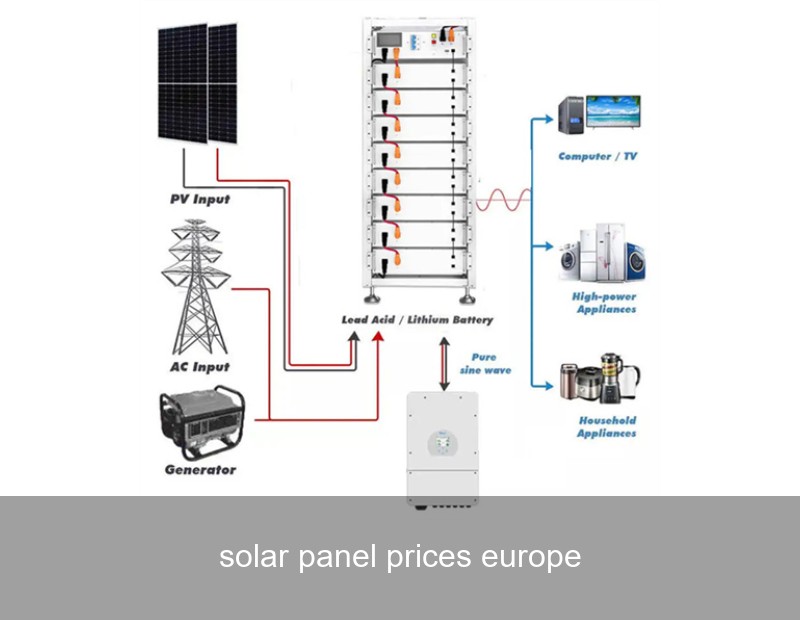
If you're in Europe and considering solar power, you've likely asked the golden question: "What's driving solar panel prices, and how can I ensure my investment pays off?" The landscape is dynamic, with prices fluctuating due to global supply, technological advances, and local policy. But here's the empowering truth: the focus is shifting from just the upfront cost per watt to the long-term value and system intelligence. A modern solar installation isn't just panels on a roof; it's the heart of a comprehensive energy ecosystem designed for resilience and savings. This article will demystify the factors behind solar panel prices in Europe and guide you toward a solution that maximizes your energy independence.
Table of Contents
- The Price Phenomenon: More Than Just a Module
- Data Decoding: The Real Cost Components
- Case Study: A German Mittelstand Business
- The Highjoule Advantage: Beyond the Price Tag
- Future-Proofing Your Investment
- Your Next Step Towards Energy Intelligence
The Price Phenomenon: More Than Just a Module
For years, the conversation around solar adoption started and ended with the module price. We saw a dramatic drop over the last decade, making panels incredibly accessible. However, in recent years, the market has experienced some volatility. Supply chain adjustments, raw material costs for polysilicon, and evolving trade policies have caused solar panel prices in Europe to see periods of both decrease and slight increase. But focusing solely on this one component is like buying a car based only on the tire cost. The true value—and the ultimate return on investment—lies in the complete system's performance, durability, and its brain: the energy management system.

Think about it. Two homes install solar arrays with similarly priced panels. One homeowner sees erratic savings and still faces high grid dependency during peak hours. The other enjoys consistent, maximized self-consumption and barely notices grid price spikes. The difference isn't the panels; it's the integration with smart storage and AI-driven control.
Data Decoding: The Real Cost Components
Let's break down what you're really investing in. A typical residential or commercial solar PV system cost is distributed across several key areas:
| Cost Component | Approx. Share of Total Cost | What It Encompasses |
|---|---|---|
| Solar Panels (Modules) | 25-35% | The physical PV panels, with variations based on efficiency (mono PERC, bifacial, etc.). |
| Inverter & Power Electronics | 15-20% | Converts DC solar power to usable AC power; the "engine" of the system. |
| Mounting System & Installation | 15-25% | Racking, wiring, labor, and structural integration. Crucial for safety and longevity. |
| Battery Storage System (BESS) | 20-35%+ | The game-changer. Stores excess solar for use at night or during outages, drastically increasing self-consumption. |
| Energy Management System (EMS) | 5-10% | The "brain" that optimizes energy flow between solar, storage, grid, and consumption. |
As data from the International Energy Agency (IEA) highlights, while module manufacturing costs are a major focus, balance-of-system costs are critical for final pricing. This is where choosing a provider with integrated expertise matters immensely. At Highjoule, we design systems where every component, from the panel orientation to the lithium-ion battery's charge cycle, is optimized by our proprietary EMS. This synergy is what turns a capital expenditure into a high-yield asset.
A Real-World Case Study: Boosting Resilience for a German Mittelstand Business
Let's look at a concrete example. A mid-sized manufacturing company in Bavaria, Germany, was facing two challenges: volatile energy costs eating into margins and a corporate sustainability mandate. They installed a 250 kWp solar array. Initially, without storage, they were only using about 30% of their solar generation directly, selling the rest to the grid at low feed-in tariffs while still buying expensive power in the evening.
In 2023, they partnered with Highjoule to integrate a Highjoule HiveStack 200 battery energy storage system. The results within the first year were telling:
- Self-Consumption Rate: Increased from 30% to over 80%.
- Grid Energy Cost Reduction: Reduced peak grid purchases by 95%.
- ROI Timeline: The enhanced system's payback period was calculated to improve by nearly 40% compared to solar-only, thanks to avoiding peak tariffs and leveraging market price signals.
The Highjoule HiveStack, coupled with our GridSync EMS, doesn't just store energy; it intelligently decides when to charge, discharge, or hold based on weather forecasts, consumption patterns, and real-time electricity prices. This transforms their solar array from a simple cost-saver into a strategic, revenue-protecting tool.
The Highjoule Advantage: Beyond the Price Tag
Since 2005, Highjoule has evolved from a component supplier to a global provider of intelligent energy ecosystems. We understand that the discussion about solar panel prices in Europe is just the entry point. Our solutions are built around the principle of Total Energy Management.
For our residential clients, the Highjoule HomeHub offers an all-in-one solution. It combines high-efficiency solar compatibility, a scalable battery (from 10 to 30 kWh), and an intuitive EMS that learns your family's habits. You can easily monitor and control your home's energy flow via a smartphone app, ensuring you get the most out of every sunbeam, regardless of panel price fluctuations.

For commercial and industrial (C&I) applications, our HiveStack series provides modular, containerized or floor-mounted BESS solutions. These systems are engineered for high-cycle life and safety, crucial for demanding operational environments. They integrate seamlessly with existing solar PV and can be configured for applications like peak shaving, backup power, and even grid services, opening potential revenue streams.
Our microgrid solutions take this further, enabling communities, campuses, or industrial parks to operate as self-sufficient energy islands, managed by Highjoule's advanced GridSync platform. This isn't just about saving money; it's about ensuring energy security and business continuity, values that are increasingly priceless in today's world.
Future-Proofing Your Investment: The Intelligent Storage Imperative
With grid electricity prices in Europe expected to remain structurally higher than pre-crisis levels, as noted by analysts like Bruegel, the economic case for solar-plus-storage is stronger than ever. The right battery system protects you from buying power at the most expensive times and ensures your self-generated solar energy doesn't go to waste.
When evaluating solar panel prices in Europe, ask yourself and your provider these forward-looking questions:
- Scalability: Can I easily add more battery capacity or solar panels later?
- Software Intelligence: Does the system have smart, updateable software that can adapt to new tariffs and market rules?
- Warranty & Lifecycle: What is the expected degradation and warranty on the complete system, especially the battery?
- Grid Services Ready: Is the system capable of participating in flexibility markets if they become available in my region?
Highjoule designs with these questions in mind. Our systems are modular, our software receives regular updates, and we offer industry-leading warranties because we build our battery packs with top-tier cells and rigorous quality control.
Your Next Step Towards Energy Intelligence
The journey to energy independence is exciting, and we're here to guide you beyond the initial price point. We invite you to use our online Energy Planner tool to get a preliminary estimate for a system tailored to your roof, consumption, and goals. More importantly, what specific energy challenge—whether it's unpredictable bills, backup power needs, or a sustainability target—is most pressing for you to solve in the next 12 months?
 Inquiry
 Online Chat